Reading Project, 17

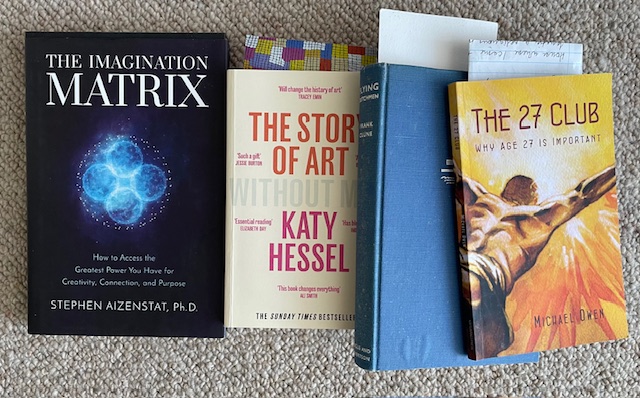
These are a bunch of books that I’m reading intermittently—for different reasons—and is also an attempt to catch up on what I’m now spending most of my time on.

Book 55 … Flying Dutchmen: a Narrative of an Expedition of Discovery from Australia to the Netherlands with “the Flying Dutchman”, by Frank Clune with illustrations by Bert Zimmerman, published in 1953 by Angus & Robertson Ltd.

Lol, this book is only about 5 years younger than I am and just as long-winded. Look at the title! Eighteen words! Plus it’s old. And Frank Clune?

Seeing that name on the spine of a book was a bit of a blast from the past as that gentleman had many titles floating around on the New South Wales summer holiday circuit in the 1960s. One reason why I picked this one out of the dumpster.

I’ve read many of his titles during holidays away while in my teens. Him and Ion Idriess, another prolific author writing about Australia. The whole family used to accompany my father to the town nearest one of his job-sites, and stay there in a boarding house or in a tent by a local beach for some or other school holiday, while he did maintenance at the local power station.

Dusty shelves in boarding house hallways and camp laundries were the places where you could find books left behind by visitors.

Frank Clune wrote about 35 books, quantity over quality, but great for practicing my new English on. Similar style to Enid Blyton’s but for adults.

The extra thing this book has going for it is that it journals a visit to the Netherlands by Clune and his wife. Once there, they met an old friend Bert Zimmerman, an artist, who did the illustrations. The description of Zimmerman’s imprisonment by the Japanese in what is now Indonesia during the war and the illustrations are the quality.

Netherland in 1953, only a eight years after the end of WWII is also interesting. Clune and his wife got to see many more sights than I did at only five years old at that time. So, yeah, this book is still on the reading-intermittently pile.

Book 56 … The Imagination Matrix: How to Access the Greatest Power You Have for Creativity, Connection, and Purpose, by Stephen Aizenstat, Ph.D. Published in 2023 by Sounds True Publishing.

I had great hopes for this book, in that I hoped that it would have something more to say about how the imagination works than the texts on that subject that I already have, or that I could learn online. Alas, that hasn’t so far eventuated.

Up to now it reads like a mash-up of Inner Work by Robert Johnson (1986) and The Artist’s Way by Julia Cameron (1994), both already in my library. I’m disappointed I fell for the upmarket marketing spiel. It’s on the intermittent pile for any new crumbs I may come across.

Book 57 … The 27 Club: Why Age 27 is Important, by Michael Owen. Published in 2012 by Kahurangi Press, Tauranga, New Zealand.

If you’ve heard of the 27 Club you’re better informed than I am. I was a complete ignoramus. When I was 27 I’d just taken off for my round-the-world trip of a life-time. At only 125 pages you’d think I would’ve ripped through it but that hasn’t been the case.

Though there are interesting parts in it, they are tacked together with a so far un-exhausted collection of people stepping off their mortal coils at 27 or thereabouts. I have started to underline sections for future reference so I guess that’s the reason it’s on the intermittent pile, and not in the books to go to Life Line bag because it’s not a keeper.

Book 58 … The Story of Art Without Men, by Katy Kessel. Published in 2022, this edition in 2024 by Penguin Random House UK.

This one qualifies as a ‘tome’ I think. Though it has the usual Penguin proportions, it outweighs all three previous books together by at least half a kilo.

This is one of those books you look at online and like what you see, order it, and receive a whole other production. The height and width are the normal Penguin style, as I said. But it might be four centimetres thick. Has glossy pages, 9 point print, small pictures.

I thought I’d be getting a magazine-style book with decent sized images. An art history that I could show off. Instead, some of the pics have to be studied with a magnifying glass. Luckily, the spine is sewn so it won’t fall apart in three minutes. And it’s thorough with 500 years worth of Western art movements with the women artists featured in each one.

I knew just a couple in the first chapter, like Artemisia Gentileschi (1593—c1653) who, like many of the early women painters, started in her father’s studio. She was raped by one of her father’s colleagues, had her fingers tortured during the subsequent trial, and at the end of it was married off. She painted in the Italian Baroque era.

Judith Leyster (1609—1660) was a Dutch Golden Age painter, famous at the time, but who married another artist and faded out of the scene to raise five children. Some of her paintings were attributed to Frans Hals though her signature was there plain to be seen, not painted over.

Two out of the fifteen women artists featured in the first chapter, and 150 women painting in the Dutch golden age compared to 3200 men was a figure also mentioned. All largely unknown.

My bookmark sits at the Eighteenth Century, Chapter II, from 1700 to 1800, a dense read that can only proceed in little gulps. This book, too, sits on the intermittent pile.

— — — —

They are a little pile sitting on the couch beside me, one of several other piles. My journals and day-book make up another pile. The third pile I’ll talk about next time.
Reading Project, 12

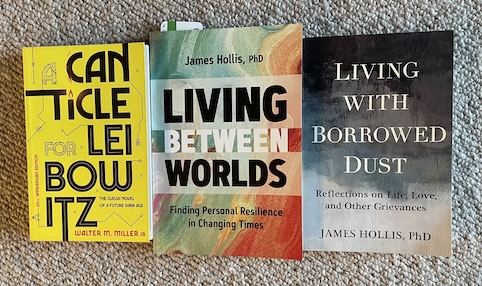
Book 35 … Living with Borrowed Dust: Reflections on Life, Love and Other Grievances by James Hollis PhD, published by Sounds True in 2025.

Had this unread on my shelves from last year. This time the title grabbed me, “living with borrowed dust.” That’s the dust of the stars we are all made of. I’ve read a few of James Hollis’s books by now, and reading this one, started to suspect that he’s regurgitating his material. And that once I’d read one I’d read them all.

That could be true about this one. It’s a kind of a autobiography/memoir—I can’t tell the difference between them. He has this aphorism, “Shut up; suit up; show up!” First time I read it, several years ago, I laughed. But took it on board. This is me, here, showing up in this project I set myself back in January.

When I read the quote above on page 106, I felt vindicated. Thought I should’ve saved my money. Because also in this little book Hollis quotes regularly from his previous books. So it’s hard to understand isn’t it, that my next read is also one of his?

Book 36 … Living Between Worlds: Finding Personal Resilience in Changing Times by James Hollis PhD, published by Sounds True in 2020

It’s an earlier book and while almost the same size, it’s weightier. Chewier. “Living between worlds” … I relate to that. I’m living between worlds, as we all are in the West. Yesterday I watched two thirds of a documentary about life in the climate-challenged parts of the world. Millions of people already impacted. And I can’t even let myself continue thinking about it all—takes too many spoons—I’m not strong enough.

But … This book. The two worlds are our inner struggles and our “modern human existence”. Looking back through it, I see I’ve underlined many sections, a sure sign I wrestled with it. In this book, Hollis is proving to us that we “human animals are equipped for survival”. With creativity, wisdom and connection, he means.

This is the kind of book I have lying beside me on the couch for a few months, to be able to read a couple of pages anytime I feel like I need to work out my mental muscles.

And this book is the reason I began a side project, painting various scenes from Theseus in the Labyrinth. Done two. More planned. Theseus turned out to be a non-hero to me. After he killed the minotaur, he abandoned Ariadne, and sailed off into the wide blue yonder. Typical for a rolling stone?

Book 37 … A Canticle for Leibowitz by Walter M Miller Jr, a 60th Anniversary edition published by Orbit Books in 2019.

I remembered starting to read this a good few years ago but could not recall why I didn’t finish it. Recently, a good friend recommended it—raved about it, in fact—saying it was the best, greatest sf novel of the 20th century. So I bought it since my local library has moved on.

Lol, might even send it to him. After I give my sf reading buddy a go at it though I seriously doubt he’ll be able to get into it.

Couldn’t remember anything about the Canticle after I confirmed it wasn’t the story about the monk who went underground in New Zealand and expected to come out in the northern hemisphere. That was a short experimental film I saw somewhere, also many years ago. I guess I conflated them since they are both about monks.

I can totally understand now why I didn’t finish it. Though, just for the heck of it, may re read it. Maybe next year. It could be one of those books that improves the better you know it. I have to give it that opportunity.

A review in Good Reading calls it a “seriously funny, stunning, and tragic, eternally fresh, imaginative, and altogether remarkable, A Canticle for Leibowitz retains its ability to enthrall and amaze.”

While a review in The Story Graph said: “There is a lot of science talk, but more in conversation/discussion rather than its use. Also there’s a lot of religious style quotes and I hate that writing style. And in general the writing style is boring and at times confusing because of huge jumps in time.”

It’s post apocalyptic, written in the nineteen fifties and probably the author went to war and had surfeit of battlefield memories he couldn’t get out of his head. There are huge time jumps and so there aren’t any characters I could get invested in. It even felt impersonal, like an overview.

Book 38 … The Messenger by Markus Zusak, published by Pan McMillan, this edition from 2023.

Tore through this in a couple of hours, a disappointingly lightweight read. Then learned it had been made into a TV series and can just about see that as a lightweight script as well, if I could be bothered viewing it. (And couldn’t find it for a pic.)

About Meld …

To all those readers keenly following MELD … I have been feeling quite doubtful about continuing it. Though I’ve written dozens of good chapters, it seems that unconsciously I’m burdening yet another suffering viewpoint character with an additional internal entity. And that, after three versions already on the same or similar theme. I’m obviously going to have to do more dream therapy.

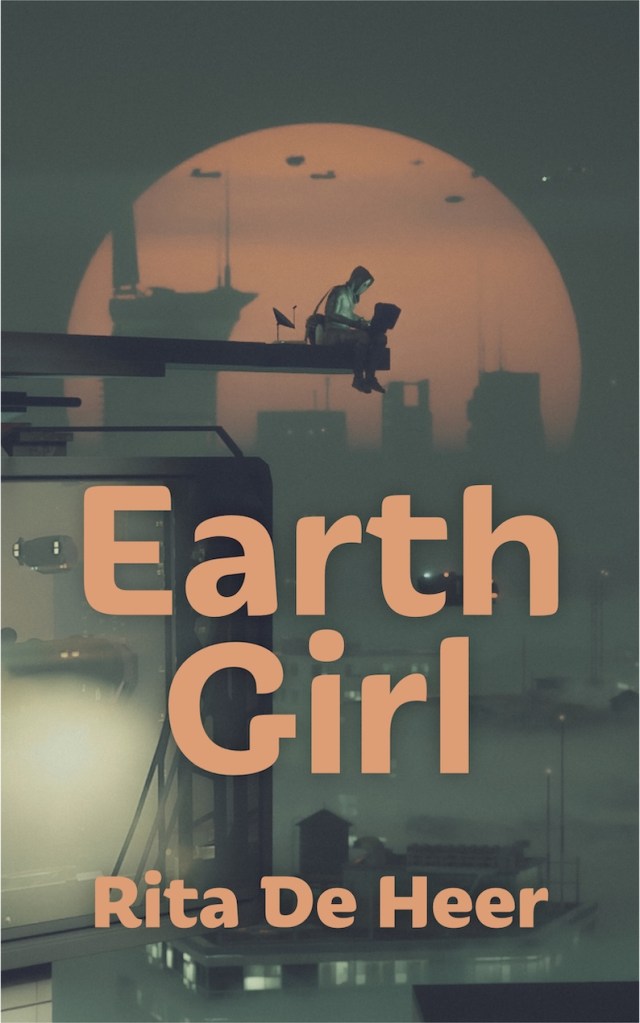
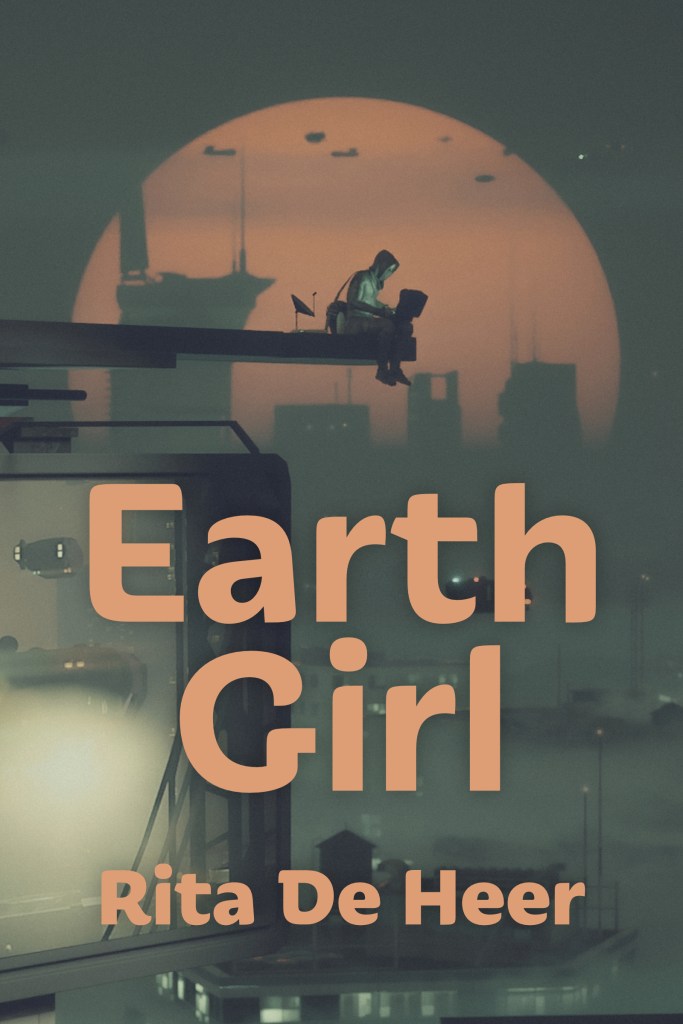
So, while I sleep on MELD, I’ll repost EARTH GIRL. I don’t think I’ve yet posted her story on this (WordPress) blog. Lol, among 600+ posts? I can’t find it. I think offered it on Google+ back in that day.

I’ve got a nice cover for it, thank you ronnie@https://tegnemaskin.no/

Links, 4

It’s getting so you can be proud for finding an image that hasn’t been meddled with by AI … so this is a real life situation …

Jar-test apparatus used for the experiment. The picture is taken from preliminary testing of different biopolymers by SN Applied Sciences at https://www.researchgate.net/publication/330866661/figure/fig1/AS:941943265697815@1601588183793/Jar-test-apparatus-used-for-the-experiment-The-picture-is-taken-from-preliminary-testing.jpg

Links, 2

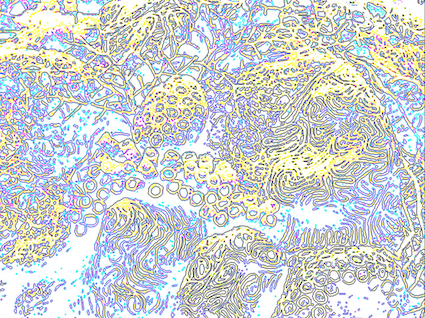
This pic had a complex beginning and I wish I could’ve listed the original artist. A friend visited a seaside art installation. He took many pictures without taking note of any artists or their details, and at home let some of them loose into the wilds of a well known art program. Representing krill in this pic. It was originally 9 MB, and 75 cm wide. Cut that down to 15 cm, and I might’ve been too stingy. My apologies.