
The project continues.
Next up was Chasm City by Alistair Reynolds, published in 2001. “A hardboiled pursuit/revenge thriller set in the RS universe,” from the author’s website. RS = Revelation Space, which I don’t know anything about other than what I’ve just read. Thriller? Nah.
An eight-day read, worked at diligently. Dense and detail rich. According to my research after reading it, this is Reynolds’ second published novel. And also second in reading order, it’s a ‘stand-alone’ as the Reddit experts tell it, but which surprised me as there seemed quite a bit of bloat. Stuff, that for the sake of the pace, readers could’ve done without. Stuff that I wanted to skim, but ended up plodding through because of not knowing what was essential to the plot.
There goes my theory that editors don’t look as closely at authors with a lot of books already published.
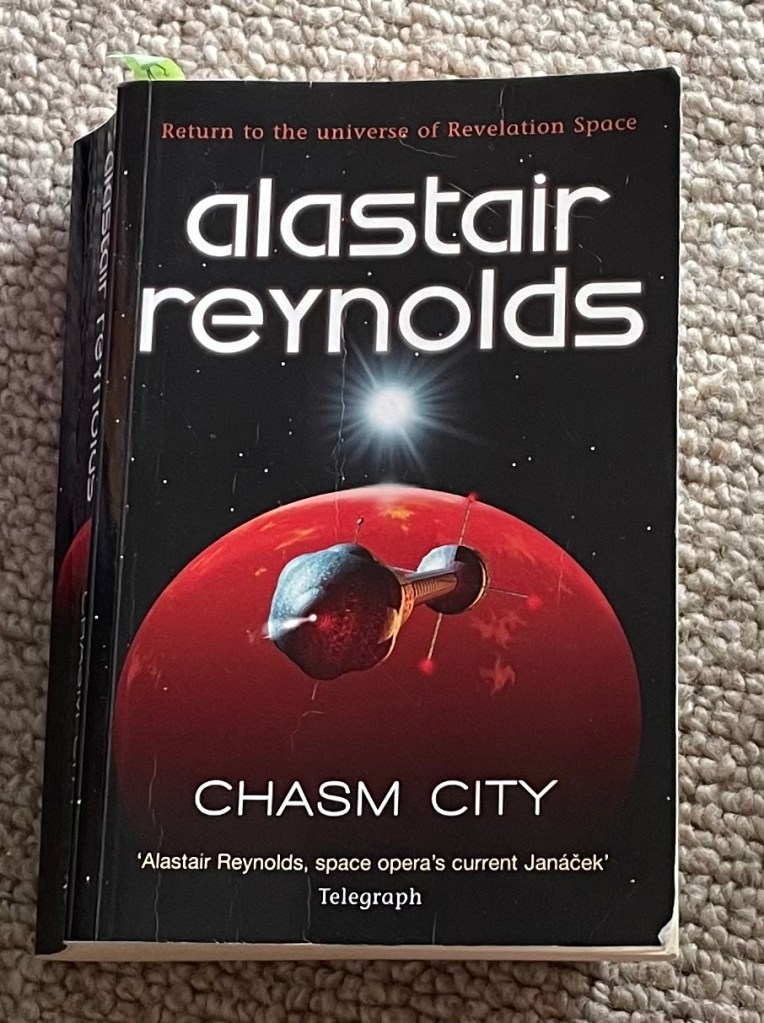
At times I thought I was reading about Mars. I think it was a case of stories bleeding into one another due to proximity. In this case, me watching The Expanse Series by James S A Corey on television. I think probably due to the sheer size of the chasm. Very Martian. Though in this case, it’s a planet called Yellowstone and a large part of the chasm is domed over.
Life in the chasm is very interesting, regional. As can be expected the upper classes live in the Canopy, the slums are in the Compost. Travel is by semi sentient vehicles that claw their way up and down and along hanging vegetation and cables. The slum dwellers are all about making a living. The rich play at turkey shoots, where they free a prisoner and force them to run for their lives.
The two main characters, with at first separate stories, eventually seem to meld into one another. The POV character keeps changing identities, and is as slippery as an eel to keep hold of. I found that quite disconcerting as the story is complex and I found it easy to get lost in. I did a lot of re-reading.
Why didn’t this turn into a DNF read? (Did Not Finish for those of us at war with acronyms). It could’ve, to be honest. But Reynolds also wrote the Revenger trilogy… Revenger, Shadow Captain, and Bone Silence. Three of my favorite modern science fiction reads.
Fantastic worldbuilding, great characters, piracy and treasure hunting, a gripping plot, a steampunk flavor. Rave, rave, rave.
Reading Chasm City I kept wanting to give Reynolds more time to come good, to tell the story with as much verve and vitality he’d shown in Revenger. I think now, knowing the Chasm City was only his second novel, that he was still learning.

 Rita de Heer