Reading Project, 9

Early in April, the old library in the part of our retirement village that is about to be rebuilt, was to shut down. Readers were encouraged to go there and ‘score’ any books they might like to take away. Don’t bother to bring them back was the second part of the instructions, and don’t return them to the new library the third.

Out I went with my walker, found about seventeen books that looked interesting enough to take away with me, and a cardboard box, thinking to pack them in that for an eventual delivery to Life Line, a charity that runs a massive annual book sale.

These books are now sitting on the floor in front of my bookshelves, no room for them on the shelves. Most will be one-read-wonders, so will be moved on, so no use making room for them yet.

I started with the five detective fictions, one of them a compendium of three novels. Fast and easy to read, good for the weeks that I was prepping for the medical procedure everybody loves to hate, a nerve-wracking time when easy reads are the go.

As we are now well into May, even I can see that I’m getting behind with this project. And I’ve ordered a bunch of study books. Wonder how I’ll go with reporting on those.

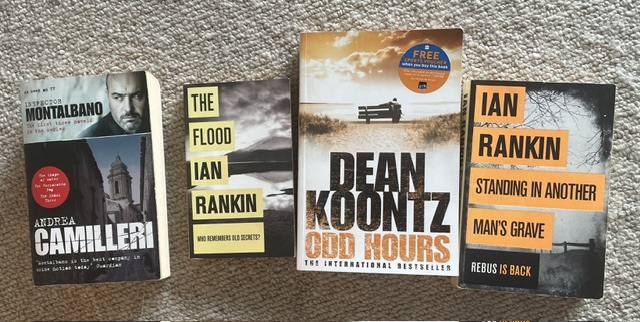
Book 22 … The Flood by Ian Rankin, published 1986 by Polygon. Strictly speaking, The Flood is not a detective fiction. But as the first published novel of one of my favorite authors of detective fiction, Ian Rankin, I thought I might as well take it along.

Rankin’s own introduction informed me that his various skills began with this little book (I’m assuming that like many first novels it’s about 60 thousand words, it has that heft) so could be worth it to read. He himself tells us its a young man’s book ‘all about the perils and pitfalls of growing up’.

It was a patchy read. Sometimes you can learn too much about a book before reading it. Some parts I enjoyed. Others not so much. The first of the three parts to my mind the more interesting though of it is left hanging.

Book 23 … Standing in Another Man’s Grave by Ian Rankin, published 2012 by Orion. This book is advertised with ‘Rebus is Back’ as though Rebus has been away, missing. Rankin has written nineteen Rebus books as well as nine or ten that are unrelated to Rebus. This one is about a crusty old detective, resigned from the police force and working independently, as a private eye, I assume.

Co-incidentally, on TV (SBS on Demand) I’m following Harry Bosch in much the same scenario, in the Harry Bosch Legacy. What I enjoy about both these detectives is their personal lives. They tell the stories not just of their police work but also about their private lives, and their frail humanity.

Both also have been left behind by technology and isn’t that a relatable feature of modern life? Anybody over fifty will always be a migrant to the computer age and will, by the time they’re seventy, need a guide.

There’s enough detail in the average Rebus, and the story arc is usually familiar enough, that reading it was quite relaxing. There isn’t that need to hurtle along hurry hurry to find out the end, because the end is a foregone conclusion. Rebus will solve the mystery and the perpetrator will go to jail.

Book 24 … Odd Hours by Dean Koontz, published 2008 by HarperCollins. Once upon a time I studied Koontz’s written dialogue, to improve dialogue in my own writings, and enjoyed many of his novels. The cut and thrust of the dialogue, the spare but informative descriptions. The suspense.

Then he went into the Odd Thomas series, and barring maybe one of them, perhaps the first, these are not his best. In my opinion. I think I’ll be tossing this one into the recycling bin.

Book 25 … The Survivor by Sean Slater, published 2011 by Simon and Schuster. I’ve already passed this one on to my reading buddy. It was good. Added to which, Slater is the pen name for an actual police officer though I don’t really know if that makes a difference, most crime writers are very good researchers. But not having the book on hand does mean I’m limited to the Good Reading Magazine, if they even have it in their files.

They do. Their summary … “Columbine. Dunblane. Virginia Tech. Winnenden. But Saint Patrick’s High? In his first hour back from a six-month leave of absence, Detective Jacob Striker’s day quickly turns into a nightmare. He is barely on scene five minutes at his daughter’s high school when he encounters an Active Shooter situation.”

I was pleasantly surprised that there was another detective fiction author whose style I like that I’ve never yet read.

Books 26, 27 and 28 … Inspector Montalbano: The First Three Novels by Andrea Camilleri, translated into English by Stephen Sartarelli, published 2002 – 2004 by Picador.
The Italian publication dates were …1994, 1996, 1996 publishe by Sellerio editore … have I got a treat for you … the Sellerio publishing group is based in Palermo the capital city of Sicily, and they’ve adopted … ‘The program at the origin of the publishing house is a return to a culture that Sciascia defines as “pleasant,” that is, a culture in which so-called commitment is implicit and not explicit, therefore a culture of lightness, which does not renounce elegance, a culture of ideas, yes, but in the form of beautiful things.’ [My paraphrase.]

That’s brave in this day and age. I’ll be enjoying the publisher’s statement for a while … the link https://www-sellerio-it.translate.goog/it/casa-editrice/

And in addition, Inspector Montalbano, an Italian cop show set in Sicily, was a favorite TV series about twenty years ago, so how could I resist?

Starting to read The Shape of Water, the first of the three books—they don’t appear to be a trilogy—I realized I’ve read it before, or maybe started to read it before, because I did not recall the end.

The first thing to get used to in the book, compared to the TV show, is that it is not a version of Keystone Cops, the way that the TV version often resembled. A bunch of police constables and members of the Sicilian public perpetually running after Inspector Salvo Montalbano.

In the book all these people have their own personalities, and it’s good to get to know their differences. OK, yes, there does appear to be at least one Keystone Cop, and that is the officer most often left behind to man the radio, (I’ll find his name …ah, Cantarella) He does have all the hallmarks of a comic turn. Though I bet in Italian he’ll be funnier than he is in English.

The Terracotta Dog and The Snack Thief are the second and third novels. Both are also full of interesting geographic and historical detail and cultural ambience. These are extras, of course, for all non-Sicilian readers.

One thing I really enjoy is Inspector Montalbano’s relationship with his cook. She’s the mother of a pair of miscreants, one of whom Montelbano put in jail. The inspector is a total foodie and Aline leaves him with a stream of interesting dinners in his fridge.

Then there’s Livia, his girlfriend. The love of his life, she lives on the mainland. They enjoy their separate/together lives until they meet the snack thief in the third novel. Then they talk about getting married. But we only get Montalbano’s POV and he has doubts. There’s no resolution so far. I expect this conundrum to continue to be debated further on in the series.

Montalbano’s love-hate relationship with his second-in-command, Mimi Augello, is mercurial with a bit of ‘plain speaking’ involved. When Augello is well-meaning, Montalbano is savage and vice versa. Augello sounds ready to move into Montalbano’s chair, but Montalbano is nowhere near ready to move up.

Fazio and Tortorella are his sergeants, “or whatever the hell they were called nowadays,” he says. Then there are all the rest, constable I assume, hard to tell apart, except maybe for Catarella who usually mans the phone and mangles any message that needs to passed on and having to be re-interpreted when Catarella grasps the wrong end of the stick.

I can see from my confusion that I’ll be re-reading the series to get the chain of command, so I can read a run of Italian names and know who all they all represent.

The comedy often is in unexpected contrasts. Montalbano spend the morning scrubbing his house and then himself. He polishes his shoes, dons a formal suit with “his most serious” tie, and then sits waiting for a visitor, getting more and more nervous. He knocks back a glass and a half of whisky just before his visitor arrives, and who tells him, “I’m almost blind, I see very poorly.”

The comedy in The Terracotta Dog dances around a tragic plot. We get a glimpse of what life must’ve been like during World War Two in Sicily when the German Navy used its coastline and harbours to repair and resupply its ships.

Sometimes an old cultural practice is discussed. Could the fact that the corpse was found with a stone in its mouth mean something other than is commonly understood? Huh, I thought. I have no idea. Another reason I enjoy this series so much, this dialogue you need to have with yourself to ‘detect’ the full range of meaning. I recommend these.

The books I have here are the first three of a long career. I’m keen to read more now, see if they become formulaic which is always a danger. I hope they don’t, I hope Camilleri can keep his plots fresh. I’ll be hanging on to this one for a while. Pity that it is a tome. It’ll need quite a wide space on the shelves.
Reading, 7

This session started while I was in hospital. Trying for easy reading matter. Easy to put down when necessary, for example to have a blood test done, or connect me to the IV.

My reading buddy brought me a book that he had trouble with and that I put aside after only one chapter, no way was I going to be able to read that in a scene where I needed to interact with maybe fifty people a day.

By day three I was hungering for anything at all to read. I’d forgotten to bring my tablet, and I’d been down to the kiosk in the downstairs lobby twice, and that had only magazines and newspapers available. Over two days, I bought two dailies of a right-wing newspaper, read them from cover to cover and felt like a foreigner.

Then, during one of my afternoon perambulations on the ward, I saw and remembered the existence of a lounge or two in each ward in that hospital, where visitors could withdraw to wait out procedures on their loved ones, and that there often were a couple of books.

Day three I sallied out and found a book that I normally wouldn’t read in a pink fit but needs must, as the saying is. A Readers’ Digest Condensed Book, in the new century renamed Readers Digest Select Editions. Still ongoing, I was amazed.

These are collections of “Popular, bestselling novels condensed to remove subplots or descriptions without altering the author’s style or story,” according to Reddit users and eBay sellers, quoted by Google’s AI. Hence me not reading them in a pink fit. However, by the 2020s I’m suspecting, the novellas could be being written purposely for the series. The four stories I read certainly seemed so.

According to Wikipedia https://en.wikipedia.org/wiki/Reader%27s_Digest_Select_Editions
I probably read

Book 18 … Volume 395 – #6 – September 2023 with • The Hunter – Jennifer Herrer • Hello Stranger – Katherine Center • Play the Fool – Lina Chern and • The Last Lifeboat – Hazel Gaynor

And because I was reading to pass the time, I have no clear memory of what all four stories were about except that one of them was about a bunch of newly-outed characters making the Titanic trip. By ‘newly outed’ I mean these people have not before featured in any of the Titanic fiction. And that they are probably completely fictional fictions. “IE did not appear in the passenger lists.” (Authorial note)

The other one I have some memory of is Hello Stranger, a thriller about a woman who has lost her memory. As this was the last story I read, I recall it best and it was good enough, in my opinion, not to give out any spoilers.

The remaining two stories? Can’t recall a word.

— — — —

After four nights, the days between, the two half-days fore and aft, and bells bells bells every minute of the night, I returned home. Blessed relief, with no bells clamoring all night I slept like a young thing.

Returned home with a prescription for another five days of antibiotics that had now to be taken by mouth, of course. And don’t bother with the probiotics yet was the word. The first couple of days I was quite well, getting stuck into the clean-up, and even managing to attend the weekly art class on Thursday morning.

By the Friday nausea began to rule. All the jobs I had begun slid into the background. There’s a pile of washed Duplo in front of me, another pile drying on the balcony. The grandkids have outgrown it, but some will still be useful to me for mountain-building. All of it needing sorting and I haven’t washed the plastic tubs yet.

Then there’s the laundry, one load ready to be folded, one load still in the washing machine, and another pile growing in a corner of the bathroom. Then there are the three days worth of dishes to be washed. Then … then …

I looked at my bookshelves, found something I hadn’t read yet, and promised myself time would pass. Five doses to go.

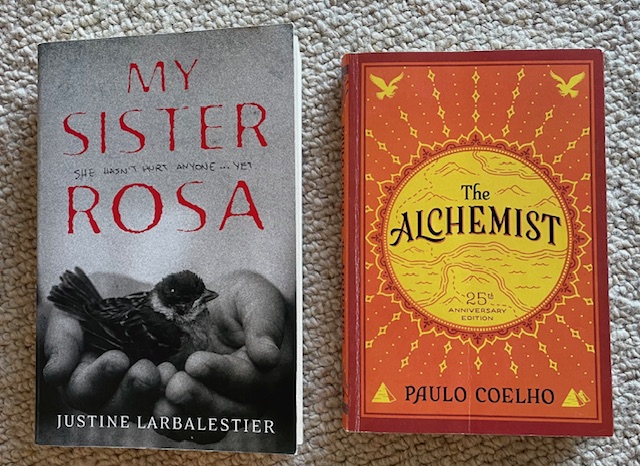
Book 19 … My Sister Rosa by Justine Larbalestier, published in 2016 by Allen and Unwin.

I picked this book up in the library in the village community center some time ago. The back cover promised me edge-of-my-seat reading and it was not wrong. I read it in one gulp, which took me till 1.30 A/M, and some time ago I’d sworn off that kind of read. Sleeping only about five hours does not agree with me these days. It’s like I’m hungover the whole next day.

Spending a bit of time at https://goodreadingmagazine.com.au/ about this one, reading reviews, I discovered that people either loved or hated the book. Also, that it’s classed as young adult fiction, which I just don’t see. Just because the POV character is a teenager does not necessarily make it a YA fiction.

Some readers thought the novel well researched, others thought it badly researched. I’m neutral about that. Just so long as the research doesn’t intrude into the reading experience I don’t mind what lengths writers go to get a readerly reality. I’ve paddled that sea myself, researching the ins and outs of surfing for my novel, Mongrel, for example. Body-surfing was the only kind of surfing I ever did and then only casually.

Some readers loved the supporting character, the ten-year-old psychopath, thinking her very realistic. Others thought her tricks were mere childishness. On that point I really don’t believe the average ten-year-old will try to talk a so-called friend into killing her twin for entertainment. People who thought that, I stopped respecting the minute I read their opinion.

Che, the older brother who told the story, was trying to be a normal teenager and not succeeding. Neither of the parents were ‘at home’, so to say, and his little sister became his responsibility. Of course in the past, it was normal for an eldest sibling to have the care of the younger brood. In my past it certainly was, and I often had three young kids trailing me. Nowadays, with families of only one or two kids it is much less common.

Book 20 … The Alchemist by Paulo Coelho. Translated by Alan R Clarke. Originally published in 1988. The first English language edition in 1993. This copy is a 25th anniversay edition published in 2014, by Harper One an imprint of HarperCollins.

Its publishing history is complex. In 1993 my son was eight years old and I was a keen library reader and thrift store customer. That would be one of the reasons this book completely passed me by. That library was struggling a bit, new books few and far between, and thrift stores feature the old and remaindered. Nor was I in any reading clubs where people raved about it. Small country town. Not even a bookshop in those days.

Nor would I have been psychologically mature enough in that time to read it. I hadn’t yet started my writing studies, and the only hero’s journey I knew about, was me eking out a living. Thirty three years later–now–I read The Alchemist with joy. I recognized so much. The hero’s journey, yes. There’s been so much said about the hero’s journey in film, literature, how-to books and descriptive critiques, most people will be familiar with its concepts.

But also some of the Jungian concepts I’ve been studying for the past couple of years. The Personal Legend, for example. Do you know yours? I’m not yet so familiar with mine that I can talk about it in detail, though I’ve received a few clues from dreams. If you don’t yet journal your dreams, start now. I recommend it.

Then there’s The Soul of the World. I know that as the collective unconscious, but described much more poetically. There’s more. The plot of the recurrent dream of treasure in a far off place that returns you to your original place? A plot that I’ve read in a couple of recently published novels. It was an aha moment and me thinking, So this is where they got that!

Even the title. The Alchemist. The alchemist is a wise man. The last thing he said to the boy? “No matter what he does, every person on earth plays a central role in the history of the world. And normally he doesn’t know it.”

This seemingly simple little book gave me a lot to think about.

Reading …

Good resolutions at the beginning of a year aren’t my bag but this year I thought I would keep a record of what I read the whole year.

In my teens, with no TV at home, a boring school life–working well below capacity I think now–and an almost non-existent social life, I often read a book a day. A regular bookworm, I chewed through most of the high school library in the first year, and was then provided with the truly educational stuff by the high school librarian. That lady saved me.

Mrs Murray. A short, orange-haired dragon to every other student, she loaned me many interesting and exciting books from her own collection. Historical fictions, lives of explorers, a journal purporting to be by Marco Polo, good novels. It was with her support that I managed A grades in Art History, Geography and Biology, a credit in English in my finals. I never studied, I read whatever came to hand. All of it grist to the mill.

I went on to use that formula all my life. All my learning is done by reading around in a subject. Two years ago I started a course in Dream Interpretation and I’ve collected a library of about twenty books, long and short. Now, while I’m still recording my dreams and practicing their interpretation, I’m slowly falling back into my normal reading habits.

Last year I read some great fiction that I wish I remembered better. I prefer thinking it’s because I have a lot of stories always on the go, that I don’t remember everything I read as well as I used to, but of course it’ll also have something to do with ageing. Forbid the thought.

Or maybe it’s to do with needing to keep myself severely in hand, not over-excited, not over-do it, keep myself on an even keel etc etc to float my ME/CFS riddled carcass through the sea of life.

So, book one of the year was book four of a sequence I began round about Christmas time. Those Who Perish by Emma Viskic: A Caleb Zelic thriller published by Echo in 2022. I thoroughly enjoyed all four of these detective fiction/thriller tales. Not least because I’ve been channeling an elder of 150 years ago, the days before hearing aids.

My hearing aids are working at approx 20% and the repair place is not re-opening until Monday–two more sleeps–and can’t come soon enough. There are far more women in my world now than men, yet men’s voices I can hear, and women are like they are mouthing noiselessly and I am not a good enough lip-reader.

Caleb Zelic, though a frustratingly impulsive protagonist, is mostly deaf and his story is punctuated by mal-functioning hear aids, people who don’t move their mouths when they talk, or turn away and talk so he misses important clues, etc etc. All things I could totally relate to. He’s a well-drawn character, the events he gets involved in are realistic, while at the same time a gripping read.

Somewhere in there, also in the first week, I read another detective fiction, which was entirely forgettable as I had to scan the back cover just now to help me remember it. When She Was Good by Michael Rowbotham. Published in 2020 by Hachette. Although Robotham is one of my favorite detective fiction writers, this one left nothing behind in me except for an Albanian proverb. “Nobody values the truth more highly than a liar.” The primary protagonist is a Cyrus Haven, forensic psychologist, and he just doesn’t have the charisma of his colleague, Joseph O’Loughlin, Robotham’s first forensic psychologist. Maybe I’ll chase those up and re-read them.

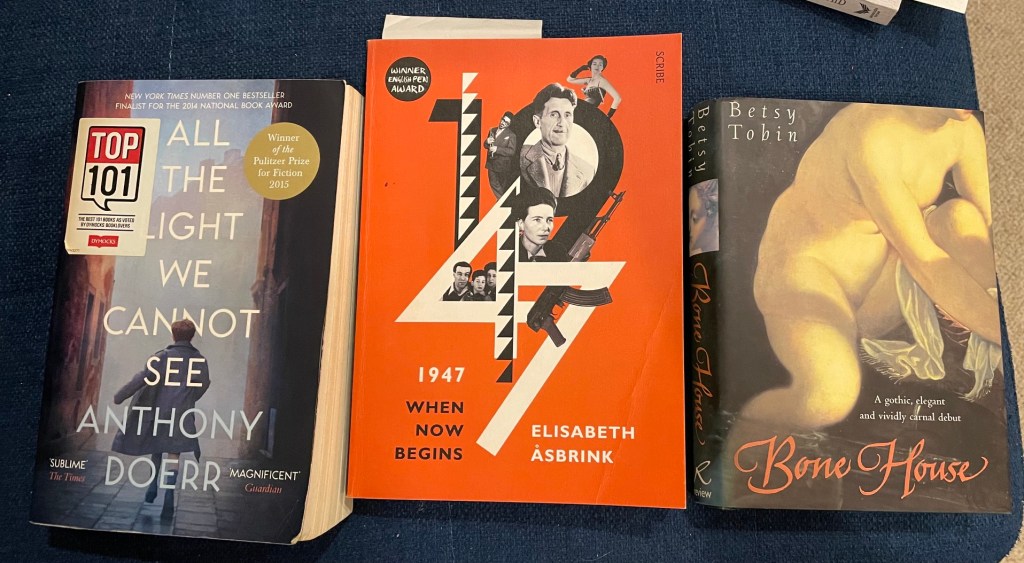
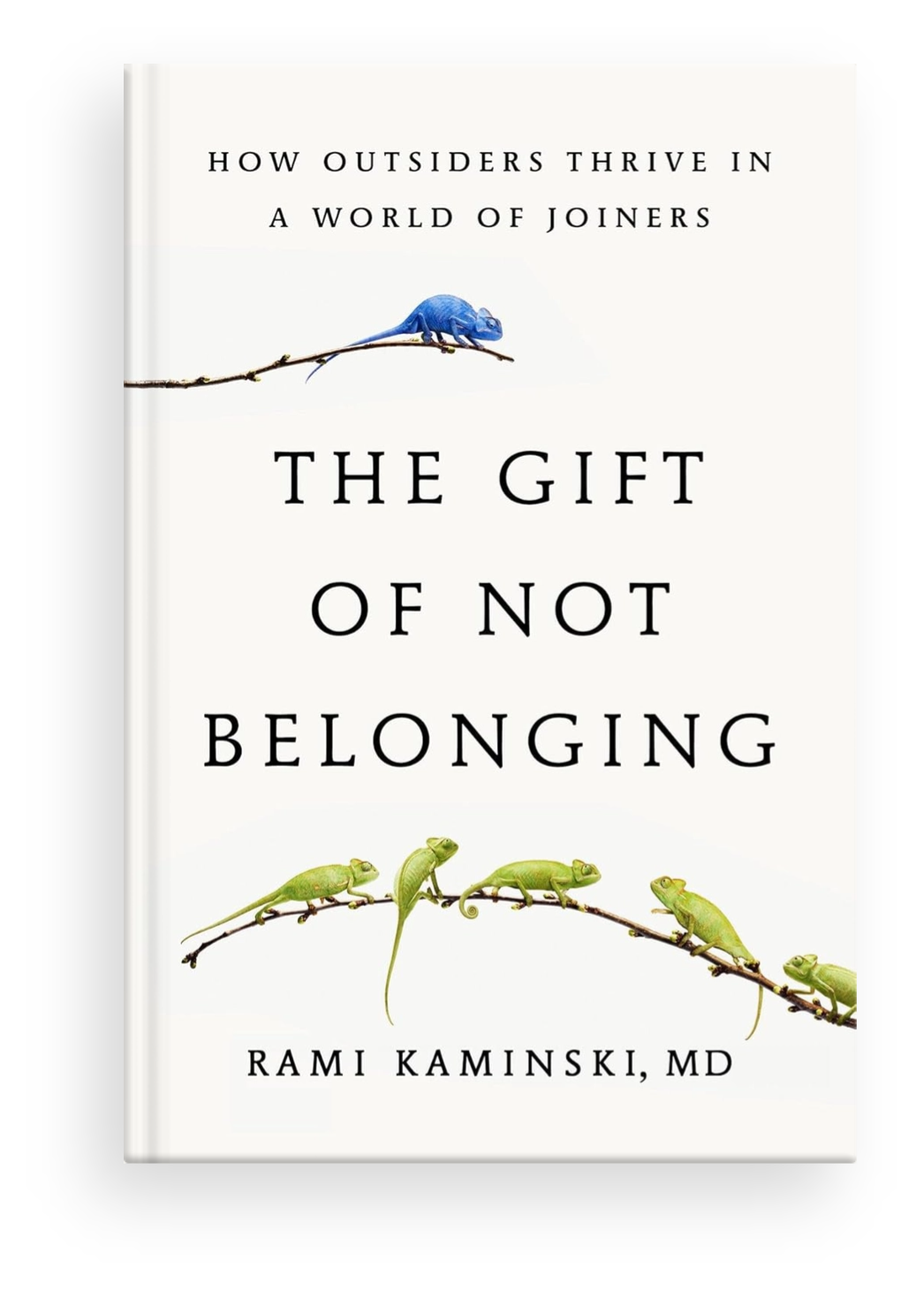
While out grocery shopping I tripped over a bookshop. Fatal, as any bookworm will tell you. Normally I steer my trusty mule in a different direction but this time I had to pass it. I came away with a book I’ve had on my list for over ten years, more on that in the goodness of time, and The Gift of Not Belonging by Dr Rami Kaminski, subtitled: How Outsiders Thrive in a World of Joiners. Published in 2025 by Scribe.

Just reading the acknowledgements told me it was my kind of book … more on that next time.

This is the work of an otrovert. As such it cannot be the fruit of a team effort and presents a dearth of people to acknowledge. …

The ‘Case for Re-reading’…

Reading this article has gifted me with a fantastic reading list. I’ve read maybe four books on the list, a couple that are also on my shelves and that are also on my re-reading list.

I came across this website only recently and haven’t explored the whole of it yet. The links in the article below are giving me a lot of food for thought.

https://aworkinglibrary.com/writing/case-for-rereading

When Mandy Brown mentioned the novel I had just started to re-read–The Peripheral by William Gibson–I felt I was finally in the right reading group.

Though maybe only a parallel group to the one being written about, I still feel like this writer is reading stuff I’m reading, and thinking along the similar lines I’m thinking. I feel relationship for the first time in a long while.

Reading isn’t an escape—it’s a reckoning.

Rereading is training, practice for remaking and unmaking—and, yes, razing—the world. Rereading draws your best thoughts close, keeps them at the ready, prepares you to think thoughts with them, prepares you to act with them at hand. Your favorite reads are your armor and your weapons and your shelter all in one. What have you gathered about you? What has taken root in your mind? What thoughts are you thinking with?

from the Case for Re-reading by Mandy Brown

Just Thinking 1: Why Write

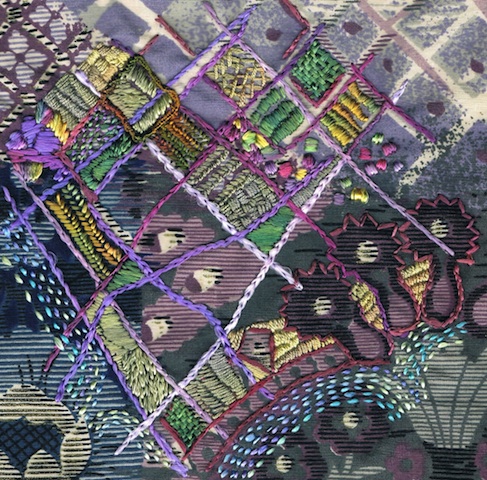
In the Fields embroidered by Rita de Heer

It’s useless to be thinking about the future when you are starting out, on anything. You start your working life putting up signs, you have no clue that one day you might be working on high rises installing in glass walls with the help of a robot.

People starting out as writers are the same. I started with writing poetry. I had no idea then that one day I’d take on an sf trilogy.

Nearly everybody here in the Discord’s Writing Cartel has a world/universe that they are either writing into or using as scene setting for any number of creative projects. Yesterday I watched a short film on Youtube, there are people developing games, writing novels, short stories, you name it, it’s being written.

Every one of these worlds/galaxies/universes are huge. Many of us have spent every spare moment of our boring work lives thinking up detail. There will always be areas in any of these worlds that will stay private to their creator, and other areas that will see heavy traffic of stories.

We’re all doing it for the love of it. World building is one of the most satisfying mind games we all engage in, relaxing and psychologically uplifting. Next comes the harder thing. Convincing other people to put their own worlds aside for an hour, and engage with us in ours. So we write stories, develop adventure games, produce visuals, film about our worlds.

The Discord Writing Cartel community is all about sticking our toes in the waters of our worlds, writing though the shallows, and finally committing ourselves to writing fully fledged stories to share first with each other, then with the world.

Only then, with that last word, can you start thinking about how much money you might make.
Though, of course, these are just my own thoughts. Take them well salted.