It was hard to figure out the cut-off point between Mongrel and Meld. In a way, the whole of Mongrel is Tardi’s backstory and set-up for his role in Meld.
I felt that, with at least the main character a familiar person, we might all be able to better understand the new scenario. Experience it through his senses, as it were. It was hard to write and it’ll be hard to understand. But I hope you’ll find it intriguing.
— — — —
I’ve seen most snakes in the wild, but never a death adder. Like most bush-walking Australians I was always on the look out for them. Very scary. I’ve known several people who thought they killed one, only for the animal to turn out to be a blue-tongue skink.
Been home since yesterday and today assessing what I’ve been reading since last time I talked about books.
And that seems weeks ago. A lot has happened.
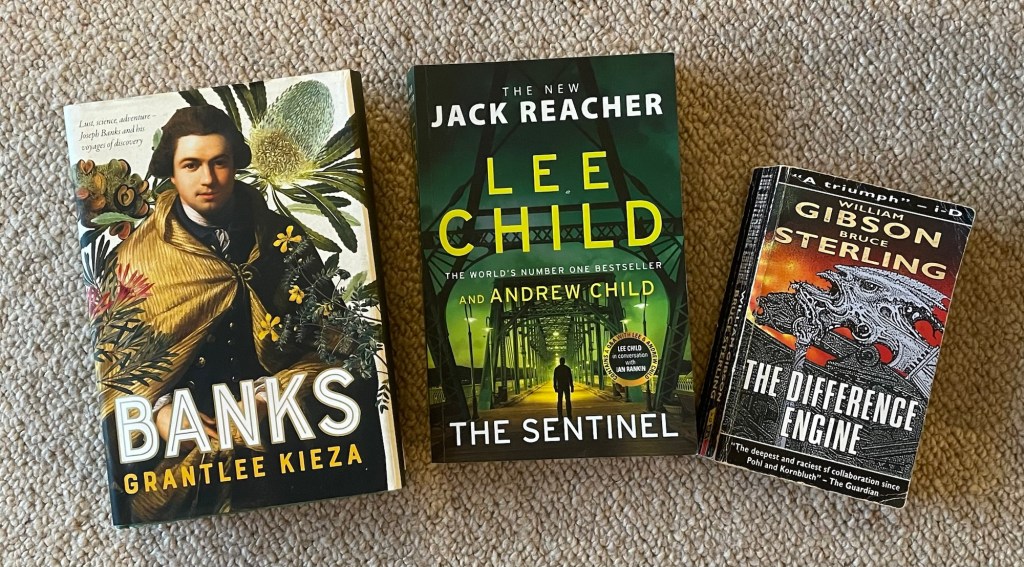
Book 15, Banks by Grantlee Kieza , published in 2020 by ABC Wave and HarperCollinsPublishers.
Though I’ve always been interested in Sir Joseph Banks and his plant discoveries in Australia, I had never read a biograpghy.
So was pleased to see this among the biographies in the Vista foyer. Started reading that night, full of vim and vigour.
My my! Did I get bogged down? I’ve seldom read a boggier book, such a disappointment. Kieza’s style is turgid, the first fifty pages are an unbroken list of namedroppings with numbers for endnotes. By page 50, there are 76 endnotes.
Normally, if a book doesn’t grab me by page 50, I give up. This time though, because it was about Banks I thought I should continue. After all, my thinking went, Banks himself is in the scene now. It isn’t just his friends and relatives tripping the stage.
On page 81 there is an interesting paragraph about the fitting out of the ship that was eventually to be named ‘Endeavour’. I must admit that here I appreciated the detail.
How a ship ninety eight feet long and twenty-nine feet and three inches wide could fit into it a crew of seventy, twenty scientists, dogs, cats, goats and poultry, is beyond belief.
The crew were alotted a space of fourteen inches wide for their hammocks. They’d have to swing top and tail, my reading buddy reminded me.
What I’m saying with these few facts … yes there are nuggets of gold in this book. They’re so far apart is the problem.
Book 16 The Difference Engine by William Gibson and Bruce Sterling. First published in 1990 by Victor Gollancz.
Started reading this when I hit another long slow chapter in Banks’ life.
The Difference Engine is a whole other kettle of fish. Fiction, of course, it’s said that with this story, Gibson and Sterling invented the cyberpunk genre.
Not a fast read either, but definitely interesting. The hold up here was the unusual terminology for what are normal concepts these days. So although you know you’re reading about a computer, it is called the difference engine.
The research done for this novel is astounding. Every kind of Victorianism is present and acounted for. Omnibuses, Hansom cabs, steam trains. Line-streamed aka stream-lined. China- hard platter of mud … many descriptions have been built using concepts right for the time.
The kind of story you want to read fast to see what happens next, but also slow to enjoy the richly described world. Quite a conundrum. I think probably in the goodness of time I will read it again.
After another couple of chapters of Banks, I picked up the so-called New Jack Reacher
Book 17, The Sentinel by Lee Child and Andrew Child. 2020 by The Bantam Press
I planned for this to be fast and thoughtless read. Pure relaxation. Didn’t turn out to be. The collaboration between these two gentlemen doesn’t work for me.
Lee Child’s normal style is spare and suspenseful. Andrew Child’s style slowed it down but not in a good way. Not by cranking up the suspense. Sentences are longer and sometimes there’s too much description.
I’m still supposedly reading Banks. Be hard to get back to it now. I might look for another biography about him
I loved reading this article right now when my cortex and lizard brain have been at odds with one another and I made the wrong decision about getting medical help for a cat scratch. And AI would’ve been no use whatever.
Am I mimetic or a stubborn fool? Anyway more on my adventures another time. There are such good ideas in here, I’ll be journalling them when I get home (from hospital).
Because the future is here already and when we have kids and grandkids we need to be able model these very important concepts.
An essay about agentic vs mimetic people, using your lizard brain, and why outsourcing your judgment to AI is a values problem before it’s a …
Now you get to witness the difficulties I have finishing. I never have been able to end a story naturally, always have to study how it’s done. Jeff Vandemeer’s Wonderbook has helped me numerous times.
In Mongrel I ran up to the end a couple of times and each time wrote yet another chapter or part and in the end … well you’ll read about the end in the goodness of time.
Now imagine this forest but thicker, with more trees …
Image by Casuarina grove (Marathi- सुरू वन) (3228093703).jpg
William Gibson is now a favorite SF author and I’ve enjoyed everything I’ve read by him recently. But reading his first novel, Neuromancer, soon after it was first published in 1984, I recall thinking then that his subject matter was hard to grasp. Whether due to the way he talked about it, or just the mere unfamiliarity … I think a combination.
At the time of that reading, I lived ‘on the road’, traveling Australia. Down-times we spent reading but in general, life was simplified to the extent it was often hard to remember what was going on in the rest of the world. Living out of a modified Toyota Landcruiser, I found it hard to figure out Gibson’s meanings. Often I didn’t know what he was talking about.
Back when Gibson wrote Neuromancer, much of the tech was new and its words hadn’t yet entered commonality. The computer and internet age had only barely got going and Gibson was describing how that world was developing. Reading the Neuromancer trilogy now, in 2026, I am right there with the characters.
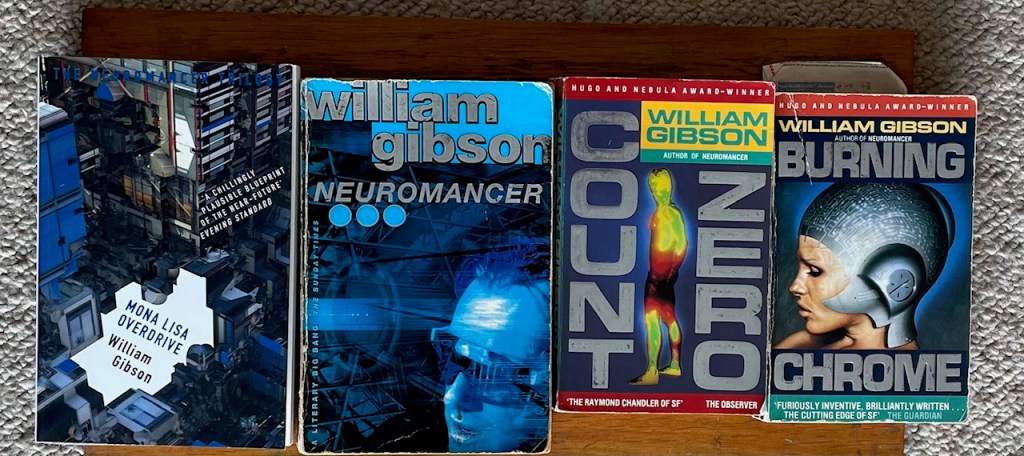
Book 11. Mona Lisa Overdrive by Willian Gibson, first published in 1988 by Gollancz.
Mona is a girl “with a murky past and uncertain future” sold to a plastic surgeon to be surgically altered to closely resemble a famous star.
I picked this up secondhand, because it was a William Gibson and I hadn’t read it yet, not realizing it is the third of his early books set in the Sprawl-universe. While enjoying Gibson’s descriptions as usual, and easily recognizing his trope of high-tech set in the slums of the future, I got hopelessly lost in the first half of the novel, reading about four very different POVs, characters that seemed to have nothing to do with each other. I was continually anticipating where and how they’d meet or intersect.
Discussing the matter with my SF reading buddy, I learned I was reading part three of Gibson’s first trilogy. That some of the characters had appeared in Neuromancer, and that all three novels—Neuromancer, Count Zero and Mona Lisa Overdrive—as well as some of the stories in the Burning Chrome collection are set partly in the Sprawl, and partly in a future Japan.
The Sprawl, the fictional equivalent of the “Boston-Atlanta Metropolitan Axis, an urban environment extending along most of the East Coast of the United States” from https://en.wikipedia.org/wiki/Sprawl_trilogy; the Japanese scenes seem to take place primarily in Chiba …
Let me tell you, in 1984 I did not yet know what a coffin hotel was, and since the internet had only barely got started in those years, there were no quick looking-up opportunities. Wikipedia, for example, started in March 2001.
Gibson often mentions the matrix and in fact he invented that concept, as well as cyber space and virtual reality. The movie that introduced the public domain to the matrix hails from 1999, fifteen years after Neuromancer hit the bookshops. All three concepts part of our ordinary understanding these days.
From the backcover of Neuromancer: “The Matrix: a world within a world, a graphic representation of the databanks of every computer in the human system; a consensual hallucination experienced daily by billions of legitimate users in the Sprawl alone.”
Nowadays even people not reading SF are aware we live in that reality.
Then, since we happened to have the whole rest of the series on hand, I re-read …
Book 12. Neuromancer by William Gibson, first published in Great Britain in 1984 by Victor Gollancz Ltd.
Also from the back cover, continuing from above … “And by Case, computer cowboy, until his nervous system is grievously maimed by a client he double-crossed. Japanese experts in nerve-splicing and micro-bionics have left him broke and close to dead. But at last Case has found a cure. He’s going back into the system. Not for the bliss of cyber-space but to steal again, this time from the big boys, the almighty mega-corps. In return, should he survive, he will stay cured.”
Book 13. Count Zero by William Gibson, first published in Great Britain in 1986 by Victor Gollancz Ltd.
Part of the back cover reads … “In the matrix of cyberspace — zaibatsus fought it out for world domination and the computer jocks risked their minds scuffling for fat crumbs — the lives of three human beings were inextricably scrambled.”
The future has totally caught up with these stories, the so-called futuristic slang sounds normal.
There are one or two concepts that even read like anachronisms. Tapes and cassettes. Polycarbon variants. Slanting gro-lights that dangled from twin lengths of curly cord.
Book 14. Burning Chrome by William Gibson and various other authors, first published in Great Britain in 1986 by Victor Gollancz Ltd.
There’s an excellent prologue by Bruce Sterling, also a well-known SF author.
The four books above are said to be a trilogy + a collection of short stories, all set in the same universe centered in the so-called Sprawl. Not a trilogy in the way of a sequence of one story too large to tell in one novel but more a threesome of books all set in the same fictional universe, and sharing some characters, at least in the case of Neuromancer and Mona Lisa Overdrive.
Gibson is the king of adjectives, he parses out meaning and description in every phrase, with every verb, every noun. And metaphors? An all-round joy to read. How can you not enjoy reading the following … ?
“Rubin inserts a skinny probe in the roller-bearing belly of a sluggish push-me-pull-you and peers at the circuitry through magnifying glasses with miniature headlights mounted at the temples.” From The Wintermarket, p 149 in Burning Chrome.
The rabbit-hole, when asked for an image of silver water pouring, coughed out this illustration for an article on colloidal silver. Then of course it had to be screen-shotted, resized and otherwise groomed to take its place in this story. In the process I lost the name of the website-of-origin, my apologies. Let me know if you recognize it as yours and I shall reference you.






 Rita de Heer