This excellent gerbera… in the wilderness that was the original village here.
When I take a photo from my balcony there is always first the roof over the BBQ area that I aim to miss, then the old olive green grey roofs of the single storey cottages that made up the old village, Carinya.
While only a few people still live there and itis generally a ghost town, the name is still often used, and a number of activities are run in Carinya’s community complex.
I haven’t explored over there yet although the Librarian at Parkland (the new community complex) said to me that if I liked old books, there are hundreds at Carinya. Kind of a red rag to an old reader, if you know what I mean.
Since my fictions range over many cultural groups and therefore different languages, and I have the main characters moving from group to group, I’m always looking for ways to write language learning …
This is the taster, as I’m on my mobile. Later, when I move onto my laptop with its bigger screen and I can see what I’m doing, I’ll write the expansion if the original idea allows itself to be expanded.
Sometimes I have two or three posts on the go being drafted due to needing more info. Like, for instance, the expansion on the mysterious stone that needs me to dig around in geological areas.
The word ‘expansion’ is really starting to bother me, it needs rephrasing. Never mind, I have a thesaurus on my laptop.
This blog seems to be the best medium to record my ideas as they arise, as I usually allow myself an hour or so of screentime on my mobile first thing in the morning. While I have my breakfast, imbibe my coffee and drink a liter of salted water.
By Vera Brittain, first published in 1933, and with a long publishing history thereafter, has kept me reading for over a week.
This is not a book review in the formal sense as I’m sure thousands of those have been written over the ninety-one years of existence of this … what we nowadays might call a memoir. (If I understand correctly that such a thing is an autobiographical account of a period of time)
Vera Brittain was of the same generation as my grandparents, who all four were also born in the 1880s to 1890s. Brittain was born in the provincial middle class hinterland of what is now the UK, my grandparents were born and raised in the provincial middleclass hinterland in the Netherlands.
There the comparison ends, for neither of my grandmothers were rebels, and due to their nation’s neutrality, they did not experience the 1914-1918 years in the same way as most other people in Europe.
According to the histories I’ve read, it suited the powers surrounding the Netherlands to allow that nation’s neutrality to continue through the whole of the war, for their convenience.
While German troops crossed and recrossed Dutch territories at will, millions of Belgian refugees made their homes in the Netherlands through the war. Coal and other minerals from the Dutch colonies warmed British homes and kept factories going.
But there was no historical, personal detail from the four families, how they were affected by the fighting on their very doorsteps, they surely would’ve been close enough to hear the guns in Belgium?
And while I’ve read a few historical novels about the Great War, I’d never read an account written from a woman’s point of view. So ‘seized’ the opportunity.
The first most noticeable thing reading a book written in the 1920s is the brand of tortured English. Well, I’m calling it that.
There are always ten words where we, nowadays, can make ourselves understood with a mere five or six. All ten, or however many there are, of the English language’s verb tenses get a good work-out.
It’s noticeable in Brittain’s account when a noun is unadorned by one or two adjectives or a verb with at least one adverb. It feels bare then. Most sentences have more than thirty words. It’s exceedingly verbose and towards the end I skipped many half page paragraphs.
Why did I even keep going, you’ll be wondering? Brittain’s experiences during the war and her incredible, through thick and thin, correspondences with her lover, her brother and two friends of theirs until they died, either in action or after being wounded is the real story here.
How the Army kept the postal service going to all areas of the front would make an amazing read. The logistics to keep that going boggles my mind.
It’s astounding, the numbers of letters written by soldiers at war, sent, and received by relatives if Vera Brittain’s experiences are anything to go by. At one point she mentions that there were daily letters or postcards or even brief notes from men stuck in the trenches.
Brittain’s own experiences as a war nurse, working in hospitals right next to various battle fronts, where they triaged men with horrific wounds make you thankful to live now. I learned more about mustard gas than I knew. More about infection when there were no antibiotics. About gangrene. About … Medicine has come a long way in a hundred years.
I understand there have been a film and TV series made. If I’d seen the film first, I’d probably not bother to read the book. It is quite heavy going. But then I wouldn’t have read the rain of little diamonds sprinkled throughout the text. The words and images that I will treasure.
Such as when Vera visits first Roland’s grave and a few years later her brother’s grave. On the way there so many broken tree-trunks lay along the road bearing witness, that only the Omniscient Mmathmatician could count them.
There was a great deal to enjoy.
But have you noticed how unconsciously influenced I was by the wordy turgidity of Miss Brittain’s style? That passive voice will haunt me.
Typed one-fingered on my mobile, this will have to go out un checked and un-proofed. I’ll do that tomorrow.
She has a lot of tracks you’ll be saying, and you’re not wrong. This particular track I’ve been on for only about six years and was off for over six to nine months.
This time last year I had a lot of nightmares, so much so that I thought to get some help figuring out why. First saw a dream analyst for about fourteen weeks. Fatigue reared its ugly head. The trip there and back by public transport once a week proved too wearing. I went to once a fortnight, then quit and looked for something online. (I am lucky to have so many good options.)
Found This Jungian Life podcasts and listened non-stop for a few weeks then signed up for their Dream School, Websites at end of the post. So for six months I painted my dreams and studied how to interpret them. That’s still going. The course is twelve months.
But once you’re taking notice, dreams come thick and fast and I only painted a few. Wrote the rest. The journal these days is a loose leaf folder with pages inserted when and where. And notes, because as you learn more previous dreams also suddenly get meaning.
The community committee organizes classes and groups. I joined a painting group. Two people are working in oils. Two in acrylics. The leader asked me what. I went home and fetched my watercolors gear. Painted a little scene.
Ordinary, compared to what came after, and there a few things I would’ve done different if I’d been more aware of what I was doing, and less concerned about where I was doing it. I’ve never painted in public.
Lol, there’s no planning in this landscape at all. I started at the top with the sky which worked OK. All the rest reminds me of the scenery of an early computer game, Robin Hood I seem to remember, forest in clumps suggesting paths where the merry men disappeared. A slope and a lake? River? Ice? That blotty bit in the middle? Was where I was distracted, painting in public as I said, and my brush hit the paper where it shouldn’t have, and I tried to blot off the marks.
Link to both Dream School and the This Jungian Life podcasts. This Jungian Life
What happened then … is that I inserted a blog post block on the Art Stories Page and one hundred existing blog posts from the Home Page loaded.
Aaarghhh!!!
That’s not what I meant! I wanted to write new art-related blog-posts, specific to that Page. Is it cheating to want that?
Not going to work, is it?
Is there anything wrong with the Brick Stories Page? It works. People read it. The proof is in the stats. Live and learn as they say, I should give up sooner this time. Not spend so much time beating my head against immovable objects. Just do what already works.
But I wanted an elegant, artistic solution! Talking to yourself also will not help. Delete the overloaded block, already.
Delving Yardbarker’s post about Place on their blog Faded Houses Green, started me thinking about what place has meant to me over the years, and how that affects my story making.
My best childhood places and events resonate in me with bursts of color. My first clear self-remembered memory is of the upturned faces of golden dandelion flowers starring the flooded and frozen grassland where my father took me and my little brothers ice skating. I was about six-years-old and had ‘proper’ child-sized skates. My brothers had flat, double-edged pieces of Meccano strapped under their shoes.
Much further on in the same year there were the glory of dahlias in a three-brick high garden bed in the backyard. A riot of pinks, plum red, orange, and golds that pronged into my eyes and heart so that I was rarely aware of the voracious pigeons sharing the backyard, quarreling over the feed scattered over the patio.
The master bedroom was curtained with a pink-orange tinted cotton. When the afternoon sun shone through, the room glowed red-gold, and I loved to be there then. Roundabout when I turned seven, my mother said that I wasn’t to hover at the bedroom door and make a nuisance of myself. She’d loaned the bedroom to a pair of unmarried teenagers expecting twins, and life became grey and ordinary for a while. Grey skies. Grey streets, red-grey brick houses. Seven dried up leaves on the sapling outside the front door.
One autumn we camped at a place called ‘Ommen’ where golden chanterelle mushrooms grew in the pine and beech forests nearby. My mother took us mushroom hunting and to find the little triangular brown beechnuts that fit exactly between my first three finger tips. Fried together on the primus camp-stove, these ‘fruits of the forest’ made dinner that night a feast.
And so I find that most of my clearest, earliest, visual memories of places are to do with warm vibrant colors. Being given my first orange when I was about eight years old, what a delicious thrill that was. I kept it for days in a special tin under my bed, to take it out and drink in its glory. Hot golden potato fries deliciously fragrant with mayonnaise that we sometimes had from a particular shop in De Haag on the way home from a long trip.
My first Lego set, the size of a packet of cigarettes, that had enough red bricks in it to build a little house, and that because I received it as a going-away present, I will always associate with the ship we traveled on to Indonesia.
Of course there were more colors. Skies of washed-out blue, steel grey or unbroken cloud. The North Sea, when I saw it, was usually also steel grey. River boats were brown or slick grey with rain and river water. The Hoogovens (steelworks) had a tall chimney belching out yellow-grey. Shades of green did not particularly impress me in those childhood days. The saddest book I ever read had covers of dark green leather.
When I look back on those years, it seems now that most people then kept their vibrant colors for indoors. Traditionalists had their rich red Persian rugs as table covers—after a meal they swept crumbs from them using a special stoffer-en-blikje, (dustpan and brush), with brass handles. Needle-worked scatter cushions and cross-stitched wall hangings brightened cosy living rooms. Highly polished brass planters and vases reflected firelight and old fashioned oil lamps.
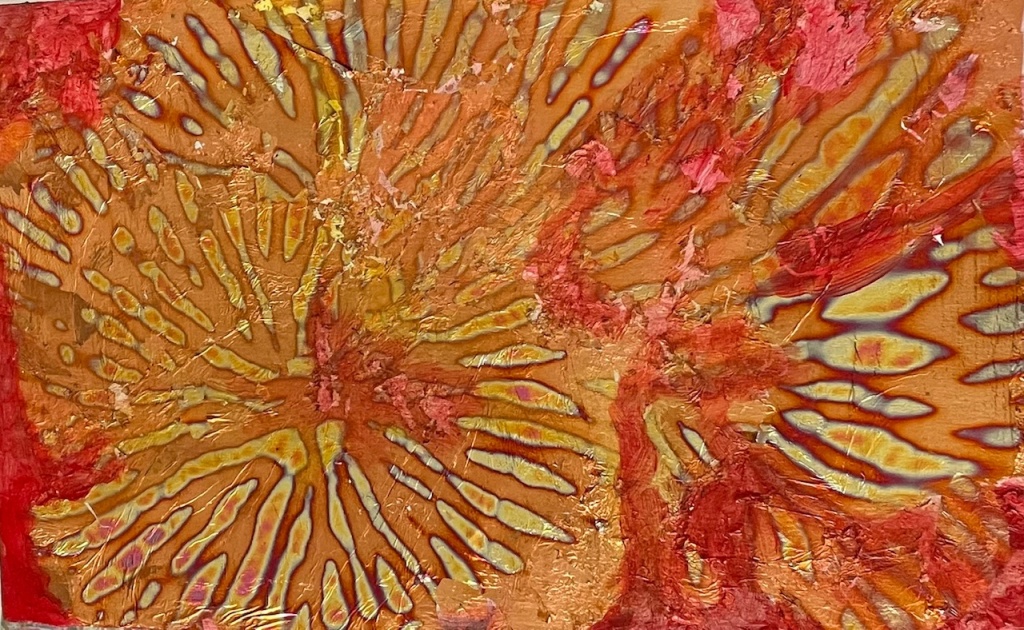
Experiment with watercolor paint and starburst foil
Make-believe curtains are the go for the moment, until I decide curtains or blinds.
What kind of ceiling is this?
The carpenters clamps, rope and bed sheets curtains to the side installed by my son, and the highly unusual ceiling detail overhead.
There are four pristine white levels with only two of them faced with painted-over timber for curtain rails and/or blinds to be fixed overhead …
To be fixed overhead on two levels, neither of them ‘regular’ lengths. Which will make it hard to buy off-the-shelf products.
This morning I was distracted while researching indoor necessities by a pageful of Temu growlights, followed by discovering specialist products are not needed to help my plants survive.
It’s too long to wait for plants until the depth of winter to get a decent day of sunlight. So that’s another ongoing search for solutions. Love a good problem to get my teeth into!



 Rita de Heer