Reading: ‘Doomsday Book’

Published in 1992

This is one of those novels that improves on a second reading. Probably I tried to race through it too fast first time I read it. And with a many stranded novel such as this, that will not work.

Although it’s a story of time travelling, and does the nitty gritty of the character in the 1300s very well, it’s also an extremely detailed story of the latter half of the twentieth century masquerading as the 2050s.

While I never confused the two eras, the detail of life in the so-called 2050s and the number of interesting lives that were being described, made it hard to sustain interest in the historian stuck in the 1320s. Especially since it became clear early in the piece that her rescue would have to originate in the future where she came from.

I found it increasingly difficult to have patience enough to go back into the 1320s and I suspect that the story set in the 1320s was always smaller. The mystery of Kithrin’s illness too had to be solved in the future.

The set-up took a long time, many pages of often not-understandable detail before we meet Kithrin in 1320. Which is normal in SF, of course. There is always a lot of material needed to be held ‘in abeyance’, as it used to be called, where a reader needs to remember a bunch of new facts before they are explained.

In this story, there were frequent reminders rather than an explanation as early as possible.

There was so much of such detail that it gave the impression of foam on the real beer underneath, or seafoam on a beach where you have to wade through to find the strand’s features.

Kithrin’s problems with the language in the medieval time where she was transposed went on for longer than I had patience for, yet this is not a novel where you can skip bits. The old words begged to be translated but the effort took me out of the story too often.

I began to look forward to Colin’s story for its comic relief, with hardly with any relevance to the main two stories.

The style tells me the time the events are taking place are maybe the 1950s to 1980s. It was published in 1992. And so the story’s present day reads like history in this present day, not the 2050s not too far into our future.

This novel will reward a patient reader prepared to chew through it steadily. Almost every actor in it, even walk on parts, get characterisation, their fifteen minutes on the stage. There were parts I enjoyed and parts that irritated me.

Reading ‘Weaponized’

Reading Weaponized by Neal asher (2023) was a marathon.

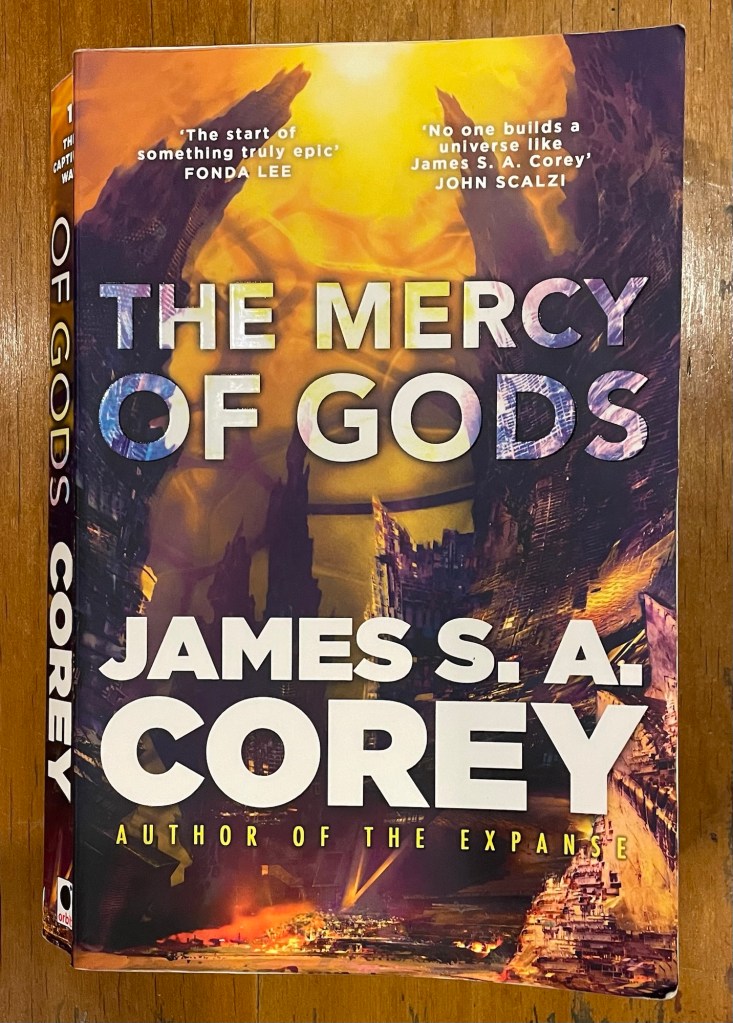
Section of the Front Cover

There are a couple of Asher’s novels I’ve enjoyed, The Skinner and The Voyage of the Sable Keech, for example, the first two instalments of the Spatterjay trilogy, published in the early 2000s.

I found those inventive and engrossing. I still think with fondness about the living ship. The Polity novels that intervene between those and Weaponized are set in a human universe ruled by AIs.

In Weaponized a bunch of human characters from the polity intend to colonize an outer planet. They’re all in their second or third century and are bored. They intend to go back to basics somewhere new.

Ursula Ossect Treloon is their leader. The plot is a relentless competition for superiority between the human would-be settlers, and the native wildlife.

Neither of them wins when both appear to be taken over by superior Jain technology, from yet another universe. The end is is circular, a mystery, when a fragment of Ursula is saved by the Polity mole.

Most of the story is the ‘science’ describing the adaptations that need to be made to continue the struggle to survive an ever evolving enemy.

And this is an evolution happening at a daily at most week’s pace. The actual plot was told with a series of one liners buried in the almost baroquely detailed descriptions of the technology. Non-stop action as the back cover promises.

By about a third of the way through, I was wishing for a bit of ordinary narrative, describing the settlers ordinary time. But if anything proceedings notched up, there was never any relief.

‘I don’t speak binary…’

One of my favorite lines in The Mandalorian, which I’ve been watching one last time before I cancel my subscrition with Disney+. Cross my fingers that I can achieve that this time.

That punch line only seems paradoxical. In a scene with the maximum amount of technology being used, Din Djindarin tells his droid don’t complain to me I don’t speak binary.

Binary? A language made up of noughts and ones? On and off? Speaking it would be quite a feat. I think it’s hilarious, that idea. Always laugh when I hear it.

Originally, I signed up to rewatch the Star Wars timeline right through. That was last year sometime. Tried to cancel my subscription then, but Disney is one of those ‘sticky’ businesses. It’s hard to get loose once you signed up.

So, OK, I’ve gotten involved in a few other shows. The Bear was good. I rewatched Avatar, then tried to get into part two.

The minute one of the baddies said that they had to leave Earth because it had died, I was over it. I switched it off.

Turns out I can watch any amount of pretend fisticuffs and sword play but keep your so-called fictional future-telling off my Earth. The present day real life predatorial delays are bad enough.

A vague shot of the mythosaur .. he’s an archetype of course. I’d love to see a bit more of him if Disney+ ever does a third series.

At the weekender

Flowers

This excellent gerbera… in the wilderness that was the original village here.

When I take a photo from my balcony there is always first the roof over the BBQ area that I aim to miss, then the old olive green grey roofs of the single storey cottages that made up the old village, Carinya.

While only a few people still live there and itis generally a ghost town, the name is still often used, and a number of activities are run in Carinya’s community complex.

I haven’t explored over there yet although the Librarian at Parkland (the new community complex) said to me that if I liked old books, there are hundreds at Carinya. Kind of a red rag to an old reader, if you know what I mean.

About The Lodestar Timeline

The Star Wars chronology has been my go-to viewing for the past few weeks. The Mandalorian has just said auf wiedersein to his small charge and will be at a loose end.

The Mandalorian series got me thinking about novels, such as The Crystal Planet by Vonda McIntyre, set in the Starwars universe.

[All Star Wars related media produced pre 2014 are now referred to as Legends, while for post 2014 material and the original series, Disney+ claims the ‘Canon’ label.]

While they all have only a tenuous position on the original timeline, TV series and books have expanded the Star Wars universe.

The original timeline of the Lodestar universe has always involved timetravel. Not sideways to expand the size of the universe yet, to give more options where to set stories, as in the Star Wars universe.

The Lodestar universe began in the future … I even set a date for its beginning when I was still new at the business of writing a universe. But it turns out that in a story that involves a time travelling, forward falling, octohedrenal spaceship such as the Lodestar, there is no beginning or end.

Because that’s what happened …

More About the Lodestar Series: Kestrel out of Jenk-Father next?

The earliest version of the series had the whole of each character’s POV chapters following on from one another. Ahni I, then Kestrel II then Srese III, then Sard IV.

Then, because Ahni’s chapters and Kestrel’s chapters often trod the same ground at the approximately the same time, I started a melded version. I seem to recall deciding that introducing Kestrel at the beginning of Ahni’s trials would prevent reader-resistance against their romantic liaison … him being born an ‘enemy’, after all.

Numbering of chapters might seem confused, though the sequence of posting should make perfect sense. Let me know if I make a mistake?