Lodestar 56, Scrim

[I didn’t want to post the whole chapter if I was going to be knocked back again.]

Scrim Learning his Ropes … Part 1
In the dawn the winkle-pickers dragged a couple of fighting screaming numbers from their hiding places. At Scrim’s hide they laughed. “You safe now, little love. See you in bits when the nubies get you.”

After the truck left, Scrim heard pigeons on the roof above him. He remembered the crust in his pocket and was chewing it without making a sound when a shining reflection flashed along the wall opposite and a high wild whistle, close enough to touch almost, dried the bread in his gullet.

Something big out there! Out the front. What did Mapmaker say? Scrim slid up to standing, pressed himself into the room’s angle, and fought crumbs from his lungs without coughing, gasping, or choking.

He breathed big to recover. Also without a sound. Then stopped breathing coz … Tick. Pause. Tick. Pause. Tick. Pause.

Claws? Clicking along the ground outside? The time between clicks made the thing sound like a giant tall enough to peer into Mapmaker’s three-high window. Ah-nui-bots, was the word Mapmaker said. 

Scrim wanted to gulp air. Min said when you’re frighted, breathe deep in and out by your nose. Calm y’self, Scrim, he thought in her snippy tone.

Thump! In the front room! His heart skittered.

The cat walked into his hide. Thin and grey, it nuzzled up to him.

In the front room—outside it—a small, nearly friendly whistle said, “Where you go?”

The cat butted against Scrim’s legs like it said, get off my bed.

Scrim lifted one foot. All the place he could spare.

The cat sat down in that corner and started washing itself.

The whistlers clicked away. So big! Where’d these things keep themselves? When he studied the city through Min’s telescope, he never saw anything but the numbers, and the transies in the square at the end of the maze, and the wall of houses-and-lanes lectrified with steel-ropes ringing the tall ruins of the city. He badly wanted to see them, these anubots, but he wasn’t in his own place. In the rubble he would of known every escape in the scene.

Next time, he promised himself. This place was more of a mystery than he expected. He sank down beside the cat and dared to put his hand on its soft back. It purring but after a time got rid of his hand with a blunt bite. Not nasty but saying, I got things to do. It started washing its back leg so Scrim busied himself with the sand.

At the hour of sundown the hooter called. The same as the kinnies always heard. The cat pricked up its ears. Scrim too, when he saw its attention. Soon after, he heard metal on metal squeaking and coming nearer and nearer. It stopped at the door. Door squealed opened. The metal thing came inside. The door closed.

The cat opened its eyes wide at Scrim. He didn’t dare move against that fierce light.
The man tocked himself up his stairs, came puffing and grey-faced into the room.

The cat released Scrim from its spell. Mapmaker had got no feet, just stubs of under-legs. He wore covers on his stumps and had a stick to help him along. He was shorter than Scrim.

“When I real little, before kinnie, I used to slide up the mud-slide with pulling on a rope.”

The man looked deep into Scrim. “That soft thinking is like you friend-gift me. Outside life is as hard as a true-stone. Soft is a gutted rabbit. For out there I say you pack that soft deep into you heart.”

Scrim thrilled to hear the man talking like a kinnie.

“Now tell me this maze you made. Show me what you know. I will talk in my normal voice because the transomatics hear me talking all night to my cat. But you must whisper so they won’t know when you leave.”

“Them tran-som-matics?”

“What you call transies. People what come to keep ahead of death by body transplant. What this city is known for, that and every other kind of transplant. Trouble is, when the transomatics first wake up, they are like new children and have to relearn everything— walking, talking, working. Once they are halfway back to normal, their keepers give them the night-streets for their learnings.”

“The ones catching new numbers is transomatics?”

“Yes. Though lots stay young and silly and are kept for making our lives a misery, it seems to me. The truth probably that such a disaster can’t easily be explained to the outside world, like the transy’s family and such. Probably the City keeps the young-and-silly to prevent it getting a bad name. One reason, I expect, they closed the gates to the world.”

“And for keeping the numbers in?”

“I know what you thinking, Scrim. Why still no way out? Scanning the wall with the telescope did you see the ones hanging burned on the wires?”

“All my kinnie-life the same rags. No new ones. Min says they are from the beginning.”

“When people that become numbers are took and all the people in their village are also took, they might think, where is home? They tell me that. And before they can get home, for a long way there is only rubble, desert, camel riders and crocodiles. They think, why not stay, instead making themselves so they are not what the customers want.”

“How?”

“One woman who comes to my stall, I paint her with soot and colors. At her hide she needles it in. She has a tree, leaves, fruit growing all over her.”

“It works?”

“The customers don’t like how she peers from among the leaves. Other times I paint a map of sun-sores. Nobody wants them either.”

“I bet.”

“And there’s hiding. Lots hide. Like you’ve got to. High-up is best when you know nothing yet. Out of reach of every kind of bad. Not near to the maze. I’m safe here because the nubies come to watch the flyers and the cat, and every transy is afraid of meeting a nubie one dusk. As you must be.”

While he looked for a hide, Scrim saw no nubies. He only had the time between the end of the day and the hooter letting the transies out, so he picked the first not-too-high place off the street. He slept. This time his bed was the bare floor.

Books On Books Collection – Karen Green

Here/Gone (2008) Here/Gone: An ABC Flip Book for Grown Ups (2008) Karen Green Perfect bound, invertible flipbook. 215 x 215 mm. pages. Acquired from…

Books On Books Collection – Karen Green

While I am always on the lookout for art books to interact with, every so often I see/read/hear about a book process or published article with so much promise as well as being very special in itself, I instantly would like to ‘own’ it.

To hold it in my hands. To leaf through it. Turn and turn it about, reading the story from go to woe … which in this story is the reality. To love it, in effect.

Yet this share to my blog will have to do me this time!

What’s a thing you would like to ‘own’ but cannot?

Testing Testing, Again!

Day before yesterday I lost contact with my blog for no reason that I can discover. This is a test to see whether the situation has righted itself without me doing anything other than signing in in the normal way.

Well, I successfully saved a draft. That’s already an improvement.

I was asked did I want AI to generate an image.

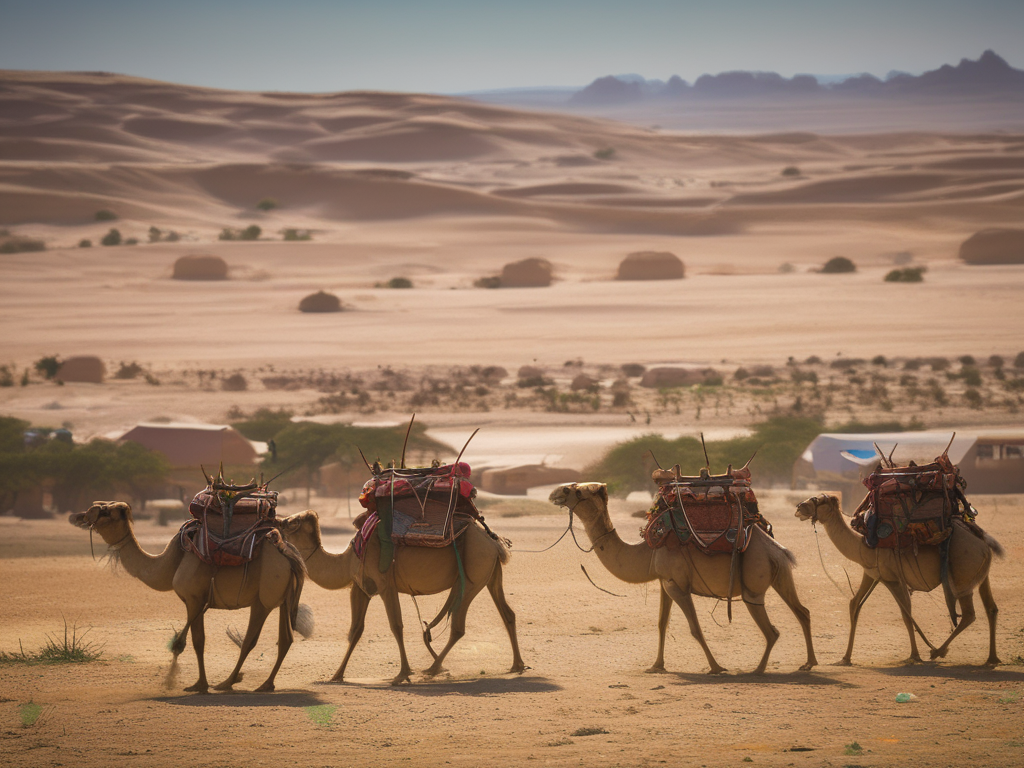
My prompt as follows … A camp of camel herders with tents and camels standing around, the surrounding countryside has corn growing, and a massive plateau rises in the background.

The result below … obviously the AI and I have a long way to go before we understand each other. My need is to learn more about prompt engineering.

The AI’s need is a more extensive library of images, the ability to ‘do’ metaphor, and an algorithm for interpreting unusual combinations.

Lodestar Over- and Under-Pass, 55.5

There were always going to be a few knotty sections in a mash-up of six novellas as the original plan was to tell the stories of each of the point-of-view characters separately. That intention got shoved to the wayside when Kes fell for Ahni and there threatened to be a lot of interaction. I let it happen, I confess. I wanted to see how the romance would pan out.

One by one the rest of the characters joined the fray. It seemed to go all right. I’m a pantser by nature, the kind of writer who slides by the seat of her pants, without too much planning. Like all pantsers I thought I could write myself out of any problem. ‘Pantser’, by the way, sounds uncomfortably like ‘Pantzer’ which I seem to remember is a type of artillery tank. Lol, one of those writers just pushes their way through! Or they tank in a deep wide trench!

We are now at a place where three viewpoint characters are in play—well, waiting in the wings—with another taking the stage. And he had to. Because if he isn’t at the appointed place at the right time, Srese will fail to be in the right place and time to meet Ahni and Kes.

This is Scrim I’m talking about, of course. He was one of the first characters who stepped into this saga, and that with just the two words at the end of his story. But don’t worry, a lot of new-miles, hours and days will be told before he says them. Most characters jump into their stories with a couple of lines of dialogue relating to their beginnings or middle events. Then it’s up to me to connect them.

Also, Scrim needs to meet up with Rockeater Ridge’s remaindered avatar. Remember him? Some of you may want to catch up with Sard before that happens. Link to Chapter One

There’s advice everywhere for budding novelists about the no-no of writing dialects. And yet, I wanted to try it. I wanted to see if it really would become a chore that readers would rather do without. Let me know if you hate Scrim’s turn of phrase?

Lol—as a reader—I just reviewed a book [link] where that became a chore very fast. My authorial defense for Scrim in Lodestar is that most of Scrim’s words are modern-day English, and it’s just that their combinations need interpreting.

Finally, if you know anything at all about sailors carving leopard seal tusks, and how the products are called scrimshaw, you will have been wondering about Scrim’s name. My lips are sealed. All will be revealed in the goodness of time.

Reading: ‘Doomsday Book’

Published in 1992

This is one of those novels that improves on a second reading. Probably I tried to race through it too fast first time I read it. And with a many stranded novel such as this, that will not work.

Although it’s a story of time travelling, and does the nitty gritty of the character in the 1300s very well, it’s also an extremely detailed story of the latter half of the twentieth century masquerading as the 2050s.

While I never confused the two eras, the detail of life in the so-called 2050s and the number of interesting lives that were being described, made it hard to sustain interest in the historian stuck in the 1320s. Especially since it became clear early in the piece that her rescue would have to originate in the future where she came from.

I found it increasingly difficult to have patience enough to go back into the 1320s and I suspect that the story set in the 1320s was always smaller. The mystery of Kithrin’s illness too had to be solved in the future.

The set-up took a long time, many pages of often not-understandable detail before we meet Kithrin in 1320. Which is normal in SF, of course. There is always a lot of material needed to be held ‘in abeyance’, as it used to be called, where a reader needs to remember a bunch of new facts before they are explained.

In this story, there were frequent reminders rather than an explanation as early as possible.

There was so much of such detail that it gave the impression of foam on the real beer underneath, or seafoam on a beach where you have to wade through to find the strand’s features.

Kithrin’s problems with the language in the medieval time where she was transposed went on for longer than I had patience for, yet this is not a novel where you can skip bits. The old words begged to be translated but the effort took me out of the story too often.

I began to look forward to Colin’s story for its comic relief, with hardly with any relevance to the main two stories.

The style tells me the time the events are taking place are maybe the 1950s to 1980s. It was published in 1992. And so the story’s present day reads like history in this present day, not the 2050s not too far into our future.

This novel will reward a patient reader prepared to chew through it steadily. Almost every actor in it, even walk on parts, get characterisation, their fifteen minutes on the stage. There were parts I enjoyed and parts that irritated me.

The Westerlies

The first day of the westerly winds? If it is, then they are about two weeks earlier than expected.

In the past it was the August Westerlies people talked about. The coldest weeks of the year. The westerly winds come straight from the mountains picking up the scent of snow and ice crystals and frost.

A parade of weather fronts coming from the west.

‘Seared in My Memory’ …Part One

Was thinking this morning about the four countries where I’ve lived. I’m not counting England/London because it was more like a long but intermittent stay of about a year.

It struck me that I have a series of images and sensations that come up for each country every time I think of anything to do with that place. And it’s like I must acknowledge those moments before any other thinking can get going.

Next I winnowed through each series to find the single most important moment to me. Came up with four moments that are seared in my memory.

I was born in North Holland, in the Netherlands. When I was about six years old, my father took me ice skating. A local farmer would’ve flooded a field for a hard winter freeze to turn into a skating rink.

The only thing I remember was how I fell over and between my hands on the ice saw a bright yellow dandelion flower set among a three of sap green dandelion leaves in the ice. Lifting my gaze a little, I understood there this ice skating rink was.

That little flower encased and covered by ice is my primary memory of my childhood. When I think of my early years up to age ten, that little flowers is always the first thing that comes to mind.

In Indonesia, where we lived next, for a ‘big’ year as my mother used to call it (about fourteen months) the moment that stands out for me was a moment of the half hour I spent utterly alone sitting on a large rock in a nearby creek (kali).

Rainforest lined both sides of the little river with no paths that I could see. And anyway, the way back was rock-hopping over the stones till I came to the place where the village (kampong) women washed their clothes.

The hot blue sky above pressed me down on the rock and I sat with my feet in the water. I don’t recall wearing shoes. A couple of rocks furter upstream, a log seemed to come alive. A large lizard, probably of the goanna tribe, dipped its fore half down into the water. To drink I thought.

But no, it slid all the way in and went I don’t know where. I’d risen as it slid down. I hovered waiting to see where it would come up.

All I recall next is the rock hopping way back, and that I was wearing a white drill cloth dress with embroidery round the hem. For heaven’s sake, I think now, why a white, embroidered dress to muck about in?

Fast forwarding now to Australia, where we arrived in late 1959. It’s difficult to extract just the one outstanding moment here. I grew up north of Sydney and then spent six years in New Zealand.

Since I returned until now I’ve lived a variety of different kinds of life. So I think I’ll honour them all, all those different lives in a separate post.

New Zealand is the first country where my soul felt at home. I haven’t worked out yet why that is. Many of my fictions are set in an amalgam of New Zealand/Aoteoroa that I called Leaf Island.

Which is a fictional island rising from the edge of the actual submerged continent Zealandia, about halfway between present day New Zealand and Australia.

My adventures in New Zealand in the early 1970s took me to a small dairying community at the base of the Urewera Range. The whole two years I lived there, I wanted to go up into the Ureweras and explore the wilderness. But I would need a guide. Someone who was native to the place.

Hard to meet for a shy new pakeha (White resident of NZ) woman when most of the Ureweras were owned by Maori.

I met a man who might’ve taken me on his last day in Murupara before he immigrated to Parramatta in Australia where he had a job. On my last day in the valley, I drove to the foot of the mountain.

The plain was flat. The Urewera Range rises steeply out of it without foothills. I parked my car in a newish gravelled carpark. Walked to the mountain. Afternoon light burnished the low heather/montane vegetation.

I put my hands on the earth and soil in front of me as if I would climb up. The slope was between 45 and 70 degrees from the horizontal I remember thinking.

I didn’t climb. Stood there with just my hands spread pressing into the thin soil backed with the stone of ages. A shield wall at the edge of the Mt Ruapehu volcano’s caldera. When I think mountain, that’s it, the Ureweras. An ongoing mystery.

When I woke I lifted my hands from the almost vertical ground taking care not to dislodge the little shrubs and miniature grasses. The sun was well down in the west, a glowing ball on the western horizon.

No other mountains have owned me the way the Ureweras own me. They are the most numinous landscape in my mind.