Reading Project, 14

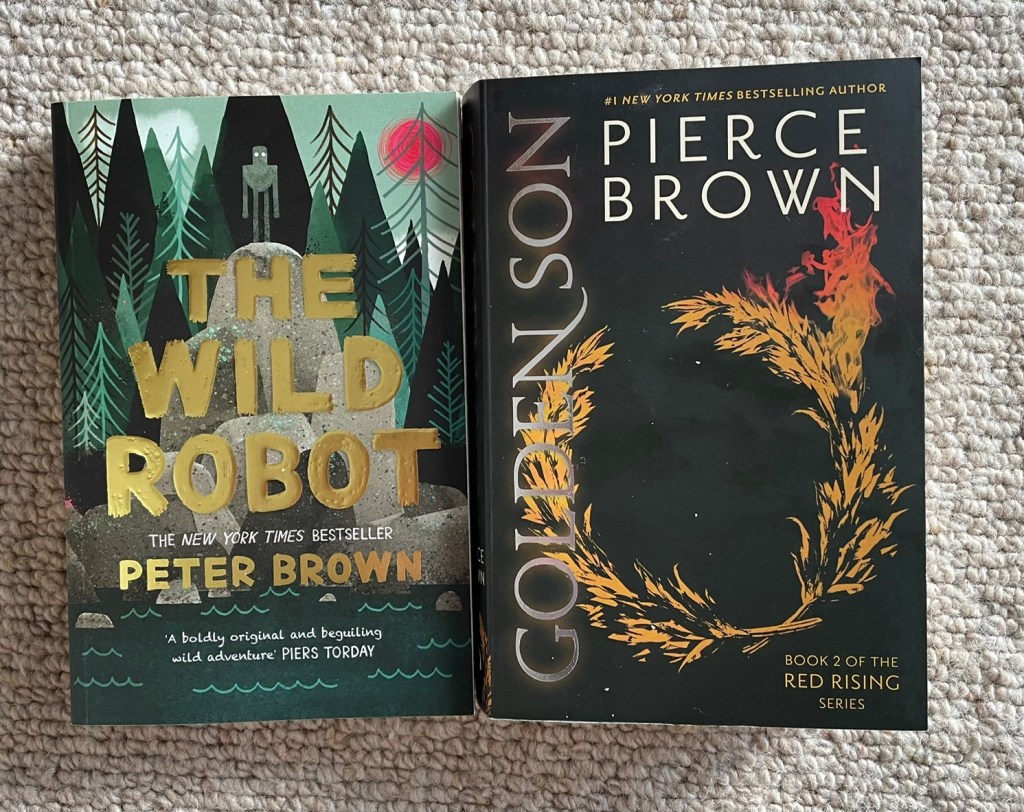
Just two of the books I read, the others I have already passed on.

After I reading the two navigator-explorers, Captains Cook and Flinders, I was ready for a bit of fiction. My SF reading buddy and I had been saying for a while that we needed a new series to get our teeth into, and couldn’t find one. With more time on my hands than he has I sourced a few 10 Best XYZ lists. Noted two or three series that all appeared on several lists.

One fine Saturday when I was grocery shopping, and then intending to look for a birthday book suitable for a nine-year-old, saw a 50% Fantasy and Science Fiction Sale at QBD (referring to Queensland Book Depot, I’m assuming).

Lol, what QBD apparently did, was mark down to 50% all first parts of series, leaving the rest of the series at the normal price. So I walked out with the book gift and three first installments of their respective series each of those between 10 and 12 dollars. How can they even produce books that cheap? Our idea being that which ever of the first installments catches our interest, we’ll continue with.

Book 44 … Mistborn, Book One of the Mistborn Series, by Brandon Sanderson, this edition published by Gollancz in 2009.

Mistborn was the first one I picked up to read. I’ve read somewhere it’s being turned into a feature film and thought I should read it before I see it as films rarely improve on books.

I find Sanderson tooth-grittingly hard to read. In my middle life I spent ten years editing undergraduate essays, an experience that has left me deeply disinterested in reading poorly phrased prose and Sanderson loves “thin alleys”!

What’s wrong with narrow alleys? And that’s just one example. I can’t believe Mistborn is being touted as literature!

Seems that I’m not alone in this, I was happy to discover. When I am alone in a complaint, there’s always the suspicion that I’m being elitist, or fussy, or or or … This time though, several Reddit commentators are of the same mind. Although one of them thought that Sanderson writes ‘flat prose’ purposely, to attract the largest possible following. In answer to that I say that George R R Martin, among others, didn’t have to resort to flattening his prose to attract a large following.

But flat prose aside, Sanderson’s ideas and inventions are fresh and capable of sending their stories into new unusual directions. Though this is not enough for me to want to read part two or more.

Book 45 … Red Rising, by Pierce Brown, first published in 2014 by Del Rey, an imprint of Random House.

Pierce Brown is one of the ‘many others’ I mentioned up there. No ‘flat prose’ in sight. This is one of those books where I hardly noticed I was reading. Some Reddit commentators have mentioned the many many short sentences and how they distract from a good read.

Others say short sentences are what makes audio books an intense listen. Oh, I thought. Audio. That’s why the short sentence style is taking over public writing. And plus, AIs seem to like it.

Red Rising read like a breath of fresh air to me, I never had to wonder what the author meant. Yes, it was a gallop. The worldbuilding, a society organized by colors and partly structured by a Roman underlay, go hand-in-hand with the plotting, and are frenetic.

Though it’s true that Darrow, the main character, is a bit of a superman, and always comes out on top despite his sometimes mistaken beliefs in the goodness of others. But never mind. I’ve read that this is the weakest of the series. If I can trust the commentators, things can only look up.

Book 46 … The Wild Robot, by Peter Brown, first published in 2016 by Little, Brown and Company, an imprint of Hachette.

The Wild Robot is the birthday book. A film is already out there and I think I’ve seen it. Which probably helped me choose the book. This is the story of a robot becoming marooned on a deserted island, and learning to live with nature, or part of nature. It seems a little moralistic but was the best that I could find without reading everything. Lol.

I despise books written purposely to teach kids morals. As if they aren’t learning them from their parents. Kids famously learn their morals by watching how their parents behave and behaving just like that. Teaching kids morals is like teaching fish to swim.

It’s increasingly hard to gloss a bookshop’s shelves for good kids’ books. It seems to me the golden age of children’s literature has gone the way of many other good things. I think Rosemary Sutcliffe’s books could do with reprinting. Penguin Books? Anyone?

I have quite a few of the really good middle grade fictions on my shelves still (some of which are forty plus years old, I confess) and although some of them are being reprinted—The Little House Series and The Rats of NIMH, for example—many others have just disappeared.
In the past, kids read about animals and their lives. Historical fictions. None of them around now. Too many good film documentaries, I suppose.

Book 47 … Golden Son, by Pierce Brown, first published in 2015 by Del Rey, an imprint of Random House.

Lol, this is not one of the three firsts that I bought. I couldn’t resist going in and buying Part 2 of the Red Rising Series. I guess I’m hooked.
However, it’s been a couple of weeks since I read Golden Son and a lot of Real Life, eg a light fling with Covid, has happened in the meantime. I will have to read Darrow’s doings again for the detail as I now remember very little as I raced through chasing the plot. A bad habit. The plot is intricate, detailed, a lot happens, there’s non-stop action.

At the end, I do remember thinking, with all that happened, and all the mysteries that have been outed, what is there left to say? How can there be all the subsequent installments? Is he going back to the beginning and start a whole lot of new threads? Re-inventing himself, no doubt.

Well, I just read a couple of articles on Wikipedia. Apparently Golden Son is the second installment of a trilogy. After Morning Star, the third one, there will be a second trilogy to make up the six books in the series so far.

I’m not sure whether I have enough puff to read any more in this arena after Golden Son. I enjoyed the two that I read, but it sounds like the next four are more of the same. And I’m pretty sure Darrow will win, somehow.

Reading Project, 13

Book 39 … The Wide Wide Sea: The Final Fatal Adventure of Captain James Cook by Hampton Sides, published by Penguin Random House UK in 2024.

My SF reading buddy and I also read non fiction such as explorers journals and accounts. To my mind, the idea of journeys in the sailing ships of yore have a lot in common with the imaginary journeys in the spacecraft of fictional futures. Both seem equally impossible from the point of view of this modern day and age.

The Resolution, Cook’s ship, was about as long as two school-buses parked end to end. Got that from Google’s AI, a useful comparison because who knows what 110 feet 8 inches or even 33.73 meters looks like? A width of approx 35 or 11 meters, so quite a lot wider than a school bus. I don’t know how many decks.

That 110 people, sailors and scientists, stuffed themselves into a ship like the Resolution, along with all their stores, living animals, and gear to repair and and maintain the ship while underway, and make a three-year journey seems almost as impossible as some of the journeys described in science fictional accounts.

Hampton Sides wrote this account seen through an American lens. Gives a completely different flavor than when I read Australian authors writing about Cook’s first two voyages. Americans are very invested in the Captain James Cook of his third voyage from 1776 to 1780, with him killed in February 1779.

Presumably because he died in the Hawaiian Islands, now part of the US, as a result of an altercation with and or misunderstanding by the Native people there. Much is made of Cook’s supposed illness. In comparison to Cook’s fair dealings with his men and with the native people they met during the first two voyages, the worn-down 52 years old captain seemed to be a changed man in his third voyage. Many writers seem to think he had a mental illness though none that I read was game to say what they really suspected. (Altzheimers? Some other breed of dementia?)

The whole story of the third voyage was new to me. I was very hazy on where Cook met his demise, I thought maybe Tahiti. I had no idea he was the first European explorer to see the Hawaiian Archipelago. All in all, an interesting account.

A few facts that stayed with me. Captain Cook’s journeys lost men overboard, falling down the masts from great heights, killed by furious islanders, taken by sharks but he never lost a man to scurvy, a sea-going disease that was a blight of that time. More men lost their health, their teeth, and their lives from scurvy than any other cause except war. But Cook had it nailed. He forced his men to drink lemon juice and eat sauerkraut.

Book 40 … Flinders by Rob Mundle, this edition published by Hachette Australia in 2012.

This is the book I intended to read earlier in the year with Matthew Flinders’ Cat. (Book 10) I learned more about 18th century sailing in this book. The author, Rob Mundle, is a sailor himself, and also can phrase the technical detail of sailing in the past in words that a landlubber can understand. Another excellent feature is the glossary. Lol, finally learned what ‘belay that thar rope!’ means.

I thoroughly enjoyed reading about the circumnavigation of Australia, and Flinders’s other explorations from 1791 to about 1803. Interestingly, Flinders and his crews suffered from scurvy and this despite that his hero, Captain James Cook, had worked out the preventative 20 years before. I can only suspect that neither lemons nor sauerkraut were available where he took on stores.

Afterwards is when a world of bad luck hit the man. He was shipwrecked, and when finally on his way back to England to his wife, was imprisoned by the French on Mauritius for six years. He lost Trim there, and lived little more than a year or two after he reached home before dying at age 40. I admit to wondering how Mrs Flinders and their one year old daughter survived after his death.

In the book’s Notes on Sources, I learned that Flinders himself wrote a short story about Trim. A tale I will hunt up.

Book 41 … Re-Visioning Psychology by James Hillman, first published in 1975. This copy published in 1992 by HarperPerennial.

After the above couple of historical accounts I took a bit of time out to re-read Re-Visioning Psychology. “This is a book about soul-making,” says the author. “This is an essay …” he says. Lol, an essay of about 80,000 words going by the thickness of the book, 229 pages not counting the end notes of which there are about 30 pages of close, 8 point print.

Hillman brings Freud’s and Carl Jung’s discoveries into the 21st century. I originally started reading him to learn more about how the imagination works, the imagination that can be seen from within the mind. The metaphoric symbol system for imagination.

Not the nuts and bolts, blood-vessel and nerve bundle imagination read from the signals of an MRI machine so dearly beloved by neuroscientists. I just can’t see what I do in my mind in the machine model. And so I read people like Hillman.

I enjoy reading Re-Visioning Psychology because, although the subject is not easy, the author explains everything. And even when he sometimes uses words that can hardly be pronounced, he explains them too. You’d think this would make the work as heavy as a cement-filled balloon but no, he’ll throw in a little six word sentence where the longest word has five letters.

“Myths do not tell us how.” (P158) is that sentence. It’s about how we can live our lives. “Living one’s myth doesn’t mean simply living one myth. It means that one lives myth; it means mythical living. As I am many persons,” he says. “So I am enacting pieces of various myths. As all myths fold into each other, no single piece can be pulled out …” and described as the myth he’s living. [Had to paraphrase the last bit of the quote as the punctuation didn’t work.]

In my dreams I’ve been Artemisia, an elderly nymph, and a high priestess of the termite people. All bits of myth. And once I’ve worked out my dreams, their maybe-meaning, I can enfold the mythical entities into my real-life story. Lately I’ve been Ariadne wandering the labyrinth of life, and painting it.

Book 42 … Farmhouse by Sophie Blackall, A Lothian’s Children’s Book, first published in Aus and NZ in 2022.

I fell in love with this book while searching for another title. It was in a specials basket, which for a book is one step before being remaindered. The book cover reminded me of the intricate collage art of Jeannie Little so of course had to have a look.

It did not disappoint. It’s the story of a house on a farm and the family of a mother, father and twelve children who lived there. The children grow up and finally the last one leaves. Then animals live in the house, even a bear, and eventually the author buys it.

My granddaughter (aged 6) and I enjoyed it when she was here last, reading it through a couple of times, one after the other. Glad I saved it.

Book 43 … My Dad’s a Birdman by David Almond and illustrated by Polly Dunbar, this book began its life as a play first performed in 2003. This edition published in 2015 by Walker Books.

A kid’s book that I intended for a read-aloud book that when I got it in my hands, turned out to be unsuitable for the intended recipient. I think I sent for it to see more of the illustrator’s work. Polly Dunbar. The story is a child looking after her father with him going through some kind of mental breakdown.

Although there’s a happy outcome, I found it quite a bleak story. I imagine that as a performance, more could’ve been made of the humorous parts.

Reading Project, 12

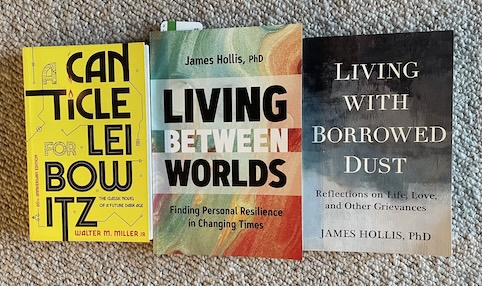
Book 35 … Living with Borrowed Dust: Reflections on Life, Love and Other Grievances by James Hollis PhD, published by Sounds True in 2025.

Had this unread on my shelves from last year. This time the title grabbed me, “living with borrowed dust.” That’s the dust of the stars we are all made of. I’ve read a few of James Hollis’s books by now, and reading this one, started to suspect that he’s regurgitating his material. And that once I’d read one I’d read them all.

That could be true about this one. It’s a kind of a autobiography/memoir—I can’t tell the difference between them. He has this aphorism, “Shut up; suit up; show up!” First time I read it, several years ago, I laughed. But took it on board. This is me, here, showing up in this project I set myself back in January.

When I read the quote above on page 106, I felt vindicated. Thought I should’ve saved my money. Because also in this little book Hollis quotes regularly from his previous books. So it’s hard to understand isn’t it, that my next read is also one of his?

Book 36 … Living Between Worlds: Finding Personal Resilience in Changing Times by James Hollis PhD, published by Sounds True in 2020

It’s an earlier book and while almost the same size, it’s weightier. Chewier. “Living between worlds” … I relate to that. I’m living between worlds, as we all are in the West. Yesterday I watched two thirds of a documentary about life in the climate-challenged parts of the world. Millions of people already impacted. And I can’t even let myself continue thinking about it all—takes too many spoons—I’m not strong enough.

But … This book. The two worlds are our inner struggles and our “modern human existence”. Looking back through it, I see I’ve underlined many sections, a sure sign I wrestled with it. In this book, Hollis is proving to us that we “human animals are equipped for survival”. With creativity, wisdom and connection, he means.

This is the kind of book I have lying beside me on the couch for a few months, to be able to read a couple of pages anytime I feel like I need to work out my mental muscles.

And this book is the reason I began a side project, painting various scenes from Theseus in the Labyrinth. Done two. More planned. Theseus turned out to be a non-hero to me. After he killed the minotaur, he abandoned Ariadne, and sailed off into the wide blue yonder. Typical for a rolling stone?

Book 37 … A Canticle for Leibowitz by Walter M Miller Jr, a 60th Anniversary edition published by Orbit Books in 2019.

I remembered starting to read this a good few years ago but could not recall why I didn’t finish it. Recently, a good friend recommended it—raved about it, in fact—saying it was the best, greatest sf novel of the 20th century. So I bought it since my local library has moved on.

Lol, might even send it to him. After I give my sf reading buddy a go at it though I seriously doubt he’ll be able to get into it.

Couldn’t remember anything about the Canticle after I confirmed it wasn’t the story about the monk who went underground in New Zealand and expected to come out in the northern hemisphere. That was a short experimental film I saw somewhere, also many years ago. I guess I conflated them since they are both about monks.

I can totally understand now why I didn’t finish it. Though, just for the heck of it, may re read it. Maybe next year. It could be one of those books that improves the better you know it. I have to give it that opportunity.

A review in Good Reading calls it a “seriously funny, stunning, and tragic, eternally fresh, imaginative, and altogether remarkable, A Canticle for Leibowitz retains its ability to enthrall and amaze.”

While a review in The Story Graph said: “There is a lot of science talk, but more in conversation/discussion rather than its use. Also there’s a lot of religious style quotes and I hate that writing style. And in general the writing style is boring and at times confusing because of huge jumps in time.”

It’s post apocalyptic, written in the nineteen fifties and probably the author went to war and had surfeit of battlefield memories he couldn’t get out of his head. There are huge time jumps and so there aren’t any characters I could get invested in. It even felt impersonal, like an overview.

Book 38 … The Messenger by Markus Zusak, published by Pan McMillan, this edition from 2023.

Tore through this in a couple of hours, a disappointingly lightweight read. Then learned it had been made into a TV series and can just about see that as a lightweight script as well, if I could be bothered viewing it. (And couldn’t find it for a pic.)

Reading, 6

Been home since yesterday and today assessing what I’ve been reading since last time I talked about books.

And that seems weeks ago. A lot has happened.

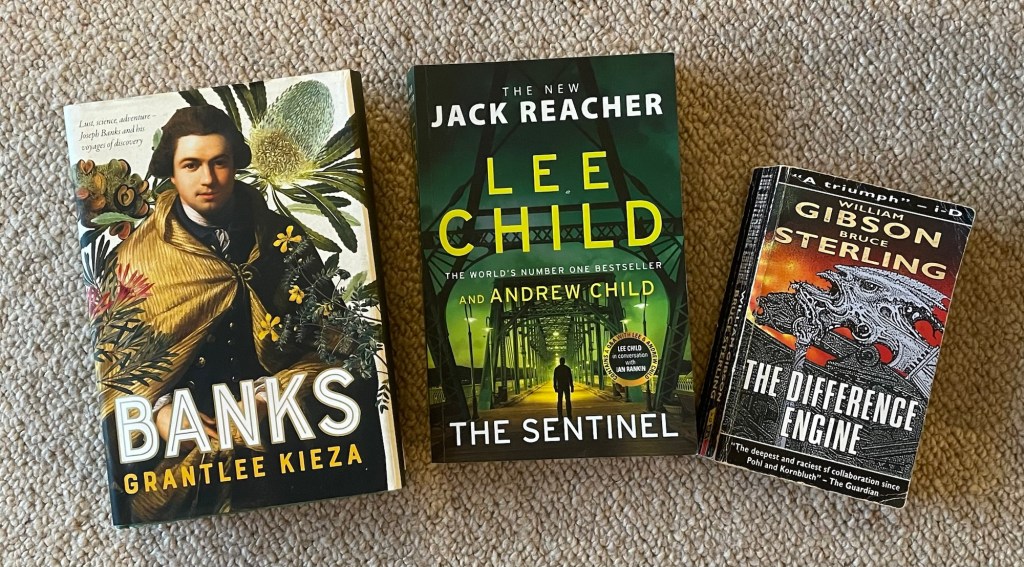
Book 15, Banks by Grantlee Kieza , published in 2020 by ABC Wave and HarperCollinsPublishers.

Though I’ve always been interested in Sir Joseph Banks and his plant discoveries in Australia, I had never read a biograpghy.

So was pleased to see this among the biographies in the Vista foyer. Started reading that night, full of vim and vigour.

My my! Did I get bogged down? I’ve seldom read a boggier book, such a disappointment. Kieza’s style is turgid, the first fifty pages are an unbroken list of namedroppings with numbers for endnotes. By page 50, there are 76 endnotes.

Normally, if a book doesn’t grab me by page 50, I give up. This time though, because it was about Banks I thought I should continue. After all, my thinking went, Banks himself is in the scene now. It isn’t just his friends and relatives tripping the stage.

On page 81 there is an interesting paragraph about the fitting out of the ship that was eventually to be named ‘Endeavour’. I must admit that here I appreciated the detail.

How a ship ninety eight feet long and twenty-nine feet and three inches wide could fit into it a crew of seventy, twenty scientists, dogs, cats, goats and poultry, is beyond belief.

The crew were alotted a space of fourteen inches wide for their hammocks. They’d have to swing top and tail, my reading buddy reminded me.

What I’m saying with these few facts … yes there are nuggets of gold in this book. They’re so far apart is the problem.

Book 16 The Difference Engine by William Gibson and Bruce Sterling. First published in 1990 by Victor Gollancz.

Started reading this when I hit another long slow chapter in Banks’ life.

The Difference Engine is a whole other kettle of fish. Fiction, of course, it’s said that with this story, Gibson and Sterling invented the cyberpunk genre.

Not a fast read either, but definitely interesting. The hold up here was the unusual terminology for what are normal concepts these days. So although you know you’re reading about a computer, it is called the difference engine.

The research done for this novel is astounding. Every kind of Victorianism is present and acounted for. Omnibuses, Hansom cabs, steam trains. Line-streamed aka stream-lined. China- hard platter of mud … many descriptions have been built using concepts right for the time.

The kind of story you want to read fast to see what happens next, but also slow to enjoy the richly described world. Quite a conundrum. I think probably in the goodness of time I will read it again.

After another couple of chapters of Banks, I picked up the so-called New Jack Reacher

Book 17, The Sentinel by Lee Child and Andrew Child. 2020 by The Bantam Press

I planned for this to be fast and thoughtless read. Pure relaxation. Didn’t turn out to be. The collaboration between these two gentlemen doesn’t work for me.

Lee Child’s normal style is spare and suspenseful. Andrew Child’s style slowed it down but not in a good way. Not by cranking up the suspense. Sentences are longer and sometimes there’s too much description.

I’m still supposedly reading Banks. Be hard to get back to it now. I might look for another biography about him

Reading, 3

The third post of this series already though I haven’t settled into a routine yet. Today had the better idea of what to do about the illustration. Instead of letting just one book have all the glory, why not give them all a chance to attract readers? Will give that a go shortly.

The longer without a routine the better, I used to think before I was pole-axed by ME/CFS. Come Easter, I’ll have lived with this malady for 29 years. Somewhere along the line I learned that making decisions is a stressor that saps my strength.

The idea out there—in the public domain—is that the more non-important decisions we encapsulate in routines the more energy we’ll have to make important decisions. It’s not wrong … routines enable me. Interesting article on decision-making … https://en.wikipedia.org/wiki/Decision-making

Then I thought what about at the end of the year? Won’t I want to know how many books I actually read? That is the project after all. I saw myself counting through the posts. Got to be an easier way. Just number them already. So … started that today.

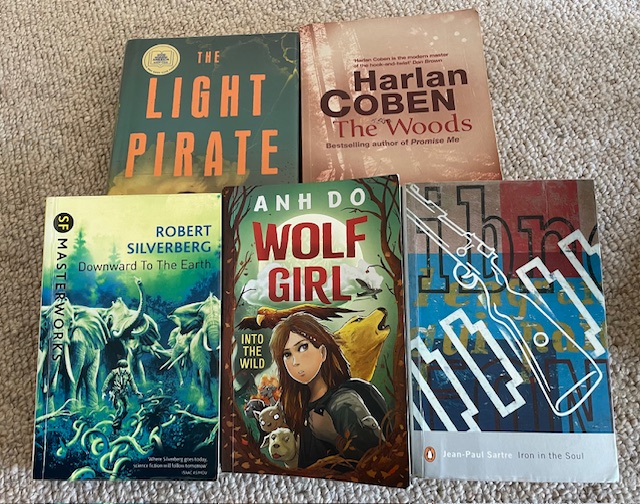
Book 5. The Light Pirate by Lily Brooks-Dalton, 2022. Published by Grand Central Publishing of New York.

This is the only book out of the five that I’ll recommend. I might’ve mentioned before on this blog that the climate change apocalypse, and its associated nightmare horsemen are my Sword of Damocles, and that the thread the sword is hanging by is wearing mighty thin and frayed.

The Light Pirate is set in the near-future and describes how the Florida coast is being engulfed the sea. It’s a blow-by-blow account of the way one family dies and adapts and is taken and finally evolves for a new existence. Ninety percent stark dark reality and ten percent luminous hope.

This is a book I would like to own. Read the good bits every now and then. This story speaks for everywhere there is low ground by the sea.

Book 6. Downward to the Earth by Robert Silverberg, 1969. First serialized in Galaxy Magazine it was published in 2015 by Gollancz in their SF Masterworks.

Although I’ve been reading science fiction since I was about 13, and Robert Silverberg has written hundreds of stories, I haven’t read all that many. Scanning through the titles in the front, I see only one that I own. Most don’t ring a bell. This little classic is said to … “blend mysticism, worldbuilding and literary references in an inventive mix …” from the backcover.

It’s probably about 60 thousand words, a common size in the 1970s, with a single storyline, the journey of the main character, Gundersen, returning to the planet after a ten year absence, out of guilt and needing to do penance for his mistreatment of the native species.

When I read old science fiction I’m forever fielding echoes. In this book I was reminded of some of Oscar Scott Card’s work. Comparing the dates of Silverberg’s and Card’s work, I think probably Card got his idea of the melding of the two species from Silverberg. Although, they could both have got the idea from Earth’s own panoply of creatures. Most insects, for example, have vastly different life-stages.

    Book 7. Iron in the Soul by Jean-Paul Satre, 1949. This edition translated by Gerald Hopkins and published by Penguin Classics, 2002.

    Despite that there was plenty of Jean-Paul Satre around when I was a young student, I was never tempted to read him then. Now I thought, browsing along the shelves at Carindale Library, why would Penguin choose to republish him as one of their classics if there wasn’t something to him?

    I read a few pages in the middle—that’s the way I test books for readability—and thought it might be interesting. A whole other viewpoint about the Second World War, this one from the POV of the rank and file of the French Army.
    Thousands were taken to Germany and, I read just now, more than ten thousand French soldiers fought alongside the Germans. I wonder if they were given a choice, fight for us or we shove you in a work camp? https://en.wikipedia.org/wiki/France_during_World_War_II

      Book 8. Wolf Girl: Into the Wild by Anh Do, 2019 with illustrations by Jeremy Ley, 2019. Published by Allen & Unwin.

      Seriously, was a bit of light relief, I zipped through this in about an hour. A story aimed at 8-10 year olds that my grandson lent me. I was interested to read how Anh Do, serious artist, translates into Anh Do, children’s author. His style reminds me of Enid Blyton’s.

      There are about a dozen installments. A money-spinner, if you ask me. And yet, Enid Blyton’s vast output was great for struggling readers, giving them lots and lots of practice of the plain vocabulary that they needed to become good readers. So perhaps this is the place for Anh Do’s output in Australia.

        Book 9. The Woods by Harlan Coben, 2007. Published by Orion Books.

        Returning a bunch of books to the in-house library in the community center, I picked up The Woods because Coben wrote it and I hadn’t read it yet. Pure indulgence. A fast forgettable read. Suspense? Of course. All the t’s crossed and the dots dotted? Yes. “The modern master of hook and twist,” says Dan Brown on the front cover. (Wonder what he got or did to get his name on someone else’s front cover?)

          Reading, 2

          The project continues.

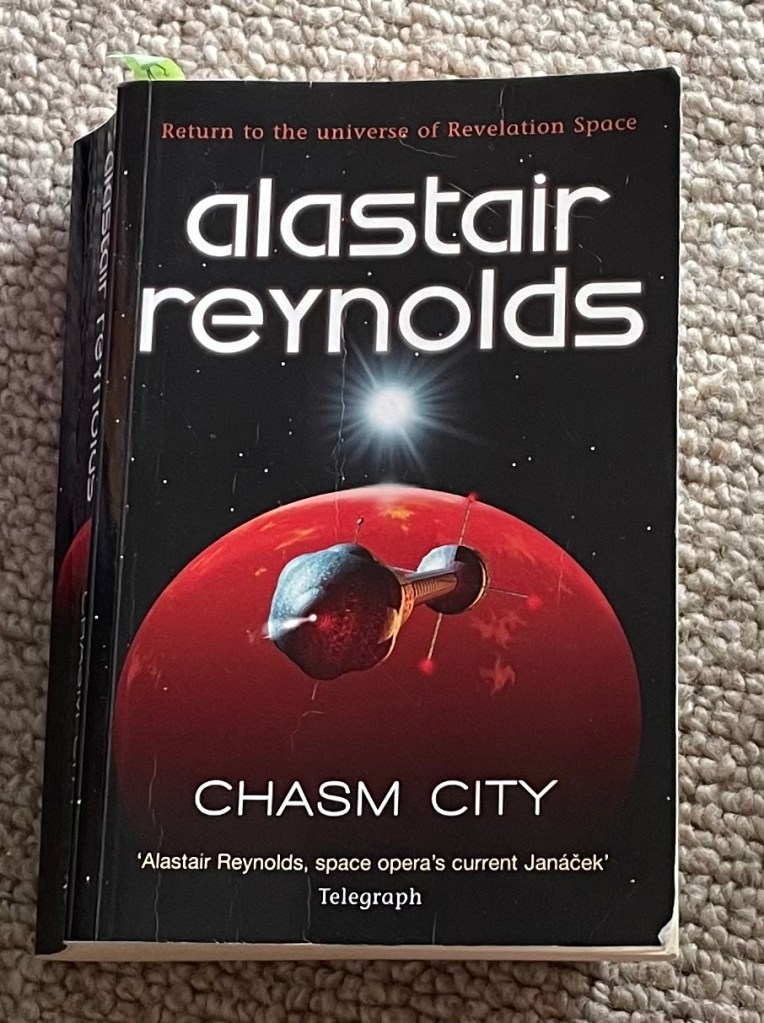
          Next up was Chasm City by Alistair Reynolds, published in 2001. “A hardboiled pursuit/revenge thriller set in the RS universe,” from the author’s website. RS = Revelation Space, which I don’t know anything about other than what I’ve just read. Thriller? Nah.

          An eight-day read, worked at diligently. Dense and detail rich. According to my research after reading it, this is Reynolds’ second published novel. And also second in reading order, it’s a ‘stand-alone’ as the Reddit experts tell it, but which surprised me as there seemed quite a bit of bloat. Stuff, that for the sake of the pace, readers could’ve done without. Stuff that I wanted to skim, but ended up plodding through because of not knowing what was essential to the plot.
          There goes my theory that editors don’t look as closely at authors with a lot of books already published.

          At times I thought I was reading about Mars. I think it was a case of stories bleeding into one another due to proximity. In this case, me watching The Expanse Series by James S A Corey on television. I think probably due to the sheer size of the chasm. Very Martian. Though in this case, it’s a planet called Yellowstone and a large part of the chasm is domed over.

          Life in the chasm is very interesting, regional. As can be expected the upper classes live in the Canopy, the slums are in the Compost. Travel is by semi sentient vehicles that claw their way up and down and along hanging vegetation and cables. The slum dwellers are all about making a living. The rich play at turkey shoots, where they free a prisoner and force them to run for their lives.

          The two main characters, with at first separate stories, eventually seem to meld into one another. The POV character keeps changing identities, and is as slippery as an eel to keep hold of. I found that quite disconcerting as the story is complex and I found it easy to get lost in. I did a lot of re-reading.

          Why didn’t this turn into a DNF read? (Did Not Finish for those of us at war with acronyms). It could’ve, to be honest. But Reynolds also wrote the Revenger trilogy… Revenger, Shadow Captain, and Bone Silence. Three of my favorite modern science fiction reads.

          Fantastic worldbuilding, great characters, piracy and treasure hunting, a gripping plot, a steampunk flavor. Rave, rave, rave.

          Reading Chasm City I kept wanting to give Reynolds more time to come good, to tell the story with as much verve and vitality he’d shown in Revenger. I think now, knowing the Chasm City was only his second novel, that he was still learning.