
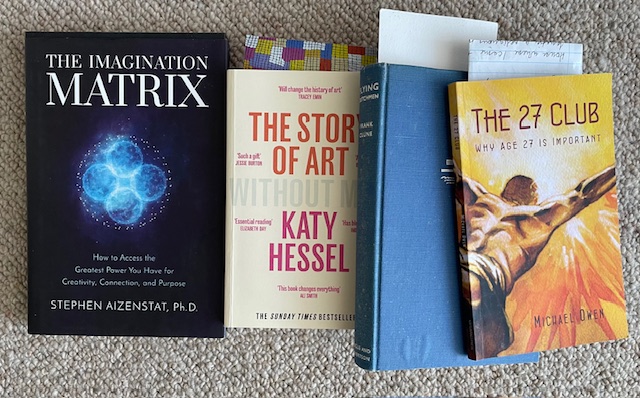
These are a bunch of books that I’m reading intermittently—for different reasons—and is also an attempt to catch up on what I’m now spending most of my time on.
Book 55 … Flying Dutchmen: a Narrative of an Expedition of Discovery from Australia to the Netherlands with “the Flying Dutchman”, by Frank Clune with illustrations by Bert Zimmerman, published in 1953 by Angus & Robertson Ltd.
Lol, this book is only about 5 years younger than I am and just as long-winded. Look at the title! Eighteen words! Plus it’s old. And Frank Clune?
Seeing that name on the spine of a book was a bit of a blast from the past as that gentleman had many titles floating around on the New South Wales summer holiday circuit in the 1960s. One reason why I picked this one out of the dumpster.
I’ve read many of his titles during holidays away while in my teens. Him and Ion Idriess, another prolific author writing about Australia. The whole family used to accompany my father to the town nearest one of his job-sites, and stay there in a boarding house or in a tent by a local beach for some or other school holiday, while he did maintenance at the local power station.
Dusty shelves in boarding house hallways and camp laundries were the places where you could find books left behind by visitors.
Frank Clune wrote about 35 books, quantity over quality, but great for practicing my new English on. Similar style to Enid Blyton’s but for adults.
The extra thing this book has going for it is that it journals a visit to the Netherlands by Clune and his wife. Once there, they met an old friend Bert Zimmerman, an artist, who did the illustrations. The description of Zimmerman’s imprisonment by the Japanese in what is now Indonesia during the war and the illustrations are the quality.
Netherland in 1953, only a eight years after the end of WWII is also interesting. Clune and his wife got to see many more sights than I did at only five years old at that time. So, yeah, this book is still on the reading-intermittently pile.
Book 56 … The Imagination Matrix: How to Access the Greatest Power You Have for Creativity, Connection, and Purpose, by Stephen Aizenstat, Ph.D. Published in 2023 by Sounds True Publishing.
I had great hopes for this book, in that I hoped that it would have something more to say about how the imagination works than the texts on that subject that I already have, or that I could learn online. Alas, that hasn’t so far eventuated.
Up to now it reads like a mash-up of Inner Work by Robert Johnson (1986) and The Artist’s Way by Julia Cameron (1994), both already in my library. I’m disappointed I fell for the upmarket marketing spiel. It’s on the intermittent pile for any new crumbs I may come across.
Book 57 … The 27 Club: Why Age 27 is Important, by Michael Owen. Published in 2012 by Kahurangi Press, Tauranga, New Zealand.
If you’ve heard of the 27 Club you’re better informed than I am. I was a complete ignoramus. When I was 27 I’d just taken off for my round-the-world trip of a life-time. At only 125 pages you’d think I would’ve ripped through it but that hasn’t been the case.
Though there are interesting parts in it, they are tacked together with a so far un-exhausted collection of people stepping off their mortal coils at 27 or thereabouts. I have started to underline sections for future reference so I guess that’s the reason it’s on the intermittent pile, and not in the books to go to Life Line bag because it’s not a keeper.
Book 58 … The Story of Art Without Men, by Katy Kessel. Published in 2022, this edition in 2024 by Penguin Random House UK.
This one qualifies as a ‘tome’ I think. Though it has the usual Penguin proportions, it outweighs all three previous books together by at least half a kilo.
This is one of those books you look at online and like what you see, order it, and receive a whole other production. The height and width are the normal Penguin style, as I said. But it might be four centimetres thick. Has glossy pages, 9 point print, small pictures.
I thought I’d be getting a magazine-style book with decent sized images. An art history that I could show off. Instead, some of the pics have to be studied with a magnifying glass. Luckily, the spine is sewn so it won’t fall apart in three minutes. And it’s thorough with 500 years worth of Western art movements with the women artists featured in each one.
I knew just a couple in the first chapter, like Artemisia Gentileschi (1593—c1653) who, like many of the early women painters, started in her father’s studio. She was raped by one of her father’s colleagues, had her fingers tortured during the subsequent trial, and at the end of it was married off. She painted in the Italian Baroque era.
Judith Leyster (1609—1660) was a Dutch Golden Age painter, famous at the time, but who married another artist and faded out of the scene to raise five children. Some of her paintings were attributed to Frans Hals though her signature was there plain to be seen, not painted over.
Two out of the fifteen women artists featured in the first chapter, and 150 women painting in the Dutch golden age compared to 3200 men was a figure also mentioned. All largely unknown.
My bookmark sits at the Eighteenth Century, Chapter II, from 1700 to 1800, a dense read that can only proceed in little gulps. This book, too, sits on the intermittent pile.
— — — —
They are a little pile sitting on the couch beside me, one of several other piles. My journals and day-book make up another pile. The third pile I’ll talk about next time.

