Reading Project, 15

Lol, I should be writing Part 17 by now. I knew when I started this project I’d have a hard time keeping up with the Reports. And, the longer I leave the reports, the harder it becomes remembering what I thought about the books. Well, here goes.

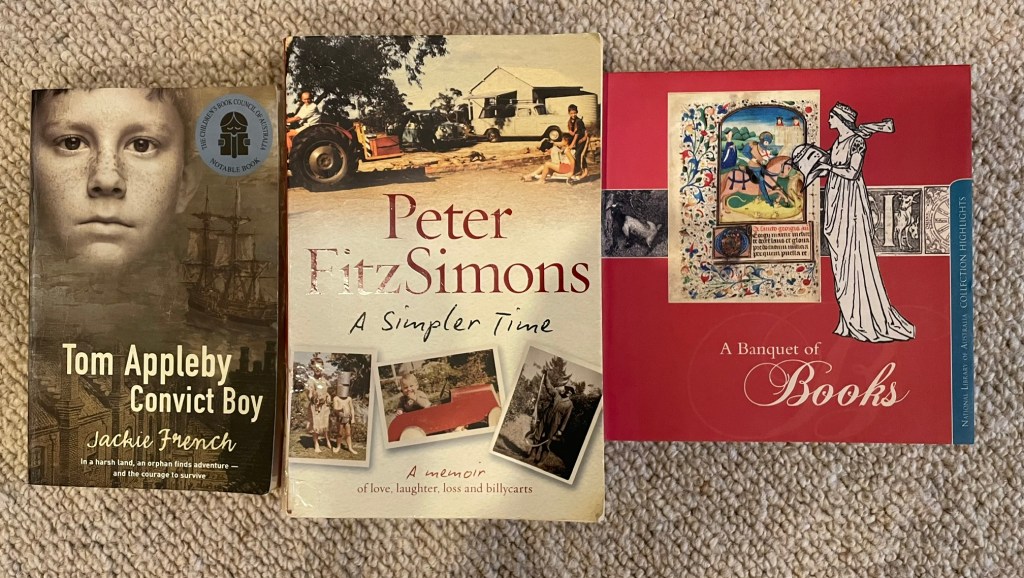
Book 48 … Tom Appleby, Convict Boy, by Jackie French, published in 2004 by Angus & Robertson, an imprint of Harper Collins Publishers.

When I read a book aimed at young readers, I’m often in the mode where I’m reading aloud. Asking myself whether it ‘sounds’ like an interesting read for both the adult reader and the young listener. And Tom Appleby sounds pretty good to my inner ear so I will be able to recommend it.

Although the main character starts off being only eight years old, his life will be so foreign to modern children being read to, there’s no flavor of childishness. And once the ships reach Port Jackson, Tom grows up a bit. He has to, in a community where hunger is the primary concern, and stealing food is not an option for him.

Tom is chosen by a sergeant in the marines for company for the sergeant’s son. The boys learn the skills necessary to survive together.

Though I’m not sure about the fact that they meet an old aboriginal lady who shows and teaches them native foods. Not sure how that would strike a modern Indigenous reader/listener.

Thirty years ago, Jackie French was a favorite source for read-aloud books. Seems like she could do with a revival. And the book has indeed passed on to its next home–the-adult-reader-and-young-listener combo.

Book 49 … A Simpler Time: a memoir of love, laughter, loss and billycarts, by Peter FitzSimons, published in 2010 by Harper Collins Publishers.

I’m glad FitzSimons called his book a memoir himself, saves me have to ponder once again about the differences between autobiography and memoir.

I saved this book from the dumpster because it’s set in the late 1950s and 1960s, and because the kids in it grew up at Peats Ridge, only about 39 kilometres by road and shorter as crows would fly from the suburb where my sisters and brothers and I were growing up in those exact years.

There’s even a possibility we might have met them at one or other time as we all would’ve traveled the same train services. Maybe in the school holidays or once we all graduated from our various high schools.

There were plenty of interesting comparisons and likenesses. The FitzSimon kids lived on a two-hundred-acre farm, where their parents had settled after WW2, to grow oranges, tomatoes and zucchinis. A seven days a week job.
We de Heer kids lived on a half-acre block carved out of the same kind of sandstone that supported Peats Ridge, covered with the same kind of bush that vegetated Peats Ridge. The de Heer father, also being a seven days a week man, chose to build our house himself on weekends, and after he got home from 12 hour days getting-there, working, and-getting-back.

There were five of them, there were six of us. The FitzSimons kids were boarders at Knox Grammar for Boys and Abbotsleigh Girls High. Both of them ‘flash’ private schools in the understanding of newbie immigrant kids like us. We went to state day schools like Asquith Girls High School and Asquith Boys High School, though one of my brothers managed to get a scholarship to attend James Ruse High School at Carlingford.

Our state primary schools, theirs and ours, would’ve been run by the same state education department, though theirs was a country school with only two classrooms and ours may have had 4 classrooms by then.

Peats Ridge. As soon as I picked up the book, it was like I recognized it and had to read it. Thoroughly enjoyed it and will send it to one of my youngest siblings for him to read.

Book 50 … A Banquet of Books: A Collection of Highlights, published in 2007 by the National Library of Australia.

I hardly know where I got this book. Must’ve been in the collection of secondhand books I saved from the dumpster. A job lot as they say. But an interesting little book, and about books you’d never ordinarily would see, hidden as they are among the collections or in the National Library’s acreage of store rooms.

After a brief intro, it is divided into three sections: Homegrown Historical Treasures; Masterpieces from Abroad; and Works of Art.

The introduction starts with one of the smallest books in the world—so small in fact that I don’t see how it could’ve been made—measuring 2.1 mm by 2.4 mm made in Germany in 2002. The largest book in the collection also gets a mention … Birds of America by James Audubon, 1785-1851. It’s a double elephant folio.

Part one’s Homegrown Historical Treasures includes a catalogue of fabrics (bark cloth or tapa) collected during the three voyages of Captain Cook. Part two, Masterpieces from Abroad, has a Book of Hours, and a leaf from the Gutenberg Bible and about fifteen more. Part three, Works of Art, contains Lionel Lindsay’s Twenty-One Woodcuts and Ann Muir’s Harvesting of Colour, from the 1990s, among a couple of dozen of historical maps, biographies, paintings by Gould, John Lewin, and other artists. I was amazed at the treasures the National Library has hidden away in its collections. Well worth visiting.

Book 51 … The Black Book by Ian Rankin, first published by Orion Books in 1993. This edition published in 1994 in the UK, but then printed in Australia in 2005 as far as I can make out.
I returned this to the library only yesterday and all I recall of it is that it’s the fifth in the Inspector Rebus series. Here a few more details by Wikipedia.

“The Black Book is a 1993 crime novel by Ian Rankin, [1][2] It is the first book to feature Siobhan Clarke, and the first one in which Morris Gerald Cafferty appears as a main character. It is also the first book in which Rebus is based at St Leonards police station.”

Neither awful nor fantastic, it delivered me a few hours of uninterrupted relaxation/reading when the stress of the previous couple of days meant my delayed fatigue forced me to rest up.

Anglified Dutch versus English …

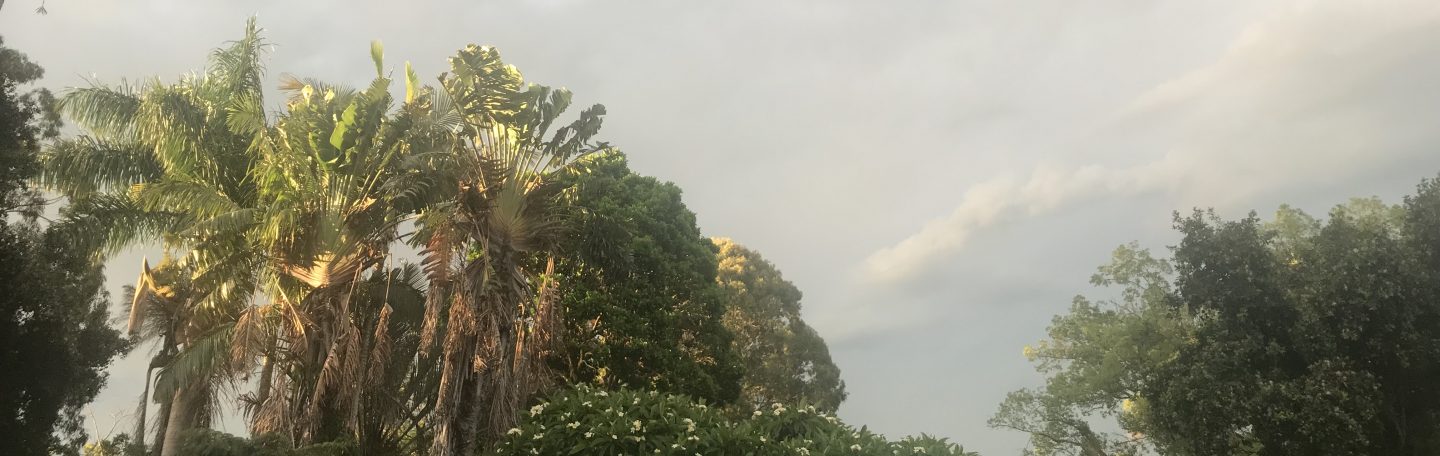
This is a screenshot, possibly from a photo by Paul Smith of an amazing-looking unnatural-looking sky. Correct me if I’m wrong. Anyone?

Finally signed up to a newspaper and even paying my way. The Guardian has Tim Winton writing on account of the ‘outrage’ of climate warming being done to us, and mincing no words at all. I’m happy to read the real story!

https://www.theguardian.com/membership/2026/aug/24/this-is-not-a-natural-calamity-it-is-being-done-to-us-knowingly?CMP=share_btn_url

So I’m glad that the Volkskrant, the Dutch outlet I was trying to subscribe to, just didn’t want to know me. Their site is run totally by machine. Without any human input, it feels like, and if the prospective subscriber asks something different to the usual, there is just no possibility to step off the beaten track.

And finally, there’s nowhere to put my Australian money since I don’t have an IBAN, don’t know what an IBAN is, and moreover my bank in Australia does not deal in IBANs. Up to now I have had no problem paying anywhere in the world by the usual international means. Must be, the Volkskrant wants only want sheeple.

From the few bits that I did read, I gather that Dutch–or should I say Nederlands–is being Anglified hand-over-fist. I saw a ton of words taken straight out of English that, where and if necessary, had Dutch pre and post fixes, and verb endings applied. Gescoort? Offeren. Privacy. Spark.

Other than that tendency, there is the Dutch practice of pasting long trains of words together to describe new concepts … onderhandelingstafel, for example, in an article to do with trade sanctions. Don’t ask, I have no idea. Vermogensbeheerder is another mysterious concept.

Is this merely a Dutch version of journalese is what I want to know? Do ordinary Dutch people speak this language?

The equivalent but opposite tendency in English seems to be to split up compound words and I admit to a tendency to put hyphens between words that read as though they are trying to belong together. Like hand-over-fist a few lines above.

Reading Project, 11

I’ve been in two minds whether to include study and text books in this project.

In October 2023 I signed up with Dream School run by the This Jungian Life group.

For a year, I read course studies and completed online assignments, to start to learn how to interpret dreams. This followed on from months of nightmares and a short stint with a Jungian psychoanalyst.

After the end of the course, I continued with the analyst for another year. Which brought me to late last year. Since then I’ve been reading rather voraciously and, at the beginning of the year, beginning this project.

After I read Book 31 … Bone House by Betsy Tobin I was at a loss. Though I have plenty of other books lying around, a dozen un read and many many that could do with a second or third reading, I was feeling jaded. Like it was the end of a holiday.

I felt like I needed some chewier fare, a project with a bit of heft. Picked up MDR by Carl Jung, having had it on my shelves for about a year.

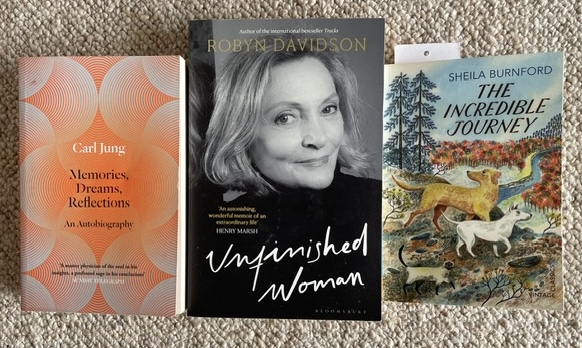
Book 32 … Memories, Dreams and Reflections: An Autobiography by Carl Jung translated from the German by Richard and Clara Winston, published by William Collins, a paperback edition in 2019.

This is not a book you can just read in one sitting, or even a week. It took me well over a month, the whole of May, I might as well say, there being plenty in it for me to think about.

When I started having nightmares back in 2023, I had already thought that I needed a way to think about what was happening in my mind. I wasn’t happy with the physical world of neuroplasticity, MRIs of people’s brains firing, the whole kit and caboodle of studying flesh-and-blood brains and what looks like is happening in them, and thinking that that is the be-all-and-end-all of how minds work.

So when I fell over Jungian dream interpretation by way of the This Jungian Life podcasts, I was stoked. Seemed to me that this was the lyric metaphoric way of thinking about what happens in minds that I could relate to. Been in that mode ever since.

(Stoked is an informal adjective meaning to be highly excited, enthusiastic, or exhilarated about something. Originating in surfing and skateboarding slang, it shares the same root as feeding or fueling a fire—meaning your energy and enthusiasm are burning brightly, Google)

Memories Dreams and Reflections, MDR for short, is both Jung’s autobiography and an account of his studies and discoveries. Despite what many people think, he went about his project of exploring what happens in our minds in a scientific way. He describes his experiments and the empirical results.

He named the personal unconscious that we all have, and discovered the deeper, archetypal unconscious we all have.

(Archetype is a Jungian psychology concept of an inherited unconscious predisposition, behavioral trait or tendency (“instinct”) shared among the members of the species …Wikipedia)

And then spent the rest of his life exploring how the unconscious works with the ego—your conscious mind. But he was writing in the early third to half of the 20th century and his turn of phrase, if anything, is quite esoteric, readable by only a small number of people, and somewhat turgid for the likes of me. I knew I would have to search out those interpreting him for more modern readers. And plus, I knew also that I’d be reading some light relief.

Book 33 … Unfinished Woman by Robyn Davison, published by Bloomsbury Publishing in 2023.

Picked this up from down in the Vista foyer where there’s a long shelf under the parcel bench, dedicated to memoirs, autobiographies and some histories.

Lol, love all these prepositions one after the other “up from down in” … makes sense, I hope?

The same Robyn Davison who lived Tracks and then wrote it. From the back cover, “In 1977, 27 year old Robyn Davison set off with a dog and four camels to cross 1700 miles of Australian desert to the sea.” I had that book for years. Don’t recall where I picked it up, second hand while traveling that same desert probably. Camp laundries are the best places to pick up good books.

I already had a soft spot for camels and loved the desert. I read that book more times than I can remember.

Davison was born on a cattle station, is quintessentially Australian, and the first modern woman explorer I read about. My heroine the minute I read about her. This memoir, about the forces that set her up to wander, to travel, to always be on the move, is a gripping read.

A poor childhood, her mother suicides, and Robyn thereafter is raised by her father and older sister in an outer Brisbane suburb. She was in London for the first time roundabout the same time I was in London.

After that she goes on to do all the romantic-sounding things that women in those days usually only could read about. Marrying an Indian prince. Living in London and writing. But, you know, there are always costs.

Book 34 … The Incredible Journey by Sheila Burnford, first published by Hodder and Stoughton in 1961. This copy by Vintage Books in 2013.

Bought this for a ninth birthday present and read it hoping to discover whether it could still rip my heart out. So many books written in the past lose their numinosity when set against more modern texts. Realizing this is a function not only of the language they are written in, but also the culture that nowadays washes through our minds.

It has this in the front as a prologue…  

The Beasts by Walt Whitman (1855)
I think I could turn and live with animals, they are so placid and self-contain’d,
I stand and look at them long and long.
They do not sweat and whine about their condition,
They do not lie awake in the dark and weep for their sins,
They do not make me sick discussing their duty to God,
Not one is dissatisfied, not one is demented with the mania of owning things,
Not one kneels to another, nor to his kind that lived thousands of years ago,
Not one is respectable or unhappy over the whole earth

Sounds modern, doesn’t it?

— — — —

The first three pages are a description of the setting, which I suspect may largely be skipped when reading them aloud. But still, the setting hasn’t suffered from the encroachment of modernity. I suspect only if you live right there will you know of the depredations of industries such as milling, mining and road-making.

The three animals are introduced in the next chapter. Two dogs and a cat. They’re being cared for by a friend of their human family and his housekeeper, Mrs Oakes, while their own family is overseas. A couple of weeks before the family is due back, the animals take off for home.

A distance of about two hundred and fifty miles separated the animals from their home, with plenty of dangers along the way. Bears, porcupine, floods, cold, snow, irascible farmers with shotguns. As well as just enough kindly humans to help the animals along.

I thoroughly enjoyed it. It hasn’t lost anything in the years since I read it to my nine year old. It’s a famous story. Disney made two movies of it, but to me it’ll always be a favorite read. And by that I mean a text I take in with my eyes.

Reading Project, 8

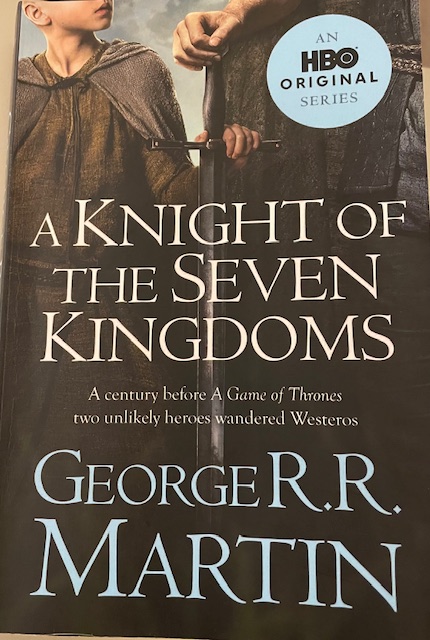
Book 21 … A Knight of the Seven Kingdoms by George R R Martin, with illustrations by Gary Gianni. This edition, being a collection of three novellas, has a complex publishing history but as a collection it was first published by Harper Collins in 2015.

After I saw the HBO TV version, I wanted to read the original, as print novels often are better at showing the complexity of characters. Which was a good move, for as well as the first story, The Hedge Knight, that the TV series is based on it, it gave me two more stories, that presumably will be televised in the goodness of time as installments 2 and 3.

A hedge knight is a knight not sworn to a lord or having land—such as Ser Duncan the Tall—and I guess would be equivalent to a ronin in the samurai tradition. Both are men who wander their countries and offer their swords in whatever battle that will give them food and shelter for a time.

Dunk (short for Duncan) is a young, tall, strong and inexperienced knight wandering the Seven Kingdoms with his squire, Egg. As soon as I read “Egg” I recalled Maester Aemon at the Wall in Westeros ( A Game of Thrones) talking about his younger brother Egg and spent quite a bit of time wondering how that worked. Forgetting that with the right question (ie prompt) Google’s AI would tell me in seconds.

Which it did. Aemon was two years older than Egg and Egg will rule as Aegon V. At the time of these stories Aemon is apprenticed at the Citadel learning to be a maester and he will serve at The Wall.

You have probably guessed by now that I am a Game-of-Thrones tragic. And you are right. I have the book series on my bookshelf. I was a member once of a huge fan club, forty thousand plus fellow tragics, industriously discussing all aspects. Though they worked out the Jon Snow is the son of Rhaegar Targaryen and Liana Stark puzzle and I still don’t know how. I confess I just took their word for it, never could find the proof in the books.

All this is getting side-tracked from the book I’m talking about, but have the excuse that the these stories brought it all back, because it is all connected. Reading it the first time round, it seems like a light read, though the battle at the tournament is quite complex. I had to read that a couple of times, nailing down who fought who and who bit the dust.

But wait, why am I saying it’s a light read? I’m changing that. Only the first story was a particularly light read and I suppose the fact that I already knew the story visually meant I just glossed the imagery in the words.

That’s the problem with visual media of all kinds and reading books after seeing related shows. By feeding viewers with media-ideas for what things look like, viewers who are also readers tend not to read stuff that will clash with pre-“recorded” visuals and as a result miss out on a lot of good metaphor.

Such as … “The spiked ball whirled round and round the sky and fell toward his head as fast as a shooting star. Dunk rolled.”

That didn’t happen in the tv series. Someone else wielded the spiked ball and not at Dunk. Why I can still appreciate it. The other thing to appreciate is a character’s thoughts. … I failed them. I am no champion. I’m not even a hedge knight. I am nothing…

I don’t mind those thoughts, they’re what anyone would think in the situation. But … He never saw dunk the lunk, though, did he?… the twenty-five times that Dunk thought that of himself … that grated on me after the fourth time. (Maybe not twenty-five, just felt like it.)

In the next story, The Sworn Sword, (p119) there’s less introspection as there is more interaction between Dunk and Egg. They are on the road, traveling to their next meal.

This story is book-ended by the two corpses hanging in a cage at the cross-roads where Dunk and Egg stop for a minute for a break and again on their way out. They’re to deliver a barrel of wine to a place called Standfast and happen to stay there, to help the inhabitants get out of a scrape they have with their neighbors about water rights, a complex quarrel. Dunc ends up fighting the opposition’s champion.

The third story is The Mystery Knight (p233). Coming away from Stoney Sept, Dunk and Egg are well supplied. As they near a town, they first see a traitor’s head on a spike on the town walls.

Two and a half pages of Dunk’s ruminations follow, about a law that allows septons to be decapitated for merely talking because … “words are wind” after all … he says. Egg puts his thoughts in where applicable and the whole is one of Martin’s stylistic manoevres to thicken up the story line with historical descriptions including the Targaeryan succession through Bloodraven.

Six days later they arrive at a ferry crossing. Here, again, as they ride toward the inn nearby, there are possibilities of informing the reader about money, as in how little they have, “twenty-two pennies, three stars, two stags, and an old chipped garnet, ser …” Egg informs us and Dunc.

All three stories give the feeling of meandering. The pace is slow while Dunc and Egg are traveling, they are on horseback, with the horses probably walking. Fights are fast blow by blow accounts of action.

Between the slow travel and fast battles unfold long sections of story needing close attention. There’s a lot of detail being slipped into every paragraph. Story-pearls are being seeded in at all times. Early in the story we learn about Bloodraven’s history. At the end we meet him, and learn that he is Egg’s cousin.

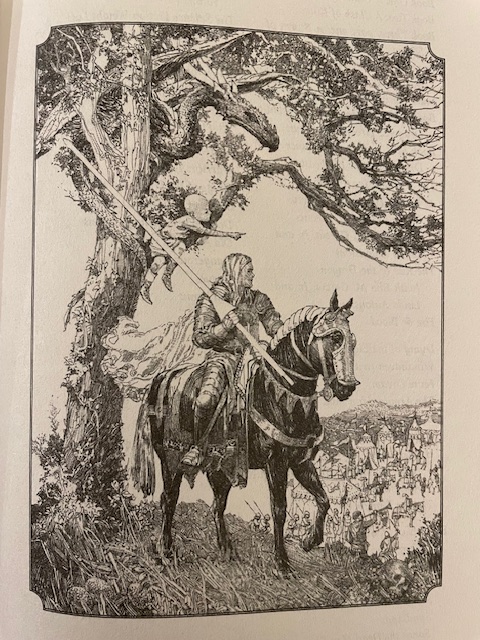
I found this book in the YA fiction section in the bookshop where I bought it. The book is probably classed as young adult fiction due to the single story line, the youth of the POV characters, and because it is illustrated.

The amount of detail in it, though, suggests an adult read. Words, phrases, clauses and sentences all contain seeds and reminders that these stories are part of the whole rest of the Westeros culture. It’s one of those books I read fast for the plot and again, slowly, for the complexity.

.Illustration by Gary Gianni.

Reading, 7

This session started while I was in hospital. Trying for easy reading matter. Easy to put down when necessary, for example to have a blood test done, or connect me to the IV.

My reading buddy brought me a book that he had trouble with and that I put aside after only one chapter, no way was I going to be able to read that in a scene where I needed to interact with maybe fifty people a day.

By day three I was hungering for anything at all to read. I’d forgotten to bring my tablet, and I’d been down to the kiosk in the downstairs lobby twice, and that had only magazines and newspapers available. Over two days, I bought two dailies of a right-wing newspaper, read them from cover to cover and felt like a foreigner.

Then, during one of my afternoon perambulations on the ward, I saw and remembered the existence of a lounge or two in each ward in that hospital, where visitors could withdraw to wait out procedures on their loved ones, and that there often were a couple of books.

Day three I sallied out and found a book that I normally wouldn’t read in a pink fit but needs must, as the saying is. A Readers’ Digest Condensed Book, in the new century renamed Readers Digest Select Editions. Still ongoing, I was amazed.

These are collections of “Popular, bestselling novels condensed to remove subplots or descriptions without altering the author’s style or story,” according to Reddit users and eBay sellers, quoted by Google’s AI. Hence me not reading them in a pink fit. However, by the 2020s I’m suspecting, the novellas could be being written purposely for the series. The four stories I read certainly seemed so.

According to Wikipedia https://en.wikipedia.org/wiki/Reader%27s_Digest_Select_Editions
I probably read

Book 18 … Volume 395 – #6 – September 2023 with • The Hunter – Jennifer Herrer • Hello Stranger – Katherine Center • Play the Fool – Lina Chern and • The Last Lifeboat – Hazel Gaynor

And because I was reading to pass the time, I have no clear memory of what all four stories were about except that one of them was about a bunch of newly-outed characters making the Titanic trip. By ‘newly outed’ I mean these people have not before featured in any of the Titanic fiction. And that they are probably completely fictional fictions. “IE did not appear in the passenger lists.” (Authorial note)

The other one I have some memory of is Hello Stranger, a thriller about a woman who has lost her memory. As this was the last story I read, I recall it best and it was good enough, in my opinion, not to give out any spoilers.

The remaining two stories? Can’t recall a word.

— — — —

After four nights, the days between, the two half-days fore and aft, and bells bells bells every minute of the night, I returned home. Blessed relief, with no bells clamoring all night I slept like a young thing.

Returned home with a prescription for another five days of antibiotics that had now to be taken by mouth, of course. And don’t bother with the probiotics yet was the word. The first couple of days I was quite well, getting stuck into the clean-up, and even managing to attend the weekly art class on Thursday morning.

By the Friday nausea began to rule. All the jobs I had begun slid into the background. There’s a pile of washed Duplo in front of me, another pile drying on the balcony. The grandkids have outgrown it, but some will still be useful to me for mountain-building. All of it needing sorting and I haven’t washed the plastic tubs yet.

Then there’s the laundry, one load ready to be folded, one load still in the washing machine, and another pile growing in a corner of the bathroom. Then there are the three days worth of dishes to be washed. Then … then …

I looked at my bookshelves, found something I hadn’t read yet, and promised myself time would pass. Five doses to go.

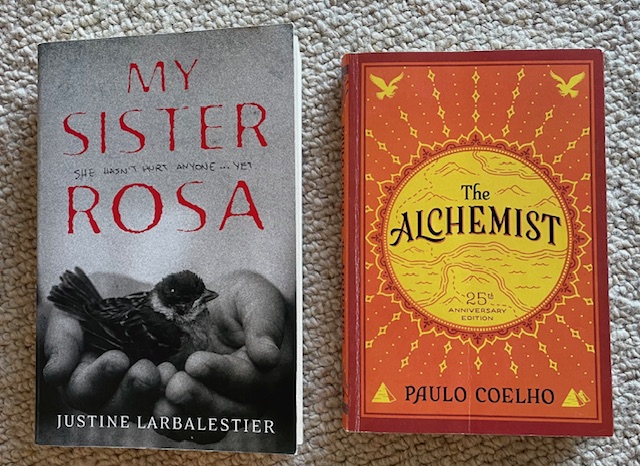
Book 19 … My Sister Rosa by Justine Larbalestier, published in 2016 by Allen and Unwin.

I picked this book up in the library in the village community center some time ago. The back cover promised me edge-of-my-seat reading and it was not wrong. I read it in one gulp, which took me till 1.30 A/M, and some time ago I’d sworn off that kind of read. Sleeping only about five hours does not agree with me these days. It’s like I’m hungover the whole next day.

Spending a bit of time at https://goodreadingmagazine.com.au/ about this one, reading reviews, I discovered that people either loved or hated the book. Also, that it’s classed as young adult fiction, which I just don’t see. Just because the POV character is a teenager does not necessarily make it a YA fiction.

Some readers thought the novel well researched, others thought it badly researched. I’m neutral about that. Just so long as the research doesn’t intrude into the reading experience I don’t mind what lengths writers go to get a readerly reality. I’ve paddled that sea myself, researching the ins and outs of surfing for my novel, Mongrel, for example. Body-surfing was the only kind of surfing I ever did and then only casually.

Some readers loved the supporting character, the ten-year-old psychopath, thinking her very realistic. Others thought her tricks were mere childishness. On that point I really don’t believe the average ten-year-old will try to talk a so-called friend into killing her twin for entertainment. People who thought that, I stopped respecting the minute I read their opinion.

Che, the older brother who told the story, was trying to be a normal teenager and not succeeding. Neither of the parents were ‘at home’, so to say, and his little sister became his responsibility. Of course in the past, it was normal for an eldest sibling to have the care of the younger brood. In my past it certainly was, and I often had three young kids trailing me. Nowadays, with families of only one or two kids it is much less common.

Book 20 … The Alchemist by Paulo Coelho. Translated by Alan R Clarke. Originally published in 1988. The first English language edition in 1993. This copy is a 25th anniversay edition published in 2014, by Harper One an imprint of HarperCollins.

Its publishing history is complex. In 1993 my son was eight years old and I was a keen library reader and thrift store customer. That would be one of the reasons this book completely passed me by. That library was struggling a bit, new books few and far between, and thrift stores feature the old and remaindered. Nor was I in any reading clubs where people raved about it. Small country town. Not even a bookshop in those days.

Nor would I have been psychologically mature enough in that time to read it. I hadn’t yet started my writing studies, and the only hero’s journey I knew about, was me eking out a living. Thirty three years later–now–I read The Alchemist with joy. I recognized so much. The hero’s journey, yes. There’s been so much said about the hero’s journey in film, literature, how-to books and descriptive critiques, most people will be familiar with its concepts.

But also some of the Jungian concepts I’ve been studying for the past couple of years. The Personal Legend, for example. Do you know yours? I’m not yet so familiar with mine that I can talk about it in detail, though I’ve received a few clues from dreams. If you don’t yet journal your dreams, start now. I recommend it.

Then there’s The Soul of the World. I know that as the collective unconscious, but described much more poetically. There’s more. The plot of the recurrent dream of treasure in a far off place that returns you to your original place? A plot that I’ve read in a couple of recently published novels. It was an aha moment and me thinking, So this is where they got that!

Even the title. The Alchemist. The alchemist is a wise man. The last thing he said to the boy? “No matter what he does, every person on earth plays a central role in the history of the world. And normally he doesn’t know it.”

This seemingly simple little book gave me a lot to think about.

What Happened …

“Been home since yesterday” I wrote in a recent post. Today I’ve been home for five days. Sunday 22nd March my cat attacked me, in the early morning, on my way back from the bathroom when I was barely awake. Out of the blue, but something she had done four or five times before.

I blame myself. After caring for six successive cats previously in my life, as well as a dog, various poultry and a lamb, I believed a rescue cat would present no problems.

The fact that Moggy had been picked up of the streets and had spent 100 days in the shelter should’ve been a warning. I read that history on her hutch at the shelter and didn’t take in what that might mean. The fact that after all the paperwork was done and we said our goodbyes, the shelter’s staff said don’t bring her back … that should’ve been my second warning.

But what should I have done then, leave her sitting on the counter and demand my money back? I didn’t.

The first time she clawed and bit me was a few days in, when I picked her up to give her a cuddle. My whole left hand swelled up and that morning I was at the GP getting antibiotics and my hand dressed. Cured me of ever again trying to pick her up.

She did not allow me to pat or brush her. She scratched the furniture. She ripped up carpet. I trained her out of all those although patting and stroking her was always a dangerous move on my part. Having her sleep beside me sitting on the couch, laying so near she touched me with her back-end was as close as we got. Sometimes lately she allowed me to lay my arm over her back and just recently she allowed me to then scratch her under an ear.

In the day-times it seemed to me we were getting somewhere, me taming her, she training me.

Night times, she ruled the apartment except for my bedroom and the bathroom, both of which I shut her out of at night. I had to be so watchful all day I just wanted to relax at night. I wrote in my journal, then slept two or three times.

The short distance between the bedroom and bathroom was when she’d sometimes claw me, always at night or early in the morning, probably when she thought she should have food and I wanted to go back to bed. When she drew blood, I washed my wounds under running water, dressed them, and called them an unfortunate mistake on her part.

Some nights on my bathroom dash, I was aware and awake enough that I waved a towel at her or a shirt on a coathanger, both of which she respected as too weird for her to deal with. She would run off down the corridor.

Weeks would go by and I would forget to be watchful on those little trips. Lately I thought she had grown out of those measures. That she trusted me enough to know that she’d never go hungry. She’d become quite the heavy weight after all, and got plenty of food, was what I thought.

So Sunday 22nd March early a/m, she jumped me when I turned to go back into my bedroom, clawed me above my ankle and hissed! The hissing part was new and I was terrified! I nipped back into the bedroom, with information flashing through my mind, I’d be alright … I had antiseptic cream in the bedside drawer, cotton wool and sticky tape. The wound looked torn, a flap of skin—awful—I covered with everything I had at hand.

Wrong.

Should’ve called somebody for help then. An ambulance, maybe.

But. It was Sunday a/m and I was in the bedroom, would ambos even come into the flat knowing there was a feral animal in there? The whole thing would’ve escalated beyond what it was worth, in my opinion.

Naturally I did not sleep, feeling baled up, knew I was doing something wrong. Knew something had to change. I’d had Moggy for 20 months by then. I was getting older, more fragile and my skin was already thin. How many more times could I allow her to attack me like that?

I got up at 6.30 a/m, and after I fed the animal with her usual 20 kibbles in the usual way, washed my leg with a Wet One because the skin was torn and I didn’t dare to put it under running water, the pain alone would’ve caused me to pass out. At that time of morning I have very low blood sugar.

Anyway, didn’t hurt once I’d covered it with a large band-aid. Once again hoped for the best. Set to thinking how to manage the situation better.

Wrong.

Didn’t ask anybody for help. Could’ve called K, who would’ve taken me to ED. Thought I could last till Monday and see the GP. Which I did.

GP very unhappy with me. They cleaned wound and dressed it. Drew a circle around the infection, told me to go to ED if the infection went over the line. Put me on antibiotics. Then they put two elastic bandages over the whole lot, these were so tight that I knew if I took them off to see whether the infection expanded, I’d never be able to get them back on.

Monday night, W came to solve the problem of a feral animal which could not be taken back to the shelter. He took her away and I haven’t asked. Mea culpa.

The GP told me to come back on Friday but probably hoped I’d come to my senses and go to ED on Wednesday. I didn’t. I’d had to wait for an eye specialist appointment for four weeks already, I had a very sore right eye, I went to the appointment on Thursday. Went back to the GP on Friday.

The antibiotics hadn’t touched the infection. The whole thing was a pus-filled crater surrounded by a large angry tight red swelling. The GP angry though he did some digging in there and mopping up. With no local anesthetic so of course I flinched. He told me to go home, pack a bag, go to ED. I was by then angry with him because why no local? And why was he so squeamish? How did he even get through medical training?

I went to ED finally. They had a look, didn’t do any digging, put me on intravenous penicillin. Four nights. And sent me home with more antibiotics to take by mouth.

At this moment in time, Monday 6th of April, the wound has partially closed over, still a large band-aid. The antibiotics are now finished and here’s hoping the infection is gone. It’s been fourteen days.