Lodestar 57, Scrim

The Dead Nubie
Scrim saw that Mapmaker had the little flag up at his house for Scrim to come over for a yarn. Good, because Scrim had a sheet of paper for Mapmaker and a couple of tallows. Already a routine, when Scrim got there, he and Mapmaker first did their trading business.

“And I would like anything colored you can find,” Mapmaker said. “Stones, bones, plastic, glass, anything. I grind it all up, and mix it with pigeon-eggyolk to make paint. Greaves left you these rabbits.”

Scrim hung the smoked rabbits by the door for on his way out then joined Mapmaker at his indoor stove fire for dinner.

“People come to me to with their things for me to paint them. I talk with them, ask them where they got this or that interesting thing. Lately, it’s always something they traded with Andover.
I ask them, Who is Andover? They tell me That kid, you know, that skinny freckle with dry-grass-colored dreads? And then they say He says, You want to trade? And-over same time, they say.”

Scrim chuckled to hear his trading described so. “I like trading. I look all over for things what people want. Glass for Grievous. What people call him behind his back.”

“Who? Why Grievous?” Mapmaker said. “I’m interested. Everything helps me.”

“He wears one arm hidden in his coat. Like he pretends that arm is gone,” Scrim said looking careful at Mapmaker. Did Mapmaker already know that? “I saw him picking up a thing from the street and forgetting to bend the arm in his coat with the rest of him. His street name is Greaves.”

Mapmaker looked disbelieving. “Greaves is a friend. You’ve heard me mention him. He gave me the rabbits for you to trade.”

“Why so kind to me? Something he wants, I bet. You’ve known him for a long time with only one arm? I feel bad that he’s pretending to you.”

Mapmaker frowned.

Scrim changed the subject. He trusted Mapmaker to ask around about the why of Grievous. “I find paper for you. Pots with holes and good dirt for Wobby and them growing gardens. All these streets are my patch for finding stuff.” He spread his arms big to show Mapmaker everywhere he went. “There’s a lot of stuff hidden in broke places where only young ones—skinny like me—can get into.”

“When you call me Mapmaker it’s like me calling you Andover. It’s a street name,” Mapmaker said. “For friends like you, I am Wal.”

“I never heard anyone call you by your friend name.”

“Friend names have to be secret. We’re always looking for ways to break the hold the medi-techs have on the numbers.”

Now Mapmaker—Wal—frowned fierce. Like he had searched his mind for knowledge he might’ve let slide into a corner. Like he found it and studied at it properly, and didn’t like what he saw.
— — — —
Grievous lived in a hide in a garbage hill with a stinking fire in the entrance making hazy smoke all day. His trade was smoked short-eared rabbits though Scrim only saw friendly fat rats playing in the mountain when he spied on Grievous from the row-houses across the street.

Next time he met Wal, Scrim told Wal his suspicioning. “Grievous is making like he got an arm took by the medi-techs like you got your under-legs took? Why?”

I’m a number,” Wal said. “My legs are on a customer who wore out his own. Greaves is no number. All week I asked every other who ran at the same time Greaves said he ran. No one saw him.”

“Running the maze, every number too busy being scared to remember anyone,” Scrim said.

“They said that. But even while being brought by the raiders no one met Greaves. Still, smoked rabbits from Grievous for glass from Scrim is a good trade. Because now we know and can find out what he’s up to by keeping our eyes on him.”
— — — — 
All Scrim’s salvaging times were in the daytime before the hooter went for the new transies to jump out of their barrack to haunt the streets. That exact time too the anubots ticked back to their gate.   

The nubies were shiver-some. After the hooter one day, a transy quicked out alone, ahead of his mates. The nubie was a slow egg unfolding like he stiff after sitting all day watching opposite Tom’s stall. So they met, nubie and transy.

The transy wanted to melt into the roadway when he knew his shadow. The nubie slitzed his knife hands and the transy was pieces in a puddle of blood, too quick for Scrim’s eyes to shut. Only good thing was no more transies in that street for a few nights.

“What’s anubots?” he asked Wal next time they met.

“The way they look. Robots like ancient old anubis-gods. Some medi-tech’s idea of a joke. Or maybe management already had that pattern and made it do for a new project. I’d like to know their use.”

“Why they’re made, you mean?”

“Yes, I bet it’s more than just killing transomatics.”

“Why do they?”

“I don’t know. Nubies look peacefully at my cat and my flyers. But I watch out I don’t cross their shadows because we don’t get to know each other. Keeping them contained could be another reason for the city to be closed.” 

The right-side gate off the walled square at the end of the maze led to the labs where the medi-techs did their deeds, Wal said. Transies went in and out of a gate at the top of the square. Left-side was the gate the nubies came out of every morning once the transies were home.

Where Scrim hid, he could only see nubies striding through their gate. Today five of them returned. Yesterday only four. Day before seven. Wal promised by talking with all his comers to find out how many nubies all told.

Because nubies being the mystery he was studying, Scrim also swung left but along the outside of the wall. He followed a good road, straight and with abandoned row-houses both sides. Yards at their backs. He searched for a high-up to camp the night and from where he’d see how it looked on the other side of the wall. But none of the ruins here were tall enough and he left hiding almost too late.

Transomatic voices cursed and complained around a side street corner. Like they seen him earlier and curved round to catch him. Scrim dived into the nearest wall-side house thanking luck for its shadowed doorway.

The transies arguing along didn’t see him.

He breathed again. Hesitated stepping back out. If he continued out on the road to return home to his high-up, he’d be scared all the time to meet a gang of transies. He might as well stay the night. In houses he often found scraps of paper Wal was always happy to see.

Before settling, he tasted the darkness, mouth open, breathing gently through his nose, ready for any stray smell. Only the moldy old of the house. Cat pee and rat piss. The dank earth below the floor. And last, a foul sweet rot of some ammal—man, woman or beast—recently dead.

All night there was no noise except for roof iron creaking to the cold and rats playing. When he woke there was a beam of sun laid over everything in its path—torn walls, stuff, dirt floor—to the few planks where he lay. In its journey to him the sun temptingly twinkled over a glass in the dirt under where the floor once was.

Though he should see the death stink first. But probly just a cat or rat, falled over of hunger. Anyway on the dirt the death smell was much less. Only the old dank smell there and the glass looked a biggie.

Curved shards of green and brown were both common. This one green. He was hopeful for a bottle because the curve went round deeper and deeper. He pushed through the dirt with a stick.

A different kind of prize appeared. Once a bottle but now a glass with its top ground smooth. He poked the stick down into it to clear dirt from inside. In the rubble he would’ve used old grass to cushion it in his pack. What here? Look around outside? He stood the glass steady in a corner to save it from an accidental.

In the yard the death smell was strong. There lay a nubie. Big steels, rounded muscled panels, toes for tickin on the road, a fist of knives flung scattered, almost at Scrim’s frightened feet.

He stood like a stone but the anubot did not move. With his stick Scrim did the unthinkable, touching stick tip to knife tip. The nubie finger fell back un-alive with a skitzing of steel over steel.

From beyond the wall came skitzy whistles and scratching like a knife edge working on true stone. A anubot-sized dark eclipsed the light showing through a gaping crack in the wall.

Then Scrim was too scared to stay and too scared to run. What if a hand of knives grasped the top of the wall and a nubie vaulted over? But only sunshards came burning holes in his eyesight from skittering on steel whenever the nubie at the wall-crack moved.

A story came to him of the events. The wall so tall, but saggy because it too heavy to straddle the slumped ground under it. In the kinnie home-cave the same thing happened. Min liked every one of her kinnies to remember because of the baby what got killed when the wall closing out the weather slumped. That wall once-upon-a-time built by kinnies themselves.

Here the wall was seriously broke, with a large piece lower than its mates. One side of this house’s yard was a stepped crack to the top, like a little set of stair, the other side a gape big enough for a nubie to see through. 

This dead one climbed the broke wall to escape? Why would he, kinnie? When they can go in and out at the regular gate? So this one made a bad mistake. Climbed the wall and killed himself dead?

Smelling of death-rot now meant it was alive before. That’s a puzzle. The smell thickest and most foul here by the head … which was of closed steel, with no mouth or lips on its muzzle. With his stick Scrim pushed the nubie muzzle skywards.

Ichor trickled from a mass of maggots under a lid thing that fell off the neck. The lid thick and silver with tech-tronics all over. The eye-window was stained with boiled brains. Scrim heaved emptily. Breakfast would’ve been wasted.

Inside the body were struts of steel and wire and technics but the poor head was flesh. And should be buried, he thought in Min’s voice. He looked around for ideas. The ground near the wall was loose and rubbley, easy to dig. He used a leg steel as scoop and got a good hole.

Because of not wanting to touch it, he shoved the head along the ground between the stick and the leg steel, and slid it into the hole so the ears stood proud out of the ground. To show that the nubie was once alive, Scrim fetched the glass to put in a feather out of his hair. Because the nubies liked the flyers. 

    Lodestar 56b: Scrim continued

    Part Two of Chapter 56: Scrim Learning his Ropes

    In the night, a number strong with drink clambered up to Scrim’s hide to talk about his fate and how he wanted to forget it with sex. “What about it, partner?” he said.

    Scrim rolled to his feet. Pushed the number to the window hole, then fought him through it.
    The number screamed getting pronged on an upstanding old iron below. He screamed and screamed until the transies came first for laughing at him and chiacking, and then killing him some more with their knives.

    Scrim hugged himself tight all night breathing Min-breathing.

    When the hooter called, the transies left quick-smart. Then crows came. So crows clean up the dead in the city as well as in the rubble. Soon after, Mapmaker squeaked by on his wheels.
    Scrim stayed hid to see what was what.

    Mapmaker stopped at an alley across the street. Put his trike into the alley. He set out his things in the mouth of the alley. Both sides of him were the dead houses of the wall strung together with lectrics on their outside.

    Further in, behind the trike, stood a steel egg as tall as a Scrim, an egg that Scrim could only see iffen he did a trick with his eyes where he stared through the wall behind the egg and suddenly the egg was there.

    Scrim’s side of the street—what he saw of it yesterday—was a cobble of lanes and high-ups, all of them near to half-broke. Not one window had glass. Entries were black holes like the black hole into the home cave in the rubble. He saw another egg when he leaned a little out his window hole. That one at the west end of the street, where the sun sank.

    Both sides of the street now had people setting up tables and tents. They filled the tables with all kinds of green plant foods, and roots, and flats of bread what made him hungry. Some had bottles of drinks. Making him thirsty. In the rubble the littlies got theirs first. The long-legs last. Here, he didn’t know and wouldn’t find out if he didn’t go down.

    He tried to not see the crows. Made himself a mouse and crossed the street to Mapmaker.
    “A man left me these,” Mapmaker said. “Smoked rabbits. I don’t need them. Maybe you can trade the ones you don’t eat.”

    Scrim took them, two sixes of naked animals with no fur strung on a pair of strings. Hard-smoked. With short ears and like rabbits only by their same-size.  

    A number who came to do business with Mapmaker pushed Scrim so he had to step into the street.

    “You, boy! With your rabbits.” A man across the street beckoned him. “You look so lost you’ll get found quick-smart. You trading those rabbits?”

    That word again, trading. Scrim had no meaning for it. He shrugged.

    “Like, are you swapping?” the man said.

    Scrim shrugged again.

    “Come here. Stand with us. We’re all getting nervous for you.”

    Scrim glanced around. No danger he could see.

    “That’s Tom,” Mapmaker said at Scrim past the man sitting opposite him. “He’s a friend of mine.”

    Scrim nodded, then crossed the street to where Tom and another man had built a table with poles and an old flat-wood.

    Tom shook Scrim’s hand, “Any friend of Mapmaker’s is my friend too. Come behind the table with us. Look at how Wobby trades. I’m the watch-out for danger. Stray whistlers, uncouth transies, crazed numbers and, of course, the customers and their guards. See our scars? Courtesy of Mapmaker. We’ve never got picked yet. Mostly people prefer trading at their houses, at night. Wobby will show you.”

    Music started up from a speaker hanging above the place.

    “Wrap it up, Tom. Here they come” Wobby said. “Don’t look anyone in the eye, kid. But watch all of them like you are a hawk.”

    The customers came tootle-cardling like magpies, the way they chattered and called to each other, making a party in the street. Their clothes were new and all the colors of old oil in a puddle of rain. Their own true wrinkles could hardly be seen under their thin masks, white-painted with friendly smiles, but staring with their own stony eyes at everyone and everything around them.

    The numbers buying food and drink were kept moving by a squad of transy guards, the sort what must have got their smarts back. Each customer also had a transy dancing attendance. Sometimes such a customer-and-guardian pair followed a particular number around the market discussing them, be they man or woman, as though the number couldn’t hear what customer said about them.

    Scrim burned for the numbers.

    After the market, Tom and Wobby took Scrim home with them. They lived a couple of streets west with a handful more people, in a ground-hole hid under a row-house with its walls still standing, roof gone, and hollow inside. A green garden grew inside the walls.

    Hundreds of flyers, that Wobby called pigeons, went out in the daytime getting their food and came back at night for sleeping and roosting on every perch Tom and his group put up. Tom’s lot made tallows with pigeon-fat that they wanted Scrim to trade.

    “Why not from your stall?” Scrim said.

    “Because we don’t want it known we have this good a place and good family.”

    “How come you let me know?”

    “Mapmaker signed at us that you are his friend so we help him help you be a trader,” Wobby said.

    “Did you see the nubies today? Three of them,” Tom said. “The robots,” he explained to Scrim’s puzzling face. “One in the alley behind our friend Mapmaker. One opposite us and one at the end of the street.”

    “You telling me and me not seeing them, gives me the heebies worse than any customer-and-guardian tandem,” Wobby said.

    “With a trick of my eyes I saw a steel egg in the alley,” Scrim said.

    “That’s them,” Tom said. “They’re nubies folded up. Most people don’t have the knack of seeing them. Like Wobby.”

    “Why we always bring Tom,” Wobby said.

    All week, every night, Wobby showed Scrim the overhead routes through the ruins, what the flyers had showed Wobby, though in some places they had to run along an alley or a street. But that was alright for they were two, one for watching the other-his-back.

    At every place Wobby said, “Next week you’re gonna have to be especial careful here on your lonesome.”

    The first time Scrim laughed to hear Wobby using Min’s favorite words, “especial” and “careful”.

    “Transies is always a gang, never alone,” Wobby said, still teaching Scrim his ropes. “If one sees you, they’ll all chase. But they’re frighted to climb, maybe scared of falling and wrecking their new bodies.”

    At the end of every route was a place with people hiding who had use for tallows and smoked rabbits. They gave Wobby and Scrim whatever they grew, whatever they made, whatever they could find. Even sunshine yellow flowers sometimes that Wobby took for Sal, his girl.

    At one place Wobby said for Scrim to give a whole tallow for one sheet of thin grey paper that Mapmaker had a use for.

    When Wobby gave a tallow and two smoked rabbits at the next place for a pot with a hole like a fist punched through, Scrim despaired his learnings. “What good? That huge hole!”

    Wobby laughed. “I love pots with holes. Good for growing things in. It’s great, you getting into trading. I can spend more days in the sun.”
 

    — — — —


    The first next dusk of Scrim on-his-own, when the meats were all traded away and the new tallows resting after they were made, Scrim searched out a high ruin for his new hide. The nubies had gone home and he wouldn’t meet any transies iffen he stayed off the streets. 

    Halfway between the market and Mapmaker’s place were two tall narrow walls once making the corner of a high house. With the rusted bar-ends sticking out inside some-places, it was easy to climb, and all that climbing done out of sight of the street. At the top, to the left of the shaft, swayed a little room on its lonesome, like a tree-house.

    Scrim remembered trees. Long time away when he was a bub. Before he was a kinnie. Sleeping that night was good and warm too because he traded two coats that day. His windows were spy-holes in the walls of his hide. In the dawn he spied out his new scene.

    Through the middle hole he saw way out east. The rubble with the cliffs at the end of the world. If he had a telescope he might even see Min walking her walk, teaching the new lot their ropes. A wave of home-sick overflowed his eyes. He sniffed it up. I can’t be looking out that hole too much.

    At another injury to the wall, in the most east-wise corner, he saw Mapmaker on his roof feeding his pigeons and petting them. After that Mapmaker stood up a thing with a yellow round with yellow stripes spurting from it. Numbers and transies in the street wouldn’t see it, or even Min with her telescope, because of where the thing was between the stair-house and the front wall. Who was Mapmaker signing to?

    In his stair-house Mapmaker waved like he knew Scrim’s hide. Then Mapmaker pointed to the round yellow thing like he told Scrim it telling him I want to see you, Scrim.

    Reading ‘Weaponized’

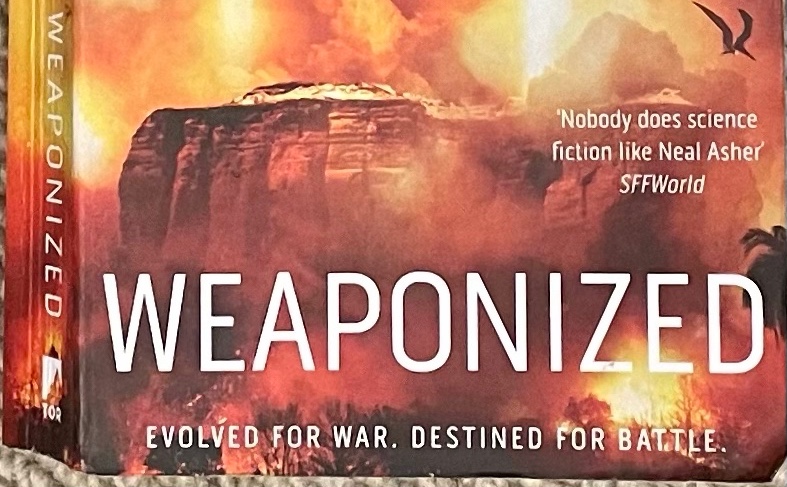
    Reading Weaponized by Neal asher (2023) was a marathon.

    Section of the Front Cover

    There are a couple of Asher’s novels I’ve enjoyed, The Skinner and The Voyage of the Sable Keech, for example, the first two instalments of the Spatterjay trilogy, published in the early 2000s.

    I found those inventive and engrossing. I still think with fondness about the living ship. The Polity novels that intervene between those and Weaponized are set in a human universe ruled by AIs.

    In Weaponized a bunch of human characters from the polity intend to colonize an outer planet. They’re all in their second or third century and are bored. They intend to go back to basics somewhere new.

    Ursula Ossect Treloon is their leader. The plot is a relentless competition for superiority between the human would-be settlers, and the native wildlife.

    Neither of them wins when both appear to be taken over by superior Jain technology, from yet another universe. The end is is circular, a mystery, when a fragment of Ursula is saved by the Polity mole.

    Most of the story is the ‘science’ describing the adaptations that need to be made to continue the struggle to survive an ever evolving enemy.

    And this is an evolution happening at a daily at most week’s pace. The actual plot was told with a series of one liners buried in the almost baroquely detailed descriptions of the technology. Non-stop action as the back cover promises.

    By about a third of the way through, I was wishing for a bit of ordinary narrative, describing the settlers ordinary time. But if anything proceedings notched up, there was never any relief.

    Lego: Bosley & Co, 15

    15. The Bunkhouse

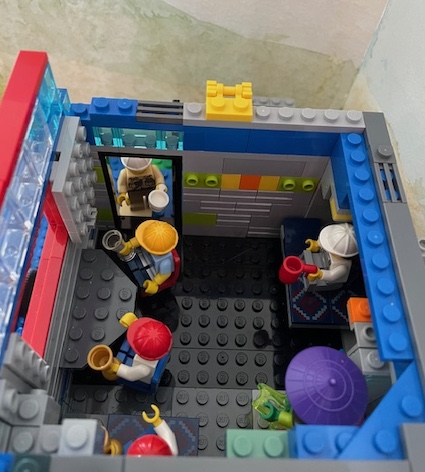
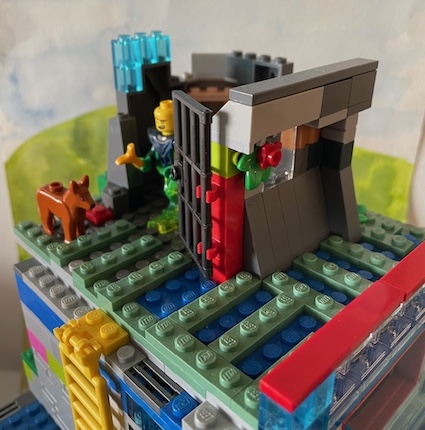
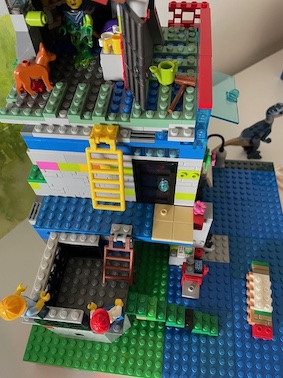
    Finally the day arrived when Bosley felt ready to put together the bunkhouse. He now had all the necessary elements stored here and there, and there was no reason, not even inclement weather, to hold off any longer.

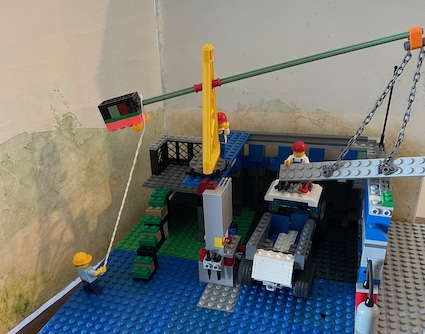
    He, Drew and Dan and Dan’s trusty four-wheel drive moved the components of the shadoof to the garage. While Drew helped Bosley put the shadoof together, Dan fetched the front beam to tie the side walls together and support the roof over the garage.  

    Drew and Dan between them managed that hiccup without Bosley’s input, though none were happy with the lack of control over the vertical movement. “Which is the bit that does the lifting, after all,” Drew said.

    “Hmm,” Bosley said. “Think I’m going to need a lever. Have a holiday, Dan. It’s back to the drawing board.”

    Dan went away and a little while later returned with Nin Wiz and the most northerly wall balanced on the truck. They stood it ready. Went back to fetch the south wall. Bosley and Drew took the shadoof arm off the upright frame and threaded a lever handle onto it. Stood the contraption back up.

    With Nin Wizard supporting the walls as they were raised, the work proceeded so smoothly that Drew quite forgot to take the snapshots they’d decided on. He only remembered when Bosley said, “Stop. Wait.”

    “What?” Drew said.

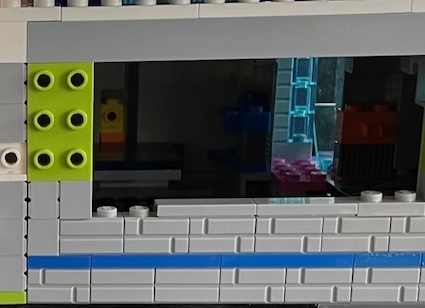
    “I’m not happy about that window hole,” Bosley said. He pointed.

    “We only have windscreens and French doors in our window store,” Dan said.

    “Fine,” Bosley said. “In making do, we’ll invent something better.”

    “We’ll sling a tarp and sleep up here,” Dan said. “I like what you did in the corner.”

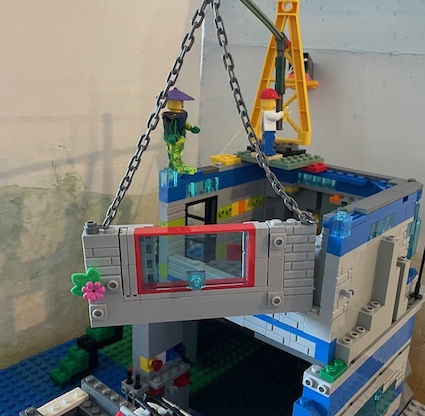
    Next morning, while Dan, Drew and Nin raised a further two courses of bricks on the walls so that people wouldn’t hit their heads on the ceiling, Bosley invented his preferred front window using a glass door on its side and a few modified blocks.

    After re-installing the shadoof, the front wall was lifted into place.

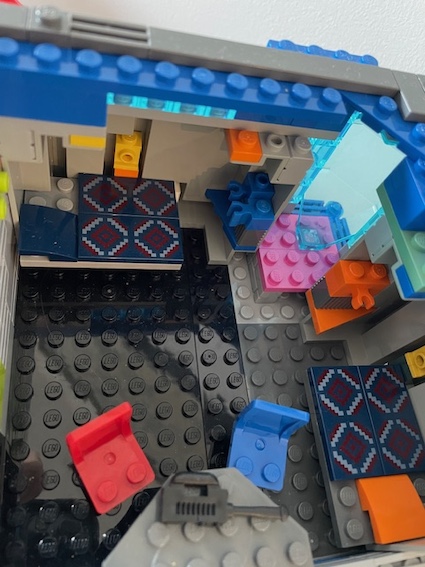
    Then the furniture, with Drew back on the drag-line.

    “Let’s celebrate!” Trish called. She brought a stack of cups and mugs while Tim followed with the bubbly. They admired the bunkhouse, Bosley & Co’s first permanent dwelling, and partied into the night.

    And after they went to bed, nobody got any sleep, Nin Wizard so busy with his build.

    Clatter bang rattle! Something fell a long way down.

    “What was that?” Dan grumbled.

    “You’re all right,” Drew said. “Sleeping in the bunkhouse. I’m just lucky it missed me!”

    Next morning, they one by one climbed the two and a half ladders to compliment Nin on his new abode, and exclaim politely over the corner-post that had clattered all the way to ground-level.

    Nin shrugged. Ran out of magic, he indicated. Only Trish stayed to plan the new bathroom annex and her and Nin’s share-garden, and have a cup of celebratory tea.

    About Lodestar

    About Lodestar Part IV
    Lodestar, up to this point, was written from more or less one viewpoint per part.
    This fourth installment is in effect a series of short installments (novellas, probably) where some of the main minor characters are sidelined and others drawn forward. One or two important characters are only just now being introduced.

    The various people whom I asked to critique the series fifteen years ago, advised against introducing important new characters at this late stage. I thought it through at the time, but quailed at the work involved in the restructuring. Put The Lodestar series aside. Years passed while I worked on a new series. Different, I thought.

    But my ‘unconscious’ a marvelous entity I am only now learning about, was well and truly in charge, and encouraged me to write multiple stories featuring a main character being invaded and controlled by a foreign influence.

    I’m laughing now when I read those lines, knowing that I am absolutely ruled by my unconscious, as you are by yours whatever you may believe. Fifteen years ago, I wasn’t writing unknowingly about my own personal unconscious mind, but about an alien, about an invasive computer program, and about the implant.

    Without me realizing, which is the part that still amazes me. Until I had three mostly polished novels, ready to be professionally edited. That’s when I realized. At the time I was poor and troubled, and could afford to have only one of them edited professionally. So I decided to forward the most recent work, which was ‘Mongrel’.

    Five years ago my life fell apart as long-time readers will know, and after the chemo, when I set about picking up the pieces, I decided I was done with marketing. The stress of dealing with giant corporations was not doing me any good. I decided that life is too short to hanker after the pittance that I would earn for not writing in the mainstream.

    That’s not to say I won’t publish them at all. They’d be a lot easier to read as novel lengths than a chapter at the time.

    Fast forward to the idea of the ‘story-debt’. It really grabbed me, for after I labored over The Lodestar world for ten years, its characters and their lives stayed with me. It’s like they are real people somewhere out there. I wondered if by paying off my story-debt, by ‘publishing’ them here, on my blog, these characters would then stop haunting me?

    t’s a work in progress. Below a snippet …

    The Implant, 1
    ‘I can almost feel the textures of the nutrient jelly I rest in. I’ve imagined them so often it must be that I now feel them. The heat of my skin melts the material near me, making it silky and fluid. It’s firmer further out. A spider webbing of fibrous supports grows among and between my miniaturized cables.

    Fresh nutrient mix is added to the bottom of my housing, its floor is gridded and sits on a saucer, the whole is very like the design for a bird-feeder I have somewhere in my memory banks, though the action of the nutrient mix is opposite to that in the bird-feeder.

    I don’t like remembering that I don’t have a skin and that I still don’t have a body. It is not my imagination that I feel a frizzle of anger pass along my synapses. If I’d had a body to use, I would’ve been able to express myself more satisfactorily. Where is that minx Ahni? The speaker fitting is clogged and I cannot call out. I’m not happy with the level of carelessness in this place. Who is on duty? I shouldn’t have to worry about utilities. That was always the work of the host.’