Spring …

The season has been very busy in these climes for most of August, somewhat earlier than the calendar announces it.

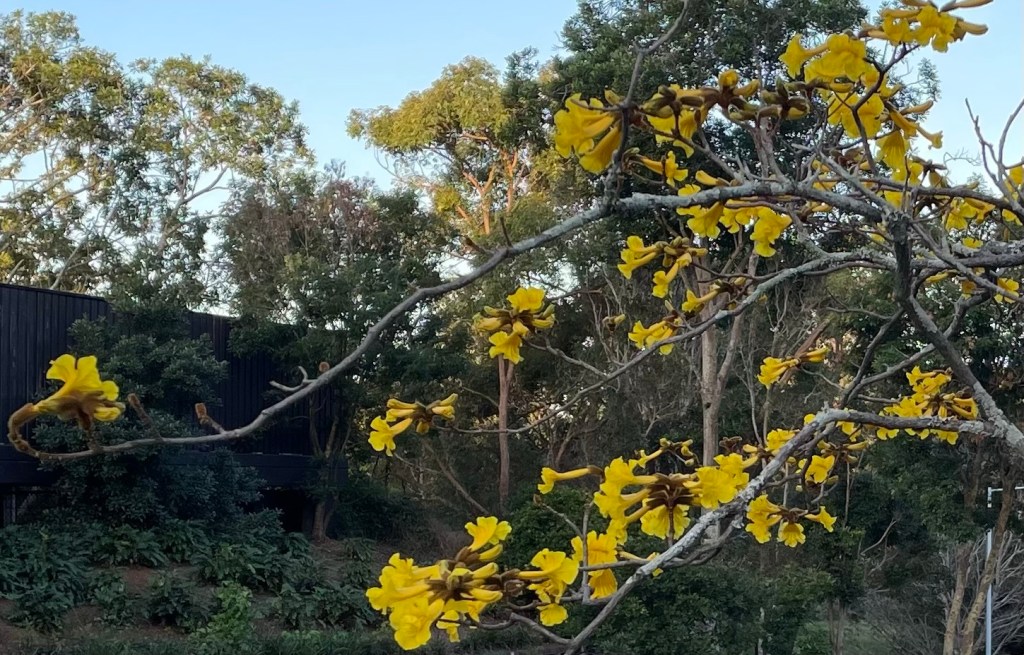
This delightful show of gold along the verge at the entrance to the complex.

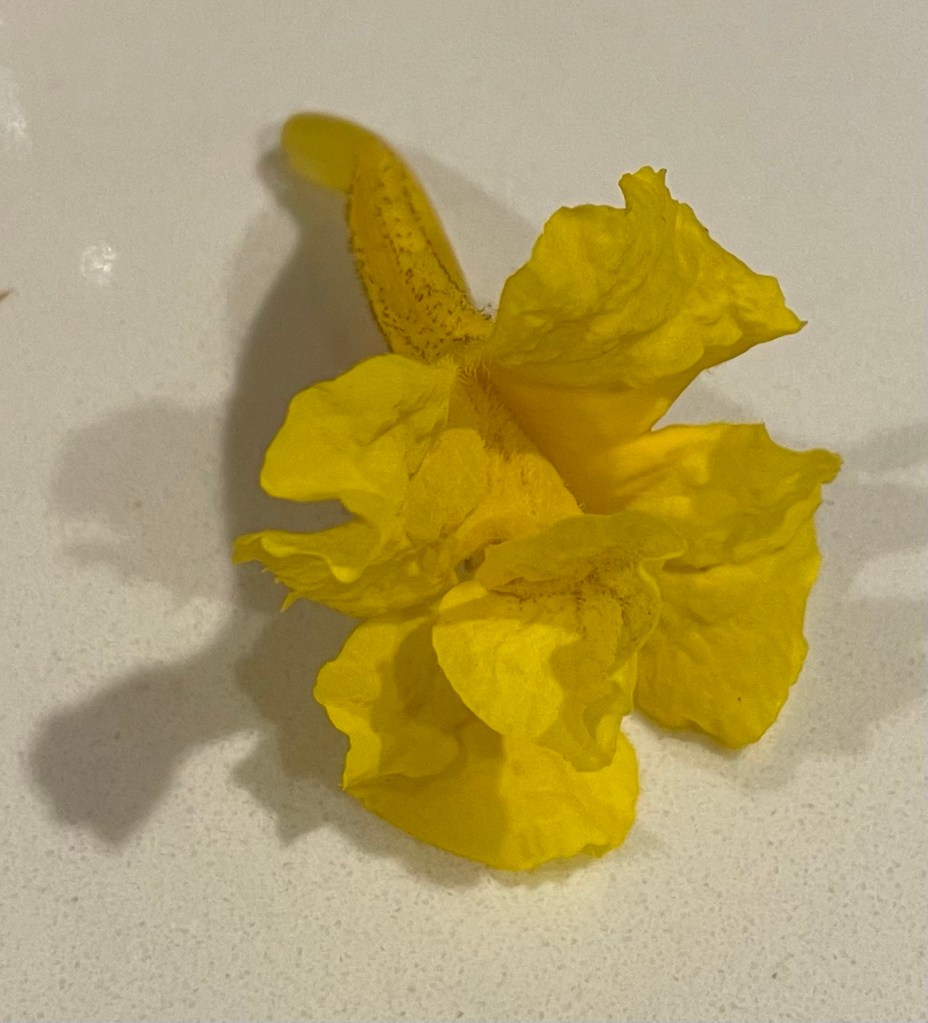
One of the flowers … vaguely funnel-shaped with an extra fold in one of the petals. I picked it up from the ground, so it’s a little battered.

It’s the third tree flowering along that verge, as if they calculated the sequence to put out their blossoms. The first was mauve-pink, then a pink, now this yellow.

From my balcony, it’s possible to hear—if not see—the scraping complaints of young Torresian crows waiting to be fed. I suspect the Carindale crow ‘murder’ calls the trees in in the Carinya grounds their home.

Cat Diary 4

Would you belive I’ve been here for almost two weeks?

This is me at my breakfast. The old woman gives me canned salmon for breakfast and dinner. Sounds special, I know. She thinks I’m too bony, the breeze will blow you away she said.

But she gives me titbits to try out at lunch time and if I don’t like them she’ll hide them in the fish at dinner time.

The other day I ate a scrap of omelette I’d politely left at the side of the bowl. She does not take no for an answer. One on her scorecard.

Mind you, I had a bit of cooked chicken today and it was delish. Bring it on. Right mow she’s out there on the balcony.

At her gardening. Where’s the garden I might ask, when it’s just leggy plants in pots, so elongated they might run away. We’re waiting for grow-lights to come in the post.

Reading: “The 2084 Report” by James Lawrence Powell

A gripping read, I think partly due to the verifiable facts often quoted with present day or historical dates attached to them.

Although promoted as fiction, it’s worrying when you’re reading about increasing bushfires in Australia, for example, the fires in 2019 (!) are part of the story.

And that’s only one incident among hundreds. most events that happen in this account have their verifiable roots in the last decades of the 20th century and the first two of the 21st century.

And by 2020, Powell posits, it all already was too late. Even if by some God-decreed disaster, CO2 emmissions had stopped right then … four years ago … it was too late to stop or even ameliorate what he calls the baked-in effects of global warming.

This book is powerful enough that I will change my political affiliation and vote for the party that promotes nuclear power.

The final and short chapters in the book “Look to Sweden” twice. Sweden turned to nuclear power starting in the 1970s and was able to ride out the cascading avalanche of effects because of having enough power … presumably to power aircon and grow enough food indoors to keep their population from starving.

By the late 2010s, 10% of the world’s electricity was produced by 449 power generating reactors in 31 countries. the final chapter describes why nuclear failed in the story.

More than two dozen countries, including the US, China, Russia and India had says the author and have say I, the necessary experience and controls to build enough nuclear power generating reactors between 2030 and 2050 to limit global temperature rise to 2 degrees Centigrade or 3.6 degrees F.

Yep. I know it’s supposed to be fiction but I call it a thin veneer of fiction tieing together the masses and masses of facts into a palatable account of what’s facing us.

I doubt I have another ten years, but there are all you and you, my kids, and grand kids. Go read this book. Hate what happens to your country. Do something about it.

The Westerlies

The first day of the westerly winds? If it is, then they are about two weeks earlier than expected.

In the past it was the August Westerlies people talked about. The coldest weeks of the year. The westerly winds come straight from the mountains picking up the scent of snow and ice crystals and frost.

A parade of weather fronts coming from the west.

‘Seared in My Memory’ …Part One

Was thinking this morning about the four countries where I’ve lived. I’m not counting England/London because it was more like a long but intermittent stay of about a year.

It struck me that I have a series of images and sensations that come up for each country every time I think of anything to do with that place. And it’s like I must acknowledge those moments before any other thinking can get going.

Next I winnowed through each series to find the single most important moment to me. Came up with four moments that are seared in my memory.

I was born in North Holland, in the Netherlands. When I was about six years old, my father took me ice skating. A local farmer would’ve flooded a field for a hard winter freeze to turn into a skating rink.

The only thing I remember was how I fell over and between my hands on the ice saw a bright yellow dandelion flower set among a three of sap green dandelion leaves in the ice. Lifting my gaze a little, I understood there this ice skating rink was.

That little flower encased and covered by ice is my primary memory of my childhood. When I think of my early years up to age ten, that little flowers is always the first thing that comes to mind.

In Indonesia, where we lived next, for a ‘big’ year as my mother used to call it (about fourteen months) the moment that stands out for me was a moment of the half hour I spent utterly alone sitting on a large rock in a nearby creek (kali).

Rainforest lined both sides of the little river with no paths that I could see. And anyway, the way back was rock-hopping over the stones till I came to the place where the village (kampong) women washed their clothes.

The hot blue sky above pressed me down on the rock and I sat with my feet in the water. I don’t recall wearing shoes. A couple of rocks furter upstream, a log seemed to come alive. A large lizard, probably of the goanna tribe, dipped its fore half down into the water. To drink I thought.

But no, it slid all the way in and went I don’t know where. I’d risen as it slid down. I hovered waiting to see where it would come up.

All I recall next is the rock hopping way back, and that I was wearing a white drill cloth dress with embroidery round the hem. For heaven’s sake, I think now, why a white, embroidered dress to muck about in?

Fast forwarding now to Australia, where we arrived in late 1959. It’s difficult to extract just the one outstanding moment here. I grew up north of Sydney and then spent six years in New Zealand.

Since I returned until now I’ve lived a variety of different kinds of life. So I think I’ll honour them all, all those different lives in a separate post.

New Zealand is the first country where my soul felt at home. I haven’t worked out yet why that is. Many of my fictions are set in an amalgam of New Zealand/Aoteoroa that I called Leaf Island.

Which is a fictional island rising from the edge of the actual submerged continent Zealandia, about halfway between present day New Zealand and Australia.

My adventures in New Zealand in the early 1970s took me to a small dairying community at the base of the Urewera Range. The whole two years I lived there, I wanted to go up into the Ureweras and explore the wilderness. But I would need a guide. Someone who was native to the place.

Hard to meet for a shy new pakeha (White resident of NZ) woman when most of the Ureweras were owned by Maori.

I met a man who might’ve taken me on his last day in Murupara before he immigrated to Parramatta in Australia where he had a job. On my last day in the valley, I drove to the foot of the mountain.

The plain was flat. The Urewera Range rises steeply out of it without foothills. I parked my car in a newish gravelled carpark. Walked to the mountain. Afternoon light burnished the low heather/montane vegetation.

I put my hands on the earth and soil in front of me as if I would climb up. The slope was between 45 and 70 degrees from the horizontal I remember thinking.

I didn’t climb. Stood there with just my hands spread pressing into the thin soil backed with the stone of ages. A shield wall at the edge of the Mt Ruapehu volcano’s caldera. When I think mountain, that’s it, the Ureweras. An ongoing mystery.

When I woke I lifted my hands from the almost vertical ground taking care not to dislodge the little shrubs and miniature grasses. The sun was well down in the west, a glowing ball on the western horizon.

No other mountains have owned me the way the Ureweras own me. They are the most numinous landscape in my mind.

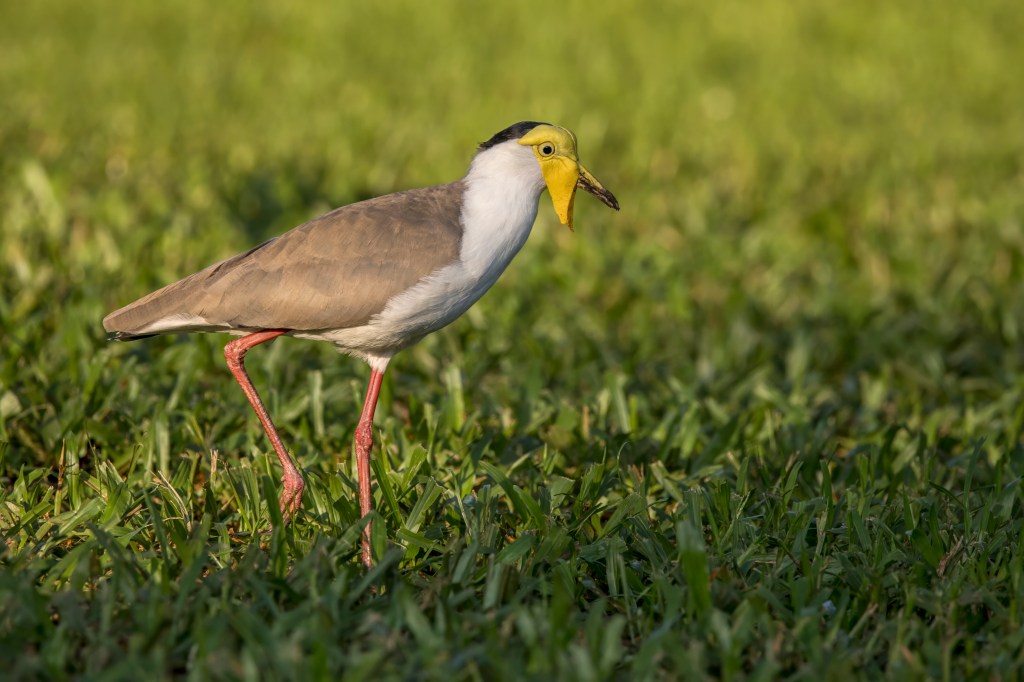
Plover aka ‘Masked Lapwing’

By Charles J. Sharp – Own work, from Sharp Photography, sharpphotography.co.uk, CC BY-SA 4.0, https://commons.wikimedia.org/w/index.php?curid=145114385

These last few day, whenever I walk into the bedroom for something, I stop and stare out through the windows at a little place on the grass beyond the podium at the plovers nesting there. Pronounced as ‘pluvvers’ according to a long-time Brisbanite.

My camera really does not do it justice so here’s where your imagination must come into play. [If you want to have a go at zooming in? The bird is sitting a little below the third panel of fencing from the right. All you will see is a little brown blob.]

In the last few days, I’ve only seen a couple of intrepid people take the concrete path from the podium across the grass to the old village. One of the dog-walkers had an angry, swooping bird follow them from one end of the path to the other. And, these birds are said to have a poisonous spur on their “wrists” … they have the spurs but they’re not poisonous.

“Breeding usually happens after the winter solstice (June 21), but sometimes before.” Quote from the Wikipedia article. Spot on. The birds began sitting seriously about four days ago. It’ll be interesting to see how long they take to hatch the eggs, as there is no info on that in my bird book or in the Wikipedia article. Today I was lucky enough to see the change over of parents a few minutes after dusk.

The chicks will be dependent on the parents for protection for about 5 months. I can’t see there being enough food (insects and worms) in that grassy area for that long, but if it does happen to suffice, I hope we residents can stay patient enough to see the chicks to maturity.

Talk about counting your chickens before they hatch! The Wildlife of Greater Brisbane tells me suburban birds rarely manage to hatch their eggs. Dogs, cats, foxes, humans … all of them disrupting and chasing and some of them predating. That’s being glum, of course. I did read that the Brisbane Snake Catchers as well as catching and relocating snakes, relocate plover nests. That has got to be a huge operation. Two large angry birds defending four eggs on a flattened bit of grass?

https://snakecatcherbrisbane.net.au/plover-management/

Just checked them and nope, they don’t. But they do give contact details to licensed plover catchers and a link to a neat “404 page IE a page not found”. [This latter will go into my collection of 404’s.]