Reading Project, 14

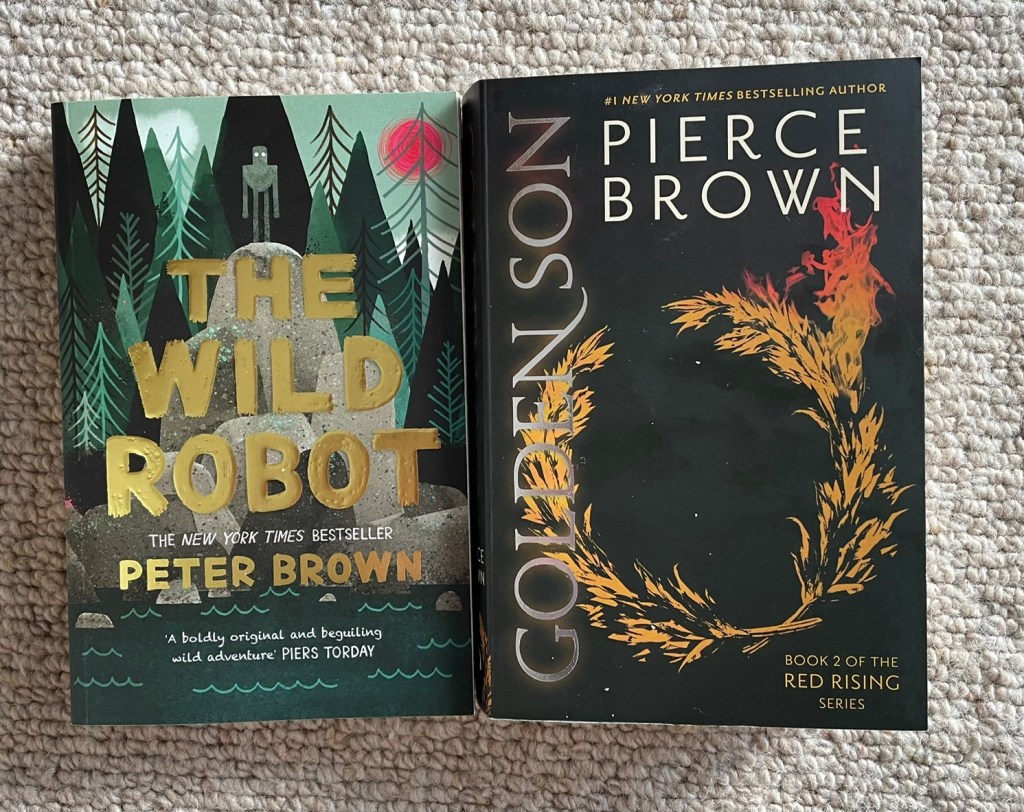
Just two of the books I read, the others I have already passed on.

After I reading the two navigator-explorers, Captains Cook and Flinders, I was ready for a bit of fiction. My SF reading buddy and I had been saying for a while that we needed a new series to get our teeth into, and couldn’t find one. With more time on my hands than he has I sourced a few 10 Best XYZ lists. Noted two or three series that all appeared on several lists.

One fine Saturday when I was grocery shopping, and then intending to look for a birthday book suitable for a nine-year-old, saw a 50% Fantasy and Science Fiction Sale at QBD (referring to Queensland Book Depot, I’m assuming).

Lol, what QBD apparently did, was mark down to 50% all first parts of series, leaving the rest of the series at the normal price. So I walked out with the book gift and three first installments of their respective series each of those between 10 and 12 dollars. How can they even produce books that cheap? Our idea being that which ever of the first installments catches our interest, we’ll continue with.

Book 44 … Mistborn, Book One of the Mistborn Series, by Brandon Sanderson, this edition published by Gollancz in 2009.

Mistborn was the first one I picked up to read. I’ve read somewhere it’s being turned into a feature film and thought I should read it before I see it as films rarely improve on books.

I find Sanderson tooth-grittingly hard to read. In my middle life I spent ten years editing undergraduate essays, an experience that has left me deeply disinterested in reading poorly phrased prose and Sanderson loves “thin alleys”!

What’s wrong with narrow alleys? And that’s just one example. I can’t believe Mistborn is being touted as literature!

Seems that I’m not alone in this, I was happy to discover. When I am alone in a complaint, there’s always the suspicion that I’m being elitist, or fussy, or or or … This time though, several Reddit commentators are of the same mind. Although one of them thought that Sanderson writes ‘flat prose’ purposely, to attract the largest possible following. In answer to that I say that George R R Martin, among others, didn’t have to resort to flattening his prose to attract a large following.

But flat prose aside, Sanderson’s ideas and inventions are fresh and capable of sending their stories into new unusual directions. Though this is not enough for me to want to read part two or more.

Book 45 … Red Rising, by Pierce Brown, first published in 2014 by Del Rey, an imprint of Random House.

Pierce Brown is one of the ‘many others’ I mentioned up there. No ‘flat prose’ in sight. This is one of those books where I hardly noticed I was reading. Some Reddit commentators have mentioned the many many short sentences and how they distract from a good read.

Others say short sentences are what makes audio books an intense listen. Oh, I thought. Audio. That’s why the short sentence style is taking over public writing. And plus, AIs seem to like it.

Red Rising read like a breath of fresh air to me, I never had to wonder what the author meant. Yes, it was a gallop. The worldbuilding, a society organized by colors and partly structured by a Roman underlay, go hand-in-hand with the plotting, and are frenetic.

Though it’s true that Darrow, the main character, is a bit of a superman, and always comes out on top despite his sometimes mistaken beliefs in the goodness of others. But never mind. I’ve read that this is the weakest of the series. If I can trust the commentators, things can only look up.

Book 46 … The Wild Robot, by Peter Brown, first published in 2016 by Little, Brown and Company, an imprint of Hachette.

The Wild Robot is the birthday book. A film is already out there and I think I’ve seen it. Which probably helped me choose the book. This is the story of a robot becoming marooned on a deserted island, and learning to live with nature, or part of nature. It seems a little moralistic but was the best that I could find without reading everything. Lol.

I despise books written purposely to teach kids morals. As if they aren’t learning them from their parents. Kids famously learn their morals by watching how their parents behave and behaving just like that. Teaching kids morals is like teaching fish to swim.

It’s increasingly hard to gloss a bookshop’s shelves for good kids’ books. It seems to me the golden age of children’s literature has gone the way of many other good things. I think Rosemary Sutcliffe’s books could do with reprinting. Penguin Books? Anyone?

I have quite a few of the really good middle grade fictions on my shelves still (some of which are forty plus years old, I confess) and although some of them are being reprinted—The Little House Series and The Rats of NIMH, for example—many others have just disappeared.
In the past, kids read about animals and their lives. Historical fictions. None of them around now. Too many good film documentaries, I suppose.

Book 47 … Golden Son, by Pierce Brown, first published in 2015 by Del Rey, an imprint of Random House.

Lol, this is not one of the three firsts that I bought. I couldn’t resist going in and buying Part 2 of the Red Rising Series. I guess I’m hooked.
However, it’s been a couple of weeks since I read Golden Son and a lot of Real Life, eg a light fling with Covid, has happened in the meantime. I will have to read Darrow’s doings again for the detail as I now remember very little as I raced through chasing the plot. A bad habit. The plot is intricate, detailed, a lot happens, there’s non-stop action.

At the end, I do remember thinking, with all that happened, and all the mysteries that have been outed, what is there left to say? How can there be all the subsequent installments? Is he going back to the beginning and start a whole lot of new threads? Re-inventing himself, no doubt.

Well, I just read a couple of articles on Wikipedia. Apparently Golden Son is the second installment of a trilogy. After Morning Star, the third one, there will be a second trilogy to make up the six books in the series so far.

I’m not sure whether I have enough puff to read any more in this arena after Golden Son. I enjoyed the two that I read, but it sounds like the next four are more of the same. And I’m pretty sure Darrow will win, somehow.

Reading Project, 13

Book 39 … The Wide Wide Sea: The Final Fatal Adventure of Captain James Cook by Hampton Sides, published by Penguin Random House UK in 2024.

My SF reading buddy and I also read non fiction such as explorers journals and accounts. To my mind, the idea of journeys in the sailing ships of yore have a lot in common with the imaginary journeys in the spacecraft of fictional futures. Both seem equally impossible from the point of view of this modern day and age.

The Resolution, Cook’s ship, was about as long as two school-buses parked end to end. Got that from Google’s AI, a useful comparison because who knows what 110 feet 8 inches or even 33.73 meters looks like? A width of approx 35 or 11 meters, so quite a lot wider than a school bus. I don’t know how many decks.

That 110 people, sailors and scientists, stuffed themselves into a ship like the Resolution, along with all their stores, living animals, and gear to repair and and maintain the ship while underway, and make a three-year journey seems almost as impossible as some of the journeys described in science fictional accounts.

Hampton Sides wrote this account seen through an American lens. Gives a completely different flavor than when I read Australian authors writing about Cook’s first two voyages. Americans are very invested in the Captain James Cook of his third voyage from 1776 to 1780, with him killed in February 1779.

Presumably because he died in the Hawaiian Islands, now part of the US, as a result of an altercation with and or misunderstanding by the Native people there. Much is made of Cook’s supposed illness. In comparison to Cook’s fair dealings with his men and with the native people they met during the first two voyages, the worn-down 52 years old captain seemed to be a changed man in his third voyage. Many writers seem to think he had a mental illness though none that I read was game to say what they really suspected. (Altzheimers? Some other breed of dementia?)

The whole story of the third voyage was new to me. I was very hazy on where Cook met his demise, I thought maybe Tahiti. I had no idea he was the first European explorer to see the Hawaiian Archipelago. All in all, an interesting account.

A few facts that stayed with me. Captain Cook’s journeys lost men overboard, falling down the masts from great heights, killed by furious islanders, taken by sharks but he never lost a man to scurvy, a sea-going disease that was a blight of that time. More men lost their health, their teeth, and their lives from scurvy than any other cause except war. But Cook had it nailed. He forced his men to drink lemon juice and eat sauerkraut.

Book 40 … Flinders by Rob Mundle, this edition published by Hachette Australia in 2012.

This is the book I intended to read earlier in the year with Matthew Flinders’ Cat. (Book 10) I learned more about 18th century sailing in this book. The author, Rob Mundle, is a sailor himself, and also can phrase the technical detail of sailing in the past in words that a landlubber can understand. Another excellent feature is the glossary. Lol, finally learned what ‘belay that thar rope!’ means.

I thoroughly enjoyed reading about the circumnavigation of Australia, and Flinders’s other explorations from 1791 to about 1803. Interestingly, Flinders and his crews suffered from scurvy and this despite that his hero, Captain James Cook, had worked out the preventative 20 years before. I can only suspect that neither lemons nor sauerkraut were available where he took on stores.

Afterwards is when a world of bad luck hit the man. He was shipwrecked, and when finally on his way back to England to his wife, was imprisoned by the French on Mauritius for six years. He lost Trim there, and lived little more than a year or two after he reached home before dying at age 40. I admit to wondering how Mrs Flinders and their one year old daughter survived after his death.

In the book’s Notes on Sources, I learned that Flinders himself wrote a short story about Trim. A tale I will hunt up.

Book 41 … Re-Visioning Psychology by James Hillman, first published in 1975. This copy published in 1992 by HarperPerennial.

After the above couple of historical accounts I took a bit of time out to re-read Re-Visioning Psychology. “This is a book about soul-making,” says the author. “This is an essay …” he says. Lol, an essay of about 80,000 words going by the thickness of the book, 229 pages not counting the end notes of which there are about 30 pages of close, 8 point print.

Hillman brings Freud’s and Carl Jung’s discoveries into the 21st century. I originally started reading him to learn more about how the imagination works, the imagination that can be seen from within the mind. The metaphoric symbol system for imagination.

Not the nuts and bolts, blood-vessel and nerve bundle imagination read from the signals of an MRI machine so dearly beloved by neuroscientists. I just can’t see what I do in my mind in the machine model. And so I read people like Hillman.

I enjoy reading Re-Visioning Psychology because, although the subject is not easy, the author explains everything. And even when he sometimes uses words that can hardly be pronounced, he explains them too. You’d think this would make the work as heavy as a cement-filled balloon but no, he’ll throw in a little six word sentence where the longest word has five letters.

“Myths do not tell us how.” (P158) is that sentence. It’s about how we can live our lives. “Living one’s myth doesn’t mean simply living one myth. It means that one lives myth; it means mythical living. As I am many persons,” he says. “So I am enacting pieces of various myths. As all myths fold into each other, no single piece can be pulled out …” and described as the myth he’s living. [Had to paraphrase the last bit of the quote as the punctuation didn’t work.]

In my dreams I’ve been Artemisia, an elderly nymph, and a high priestess of the termite people. All bits of myth. And once I’ve worked out my dreams, their maybe-meaning, I can enfold the mythical entities into my real-life story. Lately I’ve been Ariadne wandering the labyrinth of life, and painting it.

Book 42 … Farmhouse by Sophie Blackall, A Lothian’s Children’s Book, first published in Aus and NZ in 2022.

I fell in love with this book while searching for another title. It was in a specials basket, which for a book is one step before being remaindered. The book cover reminded me of the intricate collage art of Jeannie Little so of course had to have a look.

It did not disappoint. It’s the story of a house on a farm and the family of a mother, father and twelve children who lived there. The children grow up and finally the last one leaves. Then animals live in the house, even a bear, and eventually the author buys it.

My granddaughter (aged 6) and I enjoyed it when she was here last, reading it through a couple of times, one after the other. Glad I saved it.

Book 43 … My Dad’s a Birdman by David Almond and illustrated by Polly Dunbar, this book began its life as a play first performed in 2003. This edition published in 2015 by Walker Books.

A kid’s book that I intended for a read-aloud book that when I got it in my hands, turned out to be unsuitable for the intended recipient. I think I sent for it to see more of the illustrator’s work. Polly Dunbar. The story is a child looking after her father with him going through some kind of mental breakdown.

Although there’s a happy outcome, I found it quite a bleak story. I imagine that as a performance, more could’ve been made of the humorous parts.

Reading Project, 12

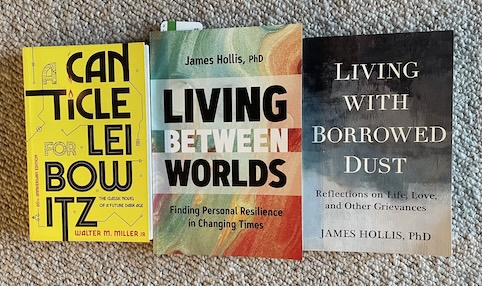
Book 35 … Living with Borrowed Dust: Reflections on Life, Love and Other Grievances by James Hollis PhD, published by Sounds True in 2025.

Had this unread on my shelves from last year. This time the title grabbed me, “living with borrowed dust.” That’s the dust of the stars we are all made of. I’ve read a few of James Hollis’s books by now, and reading this one, started to suspect that he’s regurgitating his material. And that once I’d read one I’d read them all.

That could be true about this one. It’s a kind of a autobiography/memoir—I can’t tell the difference between them. He has this aphorism, “Shut up; suit up; show up!” First time I read it, several years ago, I laughed. But took it on board. This is me, here, showing up in this project I set myself back in January.

When I read the quote above on page 106, I felt vindicated. Thought I should’ve saved my money. Because also in this little book Hollis quotes regularly from his previous books. So it’s hard to understand isn’t it, that my next read is also one of his?

Book 36 … Living Between Worlds: Finding Personal Resilience in Changing Times by James Hollis PhD, published by Sounds True in 2020

It’s an earlier book and while almost the same size, it’s weightier. Chewier. “Living between worlds” … I relate to that. I’m living between worlds, as we all are in the West. Yesterday I watched two thirds of a documentary about life in the climate-challenged parts of the world. Millions of people already impacted. And I can’t even let myself continue thinking about it all—takes too many spoons—I’m not strong enough.

But … This book. The two worlds are our inner struggles and our “modern human existence”. Looking back through it, I see I’ve underlined many sections, a sure sign I wrestled with it. In this book, Hollis is proving to us that we “human animals are equipped for survival”. With creativity, wisdom and connection, he means.

This is the kind of book I have lying beside me on the couch for a few months, to be able to read a couple of pages anytime I feel like I need to work out my mental muscles.

And this book is the reason I began a side project, painting various scenes from Theseus in the Labyrinth. Done two. More planned. Theseus turned out to be a non-hero to me. After he killed the minotaur, he abandoned Ariadne, and sailed off into the wide blue yonder. Typical for a rolling stone?

Book 37 … A Canticle for Leibowitz by Walter M Miller Jr, a 60th Anniversary edition published by Orbit Books in 2019.

I remembered starting to read this a good few years ago but could not recall why I didn’t finish it. Recently, a good friend recommended it—raved about it, in fact—saying it was the best, greatest sf novel of the 20th century. So I bought it since my local library has moved on.

Lol, might even send it to him. After I give my sf reading buddy a go at it though I seriously doubt he’ll be able to get into it.

Couldn’t remember anything about the Canticle after I confirmed it wasn’t the story about the monk who went underground in New Zealand and expected to come out in the northern hemisphere. That was a short experimental film I saw somewhere, also many years ago. I guess I conflated them since they are both about monks.

I can totally understand now why I didn’t finish it. Though, just for the heck of it, may re read it. Maybe next year. It could be one of those books that improves the better you know it. I have to give it that opportunity.

A review in Good Reading calls it a “seriously funny, stunning, and tragic, eternally fresh, imaginative, and altogether remarkable, A Canticle for Leibowitz retains its ability to enthrall and amaze.”

While a review in The Story Graph said: “There is a lot of science talk, but more in conversation/discussion rather than its use. Also there’s a lot of religious style quotes and I hate that writing style. And in general the writing style is boring and at times confusing because of huge jumps in time.”

It’s post apocalyptic, written in the nineteen fifties and probably the author went to war and had surfeit of battlefield memories he couldn’t get out of his head. There are huge time jumps and so there aren’t any characters I could get invested in. It even felt impersonal, like an overview.

Book 38 … The Messenger by Markus Zusak, published by Pan McMillan, this edition from 2023.

Tore through this in a couple of hours, a disappointingly lightweight read. Then learned it had been made into a TV series and can just about see that as a lightweight script as well, if I could be bothered viewing it. (And couldn’t find it for a pic.)

Reading Project, 11

I’ve been in two minds whether to include study and text books in this project.

In October 2023 I signed up with Dream School run by the This Jungian Life group.

For a year, I read course studies and completed online assignments, to start to learn how to interpret dreams. This followed on from months of nightmares and a short stint with a Jungian psychoanalyst.

After the end of the course, I continued with the analyst for another year. Which brought me to late last year. Since then I’ve been reading rather voraciously and, at the beginning of the year, beginning this project.

After I read Book 31 … Bone House by Betsy Tobin I was at a loss. Though I have plenty of other books lying around, a dozen un read and many many that could do with a second or third reading, I was feeling jaded. Like it was the end of a holiday.

I felt like I needed some chewier fare, a project with a bit of heft. Picked up MDR by Carl Jung, having had it on my shelves for about a year.

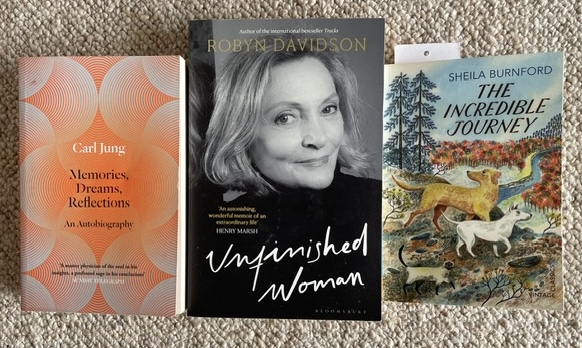
Book 32 … Memories, Dreams and Reflections: An Autobiography by Carl Jung translated from the German by Richard and Clara Winston, published by William Collins, a paperback edition in 2019.

This is not a book you can just read in one sitting, or even a week. It took me well over a month, the whole of May, I might as well say, there being plenty in it for me to think about.

When I started having nightmares back in 2023, I had already thought that I needed a way to think about what was happening in my mind. I wasn’t happy with the physical world of neuroplasticity, MRIs of people’s brains firing, the whole kit and caboodle of studying flesh-and-blood brains and what looks like is happening in them, and thinking that that is the be-all-and-end-all of how minds work.

So when I fell over Jungian dream interpretation by way of the This Jungian Life podcasts, I was stoked. Seemed to me that this was the lyric metaphoric way of thinking about what happens in minds that I could relate to. Been in that mode ever since.

(Stoked is an informal adjective meaning to be highly excited, enthusiastic, or exhilarated about something. Originating in surfing and skateboarding slang, it shares the same root as feeding or fueling a fire—meaning your energy and enthusiasm are burning brightly, Google)

Memories Dreams and Reflections, MDR for short, is both Jung’s autobiography and an account of his studies and discoveries. Despite what many people think, he went about his project of exploring what happens in our minds in a scientific way. He describes his experiments and the empirical results.

He named the personal unconscious that we all have, and discovered the deeper, archetypal unconscious we all have.

(Archetype is a Jungian psychology concept of an inherited unconscious predisposition, behavioral trait or tendency (“instinct”) shared among the members of the species …Wikipedia)

And then spent the rest of his life exploring how the unconscious works with the ego—your conscious mind. But he was writing in the early third to half of the 20th century and his turn of phrase, if anything, is quite esoteric, readable by only a small number of people, and somewhat turgid for the likes of me. I knew I would have to search out those interpreting him for more modern readers. And plus, I knew also that I’d be reading some light relief.

Book 33 … Unfinished Woman by Robyn Davison, published by Bloomsbury Publishing in 2023.

Picked this up from down in the Vista foyer where there’s a long shelf under the parcel bench, dedicated to memoirs, autobiographies and some histories.

Lol, love all these prepositions one after the other “up from down in” … makes sense, I hope?

The same Robyn Davison who lived Tracks and then wrote it. From the back cover, “In 1977, 27 year old Robyn Davison set off with a dog and four camels to cross 1700 miles of Australian desert to the sea.” I had that book for years. Don’t recall where I picked it up, second hand while traveling that same desert probably. Camp laundries are the best places to pick up good books.

I already had a soft spot for camels and loved the desert. I read that book more times than I can remember.

Davison was born on a cattle station, is quintessentially Australian, and the first modern woman explorer I read about. My heroine the minute I read about her. This memoir, about the forces that set her up to wander, to travel, to always be on the move, is a gripping read.

A poor childhood, her mother suicides, and Robyn thereafter is raised by her father and older sister in an outer Brisbane suburb. She was in London for the first time roundabout the same time I was in London.

After that she goes on to do all the romantic-sounding things that women in those days usually only could read about. Marrying an Indian prince. Living in London and writing. But, you know, there are always costs.

Book 34 … The Incredible Journey by Sheila Burnford, first published by Hodder and Stoughton in 1961. This copy by Vintage Books in 2013.

Bought this for a ninth birthday present and read it hoping to discover whether it could still rip my heart out. So many books written in the past lose their numinosity when set against more modern texts. Realizing this is a function not only of the language they are written in, but also the culture that nowadays washes through our minds.

It has this in the front as a prologue…  

The Beasts by Walt Whitman (1855)
I think I could turn and live with animals, they are so placid and self-contain’d,
I stand and look at them long and long.
They do not sweat and whine about their condition,
They do not lie awake in the dark and weep for their sins,
They do not make me sick discussing their duty to God,
Not one is dissatisfied, not one is demented with the mania of owning things,
Not one kneels to another, nor to his kind that lived thousands of years ago,
Not one is respectable or unhappy over the whole earth

Sounds modern, doesn’t it?

— — — —

The first three pages are a description of the setting, which I suspect may largely be skipped when reading them aloud. But still, the setting hasn’t suffered from the encroachment of modernity. I suspect only if you live right there will you know of the depredations of industries such as milling, mining and road-making.

The three animals are introduced in the next chapter. Two dogs and a cat. They’re being cared for by a friend of their human family and his housekeeper, Mrs Oakes, while their own family is overseas. A couple of weeks before the family is due back, the animals take off for home.

A distance of about two hundred and fifty miles separated the animals from their home, with plenty of dangers along the way. Bears, porcupine, floods, cold, snow, irascible farmers with shotguns. As well as just enough kindly humans to help the animals along.

I thoroughly enjoyed it. It hasn’t lost anything in the years since I read it to my nine year old. It’s a famous story. Disney made two movies of it, but to me it’ll always be a favorite read. And by that I mean a text I take in with my eyes.

Reading Project, 8

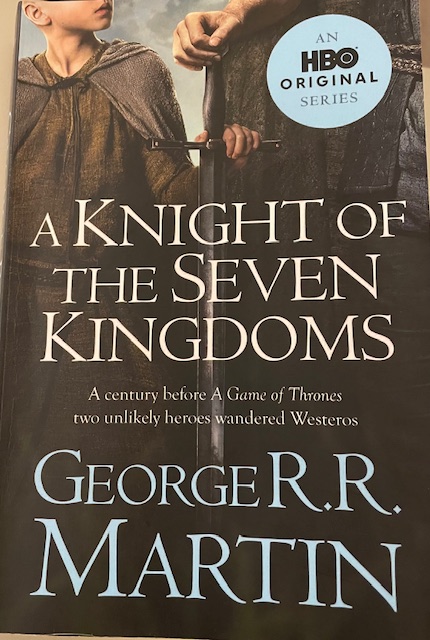
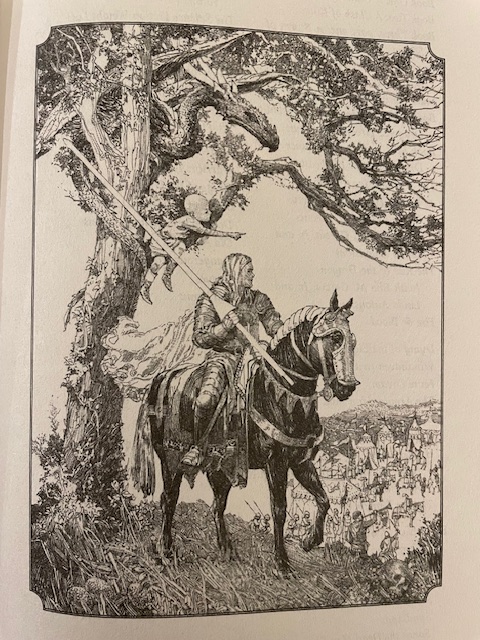
Book 21 … A Knight of the Seven Kingdoms by George R R Martin, with illustrations by Gary Gianni. This edition, being a collection of three novellas, has a complex publishing history but as a collection it was first published by Harper Collins in 2015.

After I saw the HBO TV version, I wanted to read the original, as print novels often are better at showing the complexity of characters. Which was a good move, for as well as the first story, The Hedge Knight, that the TV series is based on it, it gave me two more stories, that presumably will be televised in the goodness of time as installments 2 and 3.

A hedge knight is a knight not sworn to a lord or having land—such as Ser Duncan the Tall—and I guess would be equivalent to a ronin in the samurai tradition. Both are men who wander their countries and offer their swords in whatever battle that will give them food and shelter for a time.

Dunk (short for Duncan) is a young, tall, strong and inexperienced knight wandering the Seven Kingdoms with his squire, Egg. As soon as I read “Egg” I recalled Maester Aemon at the Wall in Westeros ( A Game of Thrones) talking about his younger brother Egg and spent quite a bit of time wondering how that worked. Forgetting that with the right question (ie prompt) Google’s AI would tell me in seconds.

Which it did. Aemon was two years older than Egg and Egg will rule as Aegon V. At the time of these stories Aemon is apprenticed at the Citadel learning to be a maester and he will serve at The Wall.

You have probably guessed by now that I am a Game-of-Thrones tragic. And you are right. I have the book series on my bookshelf. I was a member once of a huge fan club, forty thousand plus fellow tragics, industriously discussing all aspects. Though they worked out the Jon Snow is the son of Rhaegar Targaryen and Liana Stark puzzle and I still don’t know how. I confess I just took their word for it, never could find the proof in the books.

All this is getting side-tracked from the book I’m talking about, but have the excuse that the these stories brought it all back, because it is all connected. Reading it the first time round, it seems like a light read, though the battle at the tournament is quite complex. I had to read that a couple of times, nailing down who fought who and who bit the dust.

But wait, why am I saying it’s a light read? I’m changing that. Only the first story was a particularly light read and I suppose the fact that I already knew the story visually meant I just glossed the imagery in the words.

That’s the problem with visual media of all kinds and reading books after seeing related shows. By feeding viewers with media-ideas for what things look like, viewers who are also readers tend not to read stuff that will clash with pre-“recorded” visuals and as a result miss out on a lot of good metaphor.

Such as … “The spiked ball whirled round and round the sky and fell toward his head as fast as a shooting star. Dunk rolled.”

That didn’t happen in the tv series. Someone else wielded the spiked ball and not at Dunk. Why I can still appreciate it. The other thing to appreciate is a character’s thoughts. … I failed them. I am no champion. I’m not even a hedge knight. I am nothing…

I don’t mind those thoughts, they’re what anyone would think in the situation. But … He never saw dunk the lunk, though, did he?… the twenty-five times that Dunk thought that of himself … that grated on me after the fourth time. (Maybe not twenty-five, just felt like it.)

In the next story, The Sworn Sword, (p119) there’s less introspection as there is more interaction between Dunk and Egg. They are on the road, traveling to their next meal.

This story is book-ended by the two corpses hanging in a cage at the cross-roads where Dunk and Egg stop for a minute for a break and again on their way out. They’re to deliver a barrel of wine to a place called Standfast and happen to stay there, to help the inhabitants get out of a scrape they have with their neighbors about water rights, a complex quarrel. Dunc ends up fighting the opposition’s champion.

The third story is The Mystery Knight (p233). Coming away from Stoney Sept, Dunk and Egg are well supplied. As they near a town, they first see a traitor’s head on a spike on the town walls.

Two and a half pages of Dunk’s ruminations follow, about a law that allows septons to be decapitated for merely talking because … “words are wind” after all … he says. Egg puts his thoughts in where applicable and the whole is one of Martin’s stylistic manoevres to thicken up the story line with historical descriptions including the Targaeryan succession through Bloodraven.

Six days later they arrive at a ferry crossing. Here, again, as they ride toward the inn nearby, there are possibilities of informing the reader about money, as in how little they have, “twenty-two pennies, three stars, two stags, and an old chipped garnet, ser …” Egg informs us and Dunc.

All three stories give the feeling of meandering. The pace is slow while Dunc and Egg are traveling, they are on horseback, with the horses probably walking. Fights are fast blow by blow accounts of action.

Between the slow travel and fast battles unfold long sections of story needing close attention. There’s a lot of detail being slipped into every paragraph. Story-pearls are being seeded in at all times. Early in the story we learn about Bloodraven’s history. At the end we meet him, and learn that he is Egg’s cousin.

I found this book in the YA fiction section in the bookshop where I bought it. The book is probably classed as young adult fiction due to the single story line, the youth of the POV characters, and because it is illustrated.

The amount of detail in it, though, suggests an adult read. Words, phrases, clauses and sentences all contain seeds and reminders that these stories are part of the whole rest of the Westeros culture. It’s one of those books I read fast for the plot and again, slowly, for the complexity.

.Illustration by Gary Gianni.

Reading, 7

This session started while I was in hospital. Trying for easy reading matter. Easy to put down when necessary, for example to have a blood test done, or connect me to the IV.

My reading buddy brought me a book that he had trouble with and that I put aside after only one chapter, no way was I going to be able to read that in a scene where I needed to interact with maybe fifty people a day.

By day three I was hungering for anything at all to read. I’d forgotten to bring my tablet, and I’d been down to the kiosk in the downstairs lobby twice, and that had only magazines and newspapers available. Over two days, I bought two dailies of a right-wing newspaper, read them from cover to cover and felt like a foreigner.

Then, during one of my afternoon perambulations on the ward, I saw and remembered the existence of a lounge or two in each ward in that hospital, where visitors could withdraw to wait out procedures on their loved ones, and that there often were a couple of books.

Day three I sallied out and found a book that I normally wouldn’t read in a pink fit but needs must, as the saying is. A Readers’ Digest Condensed Book, in the new century renamed Readers Digest Select Editions. Still ongoing, I was amazed.

These are collections of “Popular, bestselling novels condensed to remove subplots or descriptions without altering the author’s style or story,” according to Reddit users and eBay sellers, quoted by Google’s AI. Hence me not reading them in a pink fit. However, by the 2020s I’m suspecting, the novellas could be being written purposely for the series. The four stories I read certainly seemed so.

According to Wikipedia https://en.wikipedia.org/wiki/Reader%27s_Digest_Select_Editions
I probably read

Book 18 … Volume 395 – #6 – September 2023 with • The Hunter – Jennifer Herrer • Hello Stranger – Katherine Center • Play the Fool – Lina Chern and • The Last Lifeboat – Hazel Gaynor

And because I was reading to pass the time, I have no clear memory of what all four stories were about except that one of them was about a bunch of newly-outed characters making the Titanic trip. By ‘newly outed’ I mean these people have not before featured in any of the Titanic fiction. And that they are probably completely fictional fictions. “IE did not appear in the passenger lists.” (Authorial note)

The other one I have some memory of is Hello Stranger, a thriller about a woman who has lost her memory. As this was the last story I read, I recall it best and it was good enough, in my opinion, not to give out any spoilers.

The remaining two stories? Can’t recall a word.

— — — —

After four nights, the days between, the two half-days fore and aft, and bells bells bells every minute of the night, I returned home. Blessed relief, with no bells clamoring all night I slept like a young thing.

Returned home with a prescription for another five days of antibiotics that had now to be taken by mouth, of course. And don’t bother with the probiotics yet was the word. The first couple of days I was quite well, getting stuck into the clean-up, and even managing to attend the weekly art class on Thursday morning.

By the Friday nausea began to rule. All the jobs I had begun slid into the background. There’s a pile of washed Duplo in front of me, another pile drying on the balcony. The grandkids have outgrown it, but some will still be useful to me for mountain-building. All of it needing sorting and I haven’t washed the plastic tubs yet.

Then there’s the laundry, one load ready to be folded, one load still in the washing machine, and another pile growing in a corner of the bathroom. Then there are the three days worth of dishes to be washed. Then … then …

I looked at my bookshelves, found something I hadn’t read yet, and promised myself time would pass. Five doses to go.

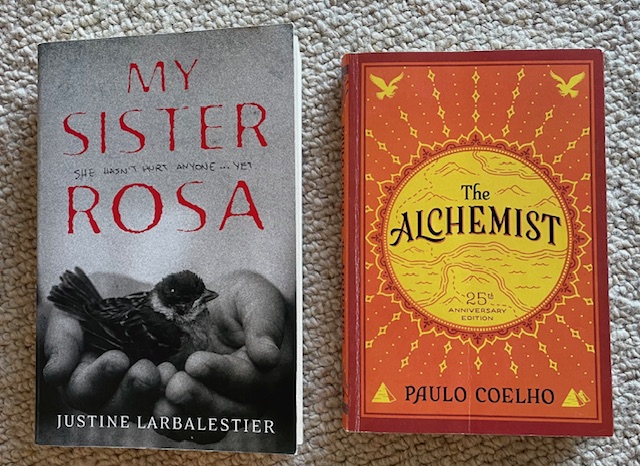
Book 19 … My Sister Rosa by Justine Larbalestier, published in 2016 by Allen and Unwin.

I picked this book up in the library in the village community center some time ago. The back cover promised me edge-of-my-seat reading and it was not wrong. I read it in one gulp, which took me till 1.30 A/M, and some time ago I’d sworn off that kind of read. Sleeping only about five hours does not agree with me these days. It’s like I’m hungover the whole next day.

Spending a bit of time at https://goodreadingmagazine.com.au/ about this one, reading reviews, I discovered that people either loved or hated the book. Also, that it’s classed as young adult fiction, which I just don’t see. Just because the POV character is a teenager does not necessarily make it a YA fiction.

Some readers thought the novel well researched, others thought it badly researched. I’m neutral about that. Just so long as the research doesn’t intrude into the reading experience I don’t mind what lengths writers go to get a readerly reality. I’ve paddled that sea myself, researching the ins and outs of surfing for my novel, Mongrel, for example. Body-surfing was the only kind of surfing I ever did and then only casually.

Some readers loved the supporting character, the ten-year-old psychopath, thinking her very realistic. Others thought her tricks were mere childishness. On that point I really don’t believe the average ten-year-old will try to talk a so-called friend into killing her twin for entertainment. People who thought that, I stopped respecting the minute I read their opinion.

Che, the older brother who told the story, was trying to be a normal teenager and not succeeding. Neither of the parents were ‘at home’, so to say, and his little sister became his responsibility. Of course in the past, it was normal for an eldest sibling to have the care of the younger brood. In my past it certainly was, and I often had three young kids trailing me. Nowadays, with families of only one or two kids it is much less common.

Book 20 … The Alchemist by Paulo Coelho. Translated by Alan R Clarke. Originally published in 1988. The first English language edition in 1993. This copy is a 25th anniversay edition published in 2014, by Harper One an imprint of HarperCollins.

Its publishing history is complex. In 1993 my son was eight years old and I was a keen library reader and thrift store customer. That would be one of the reasons this book completely passed me by. That library was struggling a bit, new books few and far between, and thrift stores feature the old and remaindered. Nor was I in any reading clubs where people raved about it. Small country town. Not even a bookshop in those days.

Nor would I have been psychologically mature enough in that time to read it. I hadn’t yet started my writing studies, and the only hero’s journey I knew about, was me eking out a living. Thirty three years later–now–I read The Alchemist with joy. I recognized so much. The hero’s journey, yes. There’s been so much said about the hero’s journey in film, literature, how-to books and descriptive critiques, most people will be familiar with its concepts.

But also some of the Jungian concepts I’ve been studying for the past couple of years. The Personal Legend, for example. Do you know yours? I’m not yet so familiar with mine that I can talk about it in detail, though I’ve received a few clues from dreams. If you don’t yet journal your dreams, start now. I recommend it.

Then there’s The Soul of the World. I know that as the collective unconscious, but described much more poetically. There’s more. The plot of the recurrent dream of treasure in a far off place that returns you to your original place? A plot that I’ve read in a couple of recently published novels. It was an aha moment and me thinking, So this is where they got that!

Even the title. The Alchemist. The alchemist is a wise man. The last thing he said to the boy? “No matter what he does, every person on earth plays a central role in the history of the world. And normally he doesn’t know it.”

This seemingly simple little book gave me a lot to think about.

Reading, 5

Books in the order that I read them …

William Gibson is now a favorite SF author and I’ve enjoyed everything I’ve read by him recently. But reading his first novel, Neuromancer, soon after it was first published in 1984, I recall thinking then that his subject matter was hard to grasp. Whether due to the way he talked about it, or just the mere unfamiliarity … I think a combination.

At the time of that reading, I lived ‘on the road’, traveling Australia. Down-times we spent reading but in general, life was simplified to the extent it was often hard to remember what was going on in the rest of the world. Living out of a modified Toyota Landcruiser, I found it hard to figure out Gibson’s meanings. Often I didn’t know what he was talking about.

Back when Gibson wrote Neuromancer, much of the tech was new and its words hadn’t yet entered commonality. The computer and internet age had only barely got going and Gibson was describing how that world was developing. Reading the Neuromancer trilogy now, in 2026, I am right there with the characters.

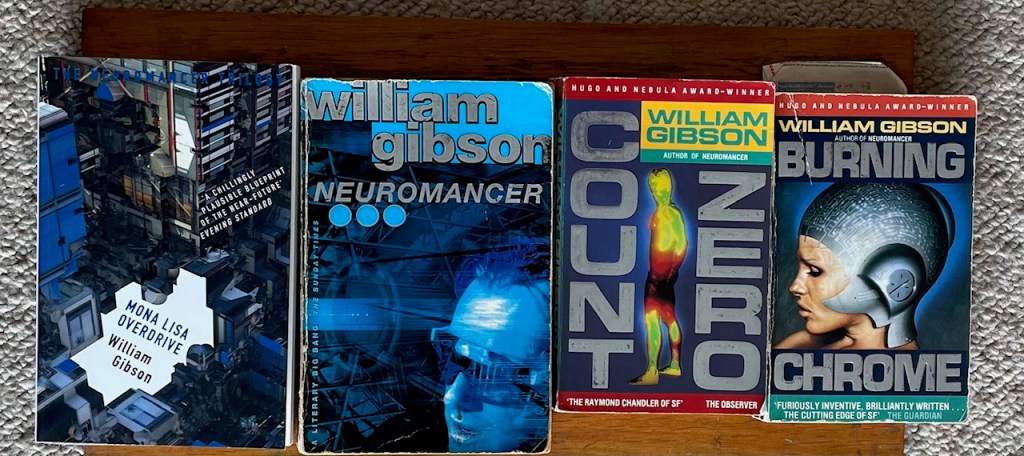
Book 11. Mona Lisa Overdrive by Willian Gibson, first published in 1988 by Gollancz.

Mona is a girl “with a murky past and uncertain future” sold to a plastic surgeon to be surgically altered to closely resemble a famous star.

I picked this up secondhand, because it was a William Gibson and I hadn’t read it yet, not realizing it is the third of his early books set in the Sprawl-universe. While enjoying Gibson’s descriptions as usual, and easily recognizing his trope of high-tech set in the slums of the future, I got hopelessly lost in the first half of the novel, reading about four very different POVs, characters that seemed to have nothing to do with each other. I was continually anticipating where and how they’d meet or intersect.

Discussing the matter with my SF reading buddy, I learned I was reading part three of Gibson’s first trilogy. That some of the characters had appeared in Neuromancer, and that all three novels—Neuromancer, Count Zero and Mona Lisa Overdrive—as well as some of the stories in the Burning Chrome collection are set partly in the Sprawl, and partly in a future Japan.

The Sprawl, the fictional equivalent of the “Boston-Atlanta Metropolitan Axis, an urban environment extending along most of the East Coast of the United States” from https://en.wikipedia.org/wiki/Sprawl_trilogy; the Japanese scenes seem to take place primarily in Chiba …

Let me tell you, in 1984 I did not yet know what a coffin hotel was, and since the internet had only barely got started in those years, there were no quick looking-up opportunities. Wikipedia, for example, started in March 2001.

Gibson often mentions the matrix and in fact he invented that concept, as well as cyber space and virtual reality. The movie that introduced the public domain to the matrix hails from 1999, fifteen years after Neuromancer hit the bookshops. All three concepts part of our ordinary understanding these days.

From the backcover of Neuromancer: “The Matrix: a world within a world, a graphic representation of the databanks of every computer in the human system; a consensual hallucination experienced daily by billions of legitimate users in the Sprawl alone.”

Nowadays even people not reading SF are aware we live in that reality.

Then, since we happened to have the whole rest of the series on hand, I re-read …

Book 12. Neuromancer by William Gibson, first published in Great Britain in 1984 by Victor Gollancz Ltd.

Also from the back cover, continuing from above … “And by Case, computer cowboy, until his nervous system is grievously maimed by a client he double-crossed. Japanese experts in nerve-splicing and micro-bionics have left him broke and close to dead. But at last Case has found a cure. He’s going back into the system. Not for the bliss of cyber-space but to steal again, this time from the big boys, the almighty mega-corps. In return, should he survive, he will stay cured.”

Book 13. Count Zero by William Gibson, first published in Great Britain in 1986 by Victor Gollancz Ltd.

Part of the back cover reads … “In the matrix of cyberspace — zaibatsus fought it out for world domination and the computer jocks risked their minds scuffling for fat crumbs — the lives of three human beings were inextricably scrambled.”

The future has totally caught up with these stories, the so-called futuristic slang sounds normal.

There are one or two concepts that even read like anachronisms. Tapes and cassettes. Polycarbon variants. Slanting gro-lights that dangled from twin lengths of curly cord.

Book 14. Burning Chrome by William Gibson and various other authors, first published in Great Britain in 1986 by Victor Gollancz Ltd.

There’s an excellent prologue by Bruce Sterling, also a well-known SF author.

The four books above are said to be a trilogy + a collection of short stories, all set in the same universe centered in the so-called Sprawl. Not a trilogy in the way of a sequence of one story too large to tell in one novel but more a threesome of books all set in the same fictional universe, and sharing some characters, at least in the case of Neuromancer and Mona Lisa Overdrive.

Gibson is the king of adjectives, he parses out meaning and description in every phrase, with every verb, every noun. And metaphors? An all-round joy to read. How can you not enjoy reading the following … ?

“Rubin inserts a skinny probe in the roller-bearing belly of a sluggish push-me-pull-you and peers at the circuitry through magnifying glasses with miniature headlights mounted at the temples.” From The Wintermarket, p 149 in Burning Chrome.